
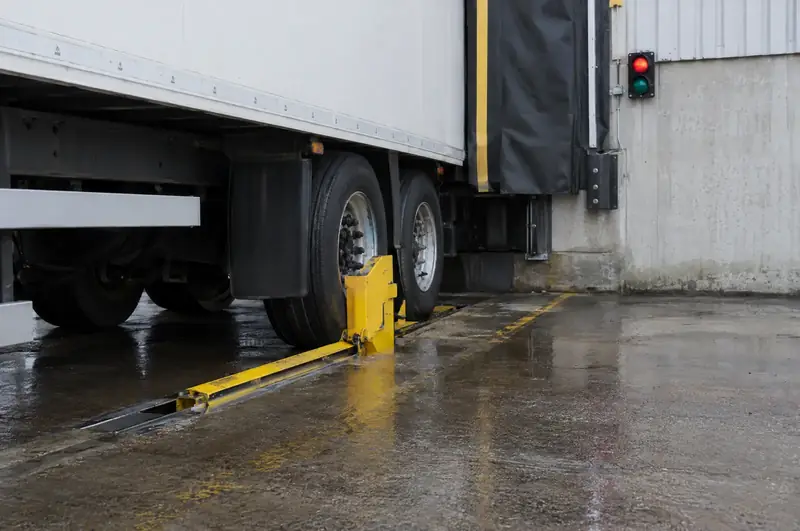
A vehicle restraint is a device at a loading bay that physically holds a trailer against the dock until it is safe to leave. In the UK most systems act on the rear wheel, either as a powered wheel-based restraint or a sensor wheel chock. Restraints guard against early drive-away and trailer creep, and are usually interlocked with the door and dock traffic lights.
How much does a vehicle restraint cost?
A vehicle restraint typically costs £4,200 to £9,800 per bay, supplied and installed, excluding VAT. Sensor wheel chocks linked to the dock controls usually sit towards the lower end, and fully automatic wheel-based restraints with rail and interlocks towards the upper end.
What moves the price:
- Restraint type: a sensor chock needs far less hardware and groundwork than a powered, rail-mounted wheel restraint.
- Yard condition: rail-mounted units need a sound, level concrete apron. Broken concrete or tarmac may need a new base, priced after survey.
- Cabling: the distance from the restraint to the dock control panel, and whether ducts must be cut into the yard.
- Integration: linking to existing door and leveller controls is simpler on modern panels; older panels may need replacing.
- Number of bays and working hours: several bays in one project spread set-up costs, while out-of-hours work adds cost.
All figures are guide budgets. After a free site survey we send a written quote, and that quote is the fixed price. VAT is added at the standard rate.
What does HSE guidance say about preventing drive-away?
HSE guidance says there must be safeguards to stop drivers driving away from a loading bay too early, and it lists vehicle or trailer restraints as one of the measures. The others it names are traffic lights and the person in charge keeping the vehicle keys or paperwork until it is safe to leave.
This comes from HSE's guide to workplace transport safety (HSG136) and its loading and unloading factsheet. The guidance sets out the outcome rather than one fixed solution, so the right combination for your site should follow your own risk assessment.
Once fitted, a restraint is work equipment under the Provision and Use of Work Equipment Regulations 1998 (PUWER), so it must be suitable, maintained in a safe condition and inspected where deterioration could lead to danger. In Northern Ireland the equivalent is PUWER (Northern Ireland) 1999, and the regulator is HSENI rather than HSE.
Our guide to preventing drive-away and trailer creep compares the options side by side.
Wheel-based or hook restraint: which suits UK trailers?
Wheel-based restraints and sensor wheel chocks suit most UK trailers, because they act on the rear wheel rather than on the back of the vehicle. Hook restraints, which catch the rear impact guard (sometimes called an ICC bar), are common elsewhere but suit fewer UK fleets.
- Wheel-based restraint: a steel guide rail fixed to the yard, with an arm or chock that moves against the rear wheel, either powered or pushed into place by the operative. It works regardless of tail lifts or underrun guard design.
- Sensor wheel chock: a heavy chock placed in front of the wheel, with a sensor or parking station that tells the dock controls it is in position. Lower cost and minimal groundwork, but it relies on someone placing it each time.
- Hook restraint: mounted on the dock face and hooking the rear guard. UK and European trailers vary widely at the rear, and tail lifts often get in the way, so this type needs checking against your actual fleet.
Which types and options are available?
Automatic wheel-based restraint
A powered arm on a yard-mounted rail that locates against the rear wheel at the push of a button and signals the dock controls once the trailer is held.
Manual wheel-based restraint
The same rail-mounted principle with the restraint pushed into position by the operative. Lower cost than a powered unit, with a sensor to confirm engagement to the controls.
Sensor wheel chock
A heavy-duty chock with a sensor or parking station that tells the dock controls when it is in place. Minimal groundwork and suited to retrofit on existing bays.
Hook restraint
A dock-mounted hook that catches the trailer's rear impact guard. Only suitable where your fleet has compatible rear guards, which we check carefully at survey.
Trailer support stands
Stands placed under the front of an uncoupled semi-trailer to stop it dropping or tipping as forklifts drive on, used alongside a wheel restraint or chock.
Typical specification
| Restraint types | typically wheel-based rail systems or sensor wheel chocks |
|---|---|
| Mounting | typically anchored to a concrete yard apron in line with the bay |
| Signals | typically linked to inside and outside dock traffic lights |
| Interlocks | typically the door cannot open until the restraint is engaged |
| Power supply | typically taken from the dock controls, confirmed at survey |
| Guide price | £4,200 to £9,800 per bay, ex VAT, supply and fit |
| Marking | UKCA or CE in Great Britain; CE or CE with UKNI in Northern Ireland |
Budget range for supply and fit. Your written quote after a free site survey is the fixed price. See all guide prices.
What happens on site when a vehicle restraint is installed?
Installing a vehicle restraint takes the bay out of use while the rail or chock station is fixed, cabled and tested, but neighbouring bays can usually keep working.
- Set out: the restraint position is marked in line with the bay so it meets the rear wheels of the trailers you receive.
- Fixing: rail-mounted units are anchored into the concrete apron. If a new concrete base is needed, it must cure before the restraint is fitted.
- Cabling: ducts are cut or laid from the restraint to the dock wall, and the control box is fitted inside next to the door.
- Connection: the restraint is wired into the door, leveller and traffic light controls so the sequence works as designed.
- Commissioning: the system is tested with a trailer on the bay, and dock staff are shown how to engage and release it.
We ask you to release the bay for the agreed period, confirm an electrical supply point, provide a trailer for commissioning and tell us about any buried services in the yard.
How does a vehicle restraint work with dock lights and interlocks?
A vehicle restraint is normally linked to the dock traffic lights and the door controls, so engaging the restraint is what allows loading to start.
A typical sequence looks like this:
- The trailer reverses on to the bay with the outside light on green and the door closed.
- The restraint engages the rear wheel. The outside light turns red for the driver and the inside light turns green for dock staff.
- The door can now be opened, and the leveller can only operate once the door is fully open.
- When loading is finished, the leveller is parked and the door closed before the restraint can release.
- The restraint releases, the outside light turns green and the driver can leave.
The exact interlocks depend on your equipment and risk assessment. See dock traffic lights and interlocks for the options on signals and control logic.
What is trailer creep and how does a restraint stop it?
Trailer creep is the gradual movement of a parked trailer away from the dock, caused by forklifts braking and accelerating as they drive on and off the trailer bed. Each movement pushes the trailer forward slightly, and over a full load the gap can grow.
Creep is more likely when:
- the trailer is uncoupled from its tractor unit and resting on its landing legs;
- air suspension or brakes have not been set correctly by the driver;
- forklifts are heavy, fast or carrying dense loads such as drinks or building materials;
- the yard falls slightly away from the building.
As the trailer moves, the leveller lip can lose its bearing on the trailer bed, and in the worst case the lip slips off with a forklift on it. A wheel-based restraint holds the wheel against the rail or chock, so the trailer cannot travel forward however many times a forklift drives on and off.
When is this the right choice?
- Drivers have pulled away while a forklift was still inside the trailer or on the leveller.
- Trailers creep forward during loading, opening a gap at the leveller lip.
- Your risk assessment relies on key control alone and you want a physical safeguard.
- You handle uncoupled trailers or third-party hauliers whose drivers you do not manage.
- You are adding traffic lights and interlocks and want the door tied to the trailer.
How the job runs
- Site survey
We check the trailers you receive, the yard surface, the approach to each bay and your existing door and leveller controls to decide which restraint type will work.
- Written quote
You get a written quote covering the restraint, groundworks, cabling and interlocks, with anything excluded made clear. The survey and quote are free and without obligation.
- Installation
The bay is released for the agreed period while the restraint is fixed, ducts and cables are run and the controls are connected to the door and lights.
- Testing and handover
Every step of the sequence is tested with a trailer on the bay, dock staff are shown how to use the system and the documentation is handed over.
Vehicle restraints for loading bays: questions
Is a vehicle restraint a legal requirement?
Not in every case: HSE guidance (followed by HSENI in Northern Ireland) says there should be safeguards against drivers driving away too early, and a vehicle restraint is one of the measures it lists. Traffic lights and the person in charge keeping keys or paperwork are the others. Which measures you use should follow your risk assessment. In Northern Ireland the regulator is HSENI.
Do vehicle restraints work with all trailers?
Wheel-based restraints and sensor chocks work with most trailers, because they act on the rear wheel rather than on the back of the vehicle. Vehicles with unusual wheel positions or very small wheels need checking, so we look at the vehicles you receive during the survey.
Can a vehicle restraint be fitted to an existing bay?
Yes, restraints are commonly retrofitted to existing bays. The main questions are whether the yard concrete in front of the bay is sound enough to anchor a rail, how cables will reach the dock controls, and whether the existing door and leveller panels can accept interlocks. Sensor chocks are often chosen where groundwork needs to be kept to a minimum.
What happens if a powered restraint loses power?
Powered restraints are normally designed with a manual release so a trailer is not trapped on the bay if power is lost. Your site procedure should say who is allowed to use the release and what checks they make first. We explain the release method at handover.
Do vehicle restraints need servicing?
Yes. A restraint is work equipment under PUWER, so it must be maintained in a safe condition and inspected where wear could lead to danger. Servicing typically covers the rail and arm, sensors, controls and the interlock sequence with the door and lights.
Will a vehicle restraint slow down loading?
Engaging a restraint adds only a short step to each docking, and once it is part of the interlock sequence it becomes routine for dock staff. Many sites find that a clear sequence actually reduces delays, because there is less confusion about when it is safe to open the door or release the driver.
Related equipment and services
Further reading
Vehicle restraints for loading bays by area
England
- Bedfordshire
- Berkshire
- Buckinghamshire
- Cambridgeshire
- Cheshire
- City and County of Bristol
- Cornwall
- County Durham
- Cumbria
- Derbyshire
- Devon
- Dorset
- East Riding of Yorkshire
- East Sussex
- Essex
- Gloucestershire
- Greater London
- Greater Manchester
- Hampshire
- Herefordshire
- Hertfordshire
- Isle of Wight
- Kent
- Lancashire
- Leicestershire
- Lincolnshire
- Merseyside
- Norfolk
- North Yorkshire
- Northamptonshire
- Northumberland
- Nottinghamshire
- Oxfordshire
- Rutland
- Shropshire
- Somerset
- South Yorkshire
- Staffordshire
- Suffolk
- Surrey
- Tyne and Wear
- Warwickshire
- West Midlands
- West Sussex
- West Yorkshire
- Wiltshire
- Worcestershire