
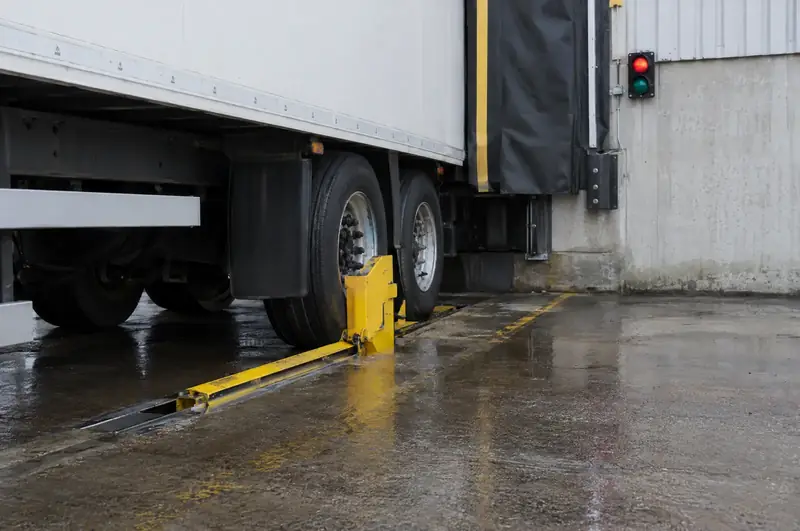
A vehicle restraint is a device at a loading bay that physically holds a trailer against the dock until it is safe to leave. In the UK most systems act on the rear wheel, either as a powered wheel-based restraint or a sensor wheel chock. Restraints guard against early drive-away and trailer creep, and are usually interlocked with the door and dock traffic lights.
What should sites in Hertfordshire consider?
Multi-tenant logistics parks around Hertfordshire can benefit from restraints when several tenants share yard space and trailers from different fleets arrive throughout the day. Yards around Hertfordshire that park uncoupled trailers at the dock can see trailers creep under forklift traffic, and a wheel-based restraint helps keep the leveller lip on the bed.
Busy cross-dock and parcel operations in Hertfordshire with frequent trailer swaps have more chances for an early drive-away, which is where a physical restraint adds real protection.
Step one is a survey at your site in Hertfordshire, which costs nothing and carries no obligation. Step two is a written quote with a fixed price and a clear scope. Step three is installation, scheduled around your operation and carried out by specialist installation engineers working under our management, including evenings or weekends if agreed. Step four is handover, when the equipment is tested in front of you and the paperwork is passed over.
What does HSE guidance say about preventing drive-away?
HSE guidance says there must be safeguards to stop drivers driving away from a loading bay too early, and it lists vehicle or trailer restraints as one of the measures. The others it names are traffic lights and the person in charge keeping the vehicle keys or paperwork until it is safe to leave.
This comes from HSE's guide to workplace transport safety (HSG136) and its loading and unloading factsheet. The guidance sets out the outcome rather than one fixed solution, so the right combination for your site should follow your own risk assessment.
Once fitted, a restraint is work equipment under the Provision and Use of Work Equipment Regulations 1998 (PUWER), so it must be suitable, maintained in a safe condition and inspected where deterioration could lead to danger. In Northern Ireland the equivalent is PUWER (Northern Ireland) 1999, and the regulator is HSENI rather than HSE.
Our guide to preventing drive-away and trailer creep compares the options side by side.
Wheel-based or hook restraint: which suits UK trailers?
Wheel-based restraints and sensor wheel chocks suit most UK trailers, because they act on the rear wheel rather than on the back of the vehicle. Hook restraints, which catch the rear impact guard (sometimes called an ICC bar), are common elsewhere but suit fewer UK fleets.
- Wheel-based restraint: a steel guide rail fixed to the yard, with an arm or chock that moves against the rear wheel, either powered or pushed into place by the operative. It works regardless of tail lifts or underrun guard design.
- Sensor wheel chock: a heavy chock placed in front of the wheel, with a sensor or parking station that tells the dock controls it is in position. Lower cost and minimal groundwork, but it relies on someone placing it each time.
- Hook restraint: mounted on the dock face and hooking the rear guard. UK and European trailers vary widely at the rear, and tail lifts often get in the way, so this type needs checking against your actual fleet.
Towns we cover in Hertfordshire
We provide vehicle restraints right across Hertfordshire. Pick the town closest to your site from the list below.
- Watford
- Hemel Hempstead
- Stevenage
- St Albans
- Welwyn Garden City
- Cheshunt
- Hatfield
- Bishop's Stortford
- Borehamwood
- Hitchin
- Hoddesdon
- Letchworth Garden City
- Harpenden
- Bushey
- Hertford
- Rickmansworth
- Potters Bar
- Berkhamsted
- Ware
- Royston
Budget range for supply and fit. The written quote after a free survey is the fixed price. All guide prices.
Regulations and approvals in England
Workplace safety in England is regulated by HSE. For a loading bay in Hertfordshire, that means doors meeting regulation 18 of the Workplace (Health, Safety and Welfare) Regulations 1992, equipment maintained under PUWER and suitable safeguards against vehicles driving away too early. We check what applies at survey and design the bay accordingly.
Questions
Is VAT included in your guide prices for vehicle restraints?
No. Our customers are businesses, so guide prices exclude VAT, which is added at the standard rate. The same guide range applies in Hertfordshire as everywhere else: for vehicle restraints, it is £4,200 to £9,800 per bay, excluding VAT. It covers supply and fit for a typical installation. Your fixed written quote after the free survey shows the net price, the VAT and exactly what is included.
Can you work outside our normal operating hours in Hertfordshire?
Yes, by arrangement. Evening, night and weekend working can be planned so the installation causes as little disruption as possible to your loading schedule. Out-of-hours work can affect the price, so mention it at the survey and we will include it in the written quote. The agreed times are confirmed in the programme before the job starts.
Do vehicle restraints work with all trailers?
Wheel-based restraints and sensor chocks work with most trailers, because they act on the rear wheel rather than on the back of the vehicle. Vehicles with unusual wheel positions or very small wheels need checking, so we look at the vehicles you receive during the survey.
Will a vehicle restraint slow down loading?
Engaging a restraint adds only a short step to each docking, and once it is part of the interlock sequence it becomes routine for dock staff. Many sites find that a clear sequence actually reduces delays, because there is less confusion about when it is safe to open the door or release the driver.
Other services in Hertfordshire
Full guide to vehicle restraints · All loading bay services in Hertfordshire