
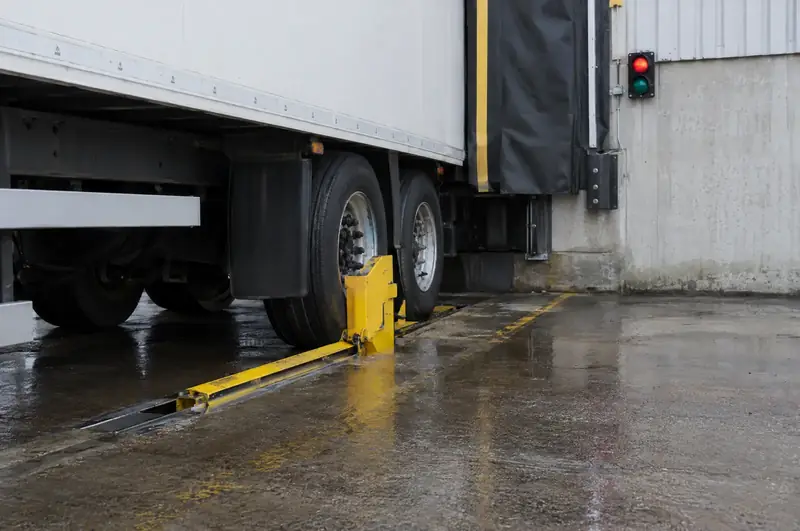
A vehicle restraint is a device at a loading bay that physically holds a trailer against the dock until it is safe to leave. In the UK most systems act on the rear wheel, either as a powered wheel-based restraint or a sensor wheel chock. Restraints guard against early drive-away and trailer creep, and are usually interlocked with the door and dock traffic lights.
What matters for vehicle restraints in Northumberland?
Third-party hauliers visiting sites in Northumberland may not know each site's procedures, so a restraint that holds the wheel removes reliance on every driver following instructions. Restraint systems for sites in Northumberland are surveyed, quoted and installed in the same way as anywhere else in the UK, with a fixed price set out in writing.
Busy cross-dock and parcel operations in Northumberland with frequent trailer swaps have more chances for an early drive-away, which is where a physical restraint adds real protection.
Our part of the job in Northumberland is to survey, quote and manage; the fitting itself is done by specialist installation engineers working under our management. The survey and the written quote are free. Once the fixed price is accepted, we agree dates that work around your deliveries and shifts, including out-of-hours working where needed. Every installation is tested before handover, and you receive the documentation for each item fitted.
Wheel-based or hook restraint: which suits UK trailers?
Wheel-based restraints and sensor wheel chocks suit most UK trailers, because they act on the rear wheel rather than on the back of the vehicle. Hook restraints, which catch the rear impact guard (sometimes called an ICC bar), are common elsewhere but suit fewer UK fleets.
- Wheel-based restraint: a steel guide rail fixed to the yard, with an arm or chock that moves against the rear wheel, either powered or pushed into place by the operative. It works regardless of tail lifts or underrun guard design.
- Sensor wheel chock: a heavy chock placed in front of the wheel, with a sensor or parking station that tells the dock controls it is in position. Lower cost and minimal groundwork, but it relies on someone placing it each time.
- Hook restraint: mounted on the dock face and hooking the rear guard. UK and European trailers vary widely at the rear, and tail lifts often get in the way, so this type needs checking against your actual fleet.
What does HSE guidance say about preventing drive-away?
HSE guidance says there must be safeguards to stop drivers driving away from a loading bay too early, and it lists vehicle or trailer restraints as one of the measures. The others it names are traffic lights and the person in charge keeping the vehicle keys or paperwork until it is safe to leave.
This comes from HSE's guide to workplace transport safety (HSG136) and its loading and unloading factsheet. The guidance sets out the outcome rather than one fixed solution, so the right combination for your site should follow your own risk assessment.
Once fitted, a restraint is work equipment under the Provision and Use of Work Equipment Regulations 1998 (PUWER), so it must be suitable, maintained in a safe condition and inspected where deterioration could lead to danger. In Northern Ireland the equivalent is PUWER (Northern Ireland) 1999, and the regulator is HSENI rather than HSE.
Our guide to preventing drive-away and trailer creep compares the options side by side.
Towns we cover in Northumberland
Choose a town below to see how we handle vehicle restraints in that part of Northumberland.
Budget range for supply and fit. The written quote after a free survey is the fixed price. All guide prices.
Which rules apply in England?
Powered doors and dock equipment installed in England may carry the UKCA or the CE mark, and doors are covered by the product standard BS EN 13241. We hand over the relevant documentation for each item fitted in Northumberland. Planning and Building Regulations questions are never assumed either way: we check what applies at survey, so you know before work is booked.
Questions
Do you cover Northumberland for vehicle restraints?
Yes. We take on vehicle restraints for businesses in Northumberland and across Northumberland. We survey the site, provide a fixed written quote and manage the installation, with specialist installation engineers working under our management. Visits are arranged in advance at a time that suits your operation, and the same single contact stays with the job through to handover.
Do you remove and dispose of the old equipment?
Yes, where it is part of the scope. When we replace doors, levellers, shelters or seals at a site in Northumberland, removal and disposal of the old equipment can be included and is itemised in the quote, so it is clear what is covered. If anything should be kept, such as a frame or motor that is still serviceable, we agree that at survey.
Can a vehicle restraint be fitted to an existing bay?
Yes, restraints are commonly retrofitted to existing bays. The main questions are whether the yard concrete in front of the bay is sound enough to anchor a rail, how cables will reach the dock controls, and whether the existing door and leveller panels can accept interlocks. Sensor chocks are often chosen where groundwork needs to be kept to a minimum.
Do vehicle restraints need servicing?
Yes. A restraint is work equipment under PUWER, so it must be maintained in a safe condition and inspected where wear could lead to danger. Servicing typically covers the rail and arm, sensors, controls and the interlock sequence with the door and lights.
Other services in Northumberland
Full guide to vehicle restraints · All loading bay services in Northumberland