
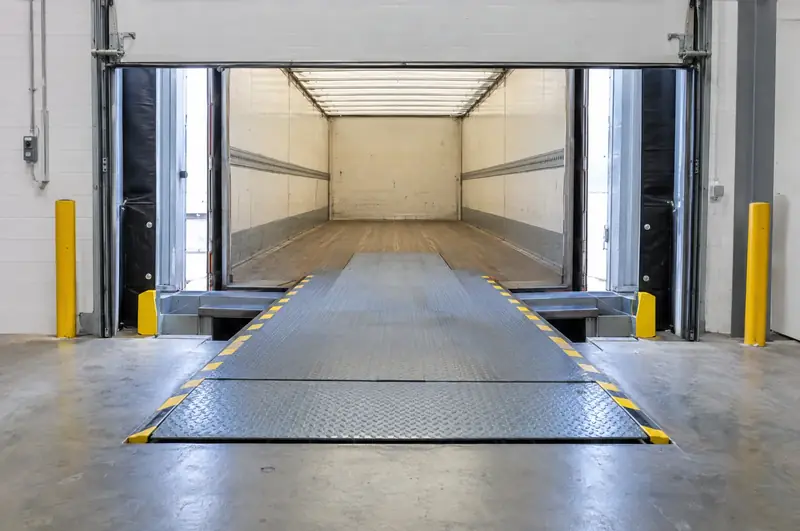
A telescopic-lip dock leveller is a hydraulic pit leveller whose front lip slides forward out of the platform, rather than swinging on a hinge, and can be extended by a controlled amount onto the trailer bed. Telescopic lips commonly extend 500 to 1,000 mm, which lets operators reach over tail lifts, place the lip between pallets and load the last row in a trailer.
Why does a telescopic-lip leveller cost more than a swing-lip unit?
A telescopic-lip dock leveller typically costs £6,800 to £11,800 per leveller, excluding VAT, supply and fit, assuming an existing, sound pit. It costs more than a swing-lip unit because the lip slides in its own guides inside the platform, which means more steel, a longer lip and more involved hydraulics and controls.
Within the range, the price depends on:
- Lip extension: a longer reach needs a longer lip and stronger guides.
- Platform length and width: longer platforms give gentler gradients across mixed trailer heights.
- Capacity: higher ratings for heavy loads or large forklifts.
- Insulation: insulated platforms and pit seals for chilled and frozen docks.
- Controls: automatic return, interlocks and links to restraints and traffic lights.
New pits, pit repairs and groundworks are priced separately after survey, and the written quote is the fixed price. We often quote both lip types side by side, so you can see whether the extra flexibility justifies the cost on each bay.
How are drive-away risks managed while the lip rests on a trailer?
Drive-away risks are managed by stopping the vehicle leaving until loading has finished and the lip has been withdrawn, using traffic lights, vehicle or trailer restraints, or the person in charge keeping the keys or paperwork. HSE workplace transport guidance (HSG136) and the HSE loading factsheet (followed by HSENI in Northern Ireland) call for safeguards against drivers driving away too early.
- Why it matters: a lip resting on the bed is only safe while the trailer stays put, and trailer creep during forklift loading can open a gap at the dock edge.
- Equipment duties: the leveller is work equipment under PUWER 1998 in Great Britain or PUWER (Northern Ireland) 1999, so it must be maintained and inspected where deterioration could lead to danger. Engineering insurers commonly inspect at 12-month intervals.
- Standard: BS EN 1398:2009 sets the safety requirements for dock levellers and is current, under review.
Enforcement is by HSE in Great Britain and HSENI in Northern Ireland. Our guide to preventing drive-away and trailer creep compares the safeguards.
How far should a telescopic lip extend?
A telescopic lip should extend far enough to reach clear bed space on every trailer you load, including over tail lifts, while still leaving a secure overlap on the bed. Telescopic lips commonly extend 500 to 1,000 mm.
- Around 500 mm: suits fleets without tail lifts that need precise placement and end loading.
- Up to around 1,000 mm: reaches over folded tail lifts and across the larger gap left where deep bumpers hold trailers back from the dock edge.
- Platform length: should match the lip, as a long reach on a short platform can leave steep gradients.
- Lip width: full-width lips suit most work, while narrower or tapered lips help with smaller vehicles.
We record the rear details of the trailers you receive, including tail lift depth and bumper projection, then recommend the shortest extension that covers them all. A longer lip than you need adds cost and weight without benefit.
Which types and options are available?
500 mm lip extension
A commonly specified reach for precise placement and end loading on standard trailers and refrigerated vehicles that do not have tail lifts.
1,000 mm lip extension
A longer reach that clears folded tail lifts and deep bumper projections, so rigids and tail-lift trailers can be loaded at the same bay.
Insulated cold store version
An insulated platform with perimeter seals for chilled and frozen docks, often paired with an inflatable shelter and an insulated dock door.
Automatic return control
A single button that withdraws the lip and lowers the platform to its stored position, reducing the risk of a trailer leaving with the lip still out.
Typical specification
| Lip extension | Commonly 500 to 1,000 mm |
|---|---|
| Platform length | Commonly about 2.5 to 4 m |
| Capacity | Typically around 60 kN, higher ratings on request |
| Operation | Electro-hydraulic, with separate lip control or an automatic sequence |
| Safety features | Typically toe guards, velocity fuse, emergency stop and maintenance strut |
| Pit | Prices assume an existing sound pit; new pits and repairs quoted separately |
| Standard | BS EN 1398:2009 |
Budget range for supply and fit. Your written quote after a free site survey is the fixed price. See all guide prices.
Can a telescopic leveller replace a swing-lip unit in the same pit?
Often yes, a telescopic-lip leveller can replace a swing-lip unit in the same pit, provided the pit is square and deep enough and the edge steel is in good condition. Some telescopic units need a little more depth for the lip mechanism, so we measure carefully at survey.
A typical installation:
- The bay is closed and the old leveller isolated, lifted out and removed.
- The pit is cleaned and measured, and any edge steel repairs carried out.
- The new unit is set in, levelled and fixed to the pit steel.
- The power pack, control panel and lip controls are connected and interlocks wired.
- The platform and lip are tested through their full travel.
You will need to provide a clear bay, access for lifting equipment and a suitable power supply, typically three-phase. Installation commonly takes one to two working days per bay once the pit is ready.
Which operations benefit most from a telescopic lip?
Telescopic lips benefit operations that need precise lip placement, load trailers right to the rear doors, or receive vehicles with tail lifts. A swing lip lands wherever its fixed length takes it, while a telescopic lip can be stopped exactly where it is wanted.
- End loading: the lip can be placed in the gap between pallets so the last row can be loaded or removed.
- Tail-lift trailers and rigids: the lip reaches over the folded tail lift onto the bed.
- Cold chain: pallets are often loaded tight to the rear doors of refrigerated trailers.
- Double-deck and container trailers: beds sit at varied heights and lip placement needs care.
- Mixed fleets: one bay can handle a wider range of vehicles.
For straightforward pallet loading of standard trailers, a swing-lip dock leveller is simpler and lower in cost.
How should staff use a telescopic-lip leveller safely?
Staff should only operate a telescopic-lip leveller once the trailer is secured and the dock door is open, and should always return the lip and platform to the stored position before the trailer leaves. Simple routines prevent most damage.
- Extend the lip only as far as needed and check it has the overlap on the bed that the manufacturer specifies.
- Keep feet and loads clear of the platform sides while it moves; that is what the toe guards are for.
- Never operate the leveller with a forklift or load standing on it.
- Use the automatic return function where fitted, so the lip withdraws and the platform stores at the end of loading.
- Report hydraulic leaks, unusual noises or a sticking lip straight away.
Training new dock staff on these steps, and displaying them beside the control panel, keeps practice consistent across shifts.
When is this the right choice?
- Your fleet includes tail-lift vehicles that a swing lip cannot reach over.
- Staff struggle to load or unload the last row of pallets in a trailer.
- Refrigerated trailers regularly arrive loaded tight to the rear doors.
- The same bay must handle rigids, artics and containers in one shift.
- A swing-lip leveller is due for replacement and your trailer mix has changed.
How the job runs
- Free site survey
We measure the pit and record the trailers you receive, including bed heights, tail lifts and rear overhangs, and check bumper projection and the power supply.
- Written quote
A fixed written price stating lip extension, platform size, capacity, controls and interlocks, with removal of the old unit and any pit work listed separately.
- Installation
The old leveller is lifted out, the new unit set into the pit, fixed and connected to its power pack, with lip controls and interlocks wired in.
- Testing and handover
Platform and lip are tested through full travel, safety devices checked, and dock staff shown how to place the lip and use the automatic return.
Telescopic-lip dock levellers: questions
Can telescopic and swing-lip levellers be mixed on one dock?
Yes, and many sites do. Fitting telescopic levellers on the bays that receive tail-lift vehicles or need end loading, and swing-lip units on the rest, keeps costs down while covering every vehicle type. Clear bay signage helps drivers reverse onto the right one.
Is a telescopic lip slower to operate?
Slightly, because the lip is extended as a separate movement rather than swinging out as the platform rises. In practice the difference is small, and automatic sequences can raise the platform and extend the lip in one action, then return both at the end of loading.
Do telescopic levellers need more maintenance?
They have more moving parts than a swing-lip leveller, including the lip guides and lip cylinder, so these need checking and lubricating at each service. With planned servicing the extra work is modest. Servicing is chargeable, with the visit price agreed in advance.
Can a telescopic lip bridge a larger gap to the trailer?
Yes, that is one of its strengths. Where deep bumpers hold the trailer further from the dock edge, a telescopic lip can extend to bridge a gap that a fixed swing lip may not cover. We check bumper projection at survey so the lip length suits the dock.
What overlap should the lip have on the trailer bed?
The lip should rest on the trailer bed with the overlap the manufacturer specifies, so it cannot slip off as the trailer moves under load. Extending further than needed adds no benefit. We show dock staff what a correct overlap looks like at handover.
Are telescopic levellers suitable for cold stores?
Yes, telescopic levellers are widely used in cold stores because refrigerated trailers are often loaded right to the rear doors. Insulated platforms and perimeter seals reduce cold loss through the pit, and the leveller is usually interlocked with the door and shelter.
Related equipment and services
Further reading
Telescopic-lip dock levellers by area
England
- Bedfordshire
- Berkshire
- Buckinghamshire
- Cambridgeshire
- Cheshire
- City and County of Bristol
- Cornwall
- County Durham
- Cumbria
- Derbyshire
- Devon
- Dorset
- East Riding of Yorkshire
- East Sussex
- Essex
- Gloucestershire
- Greater London
- Greater Manchester
- Hampshire
- Herefordshire
- Hertfordshire
- Isle of Wight
- Kent
- Lancashire
- Leicestershire
- Lincolnshire
- Merseyside
- Norfolk
- North Yorkshire
- Northamptonshire
- Northumberland
- Nottinghamshire
- Oxfordshire
- Rutland
- Shropshire
- Somerset
- South Yorkshire
- Staffordshire
- Suffolk
- Surrey
- Tyne and Wear
- Warwickshire
- West Midlands
- West Sussex
- West Yorkshire
- Wiltshire
- Worcestershire