
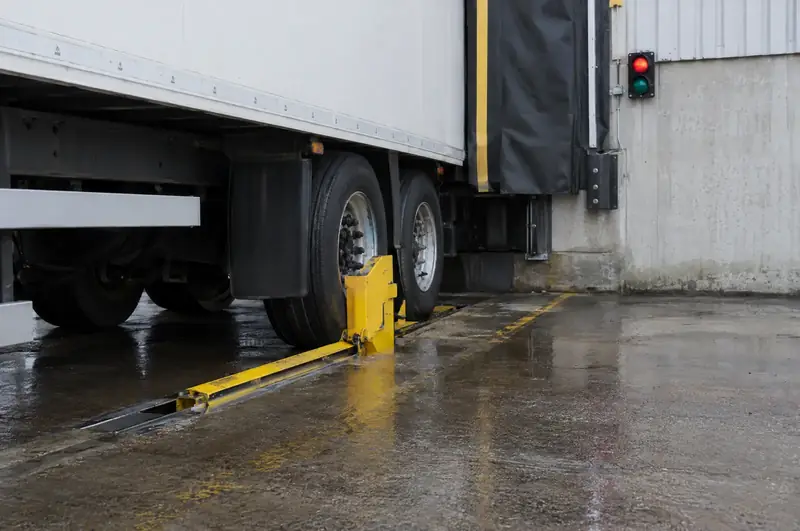
A vehicle restraint is a device at a loading bay that physically holds a trailer against the dock until it is safe to leave. In the UK most systems act on the rear wheel, either as a powered wheel-based restraint or a sensor wheel chock. Restraints guard against early drive-away and trailer creep, and are usually interlocked with the door and dock traffic lights.
Where does this fit at a dock in Forth Valley?
Restraint systems for sites in Forth Valley are surveyed, quoted and installed in the same way as anywhere else in the UK, with a fixed price set out in writing. New-build distribution sheds in Forth Valley can have restraint rails and ducting planned into the yard slab from the start, which is simpler than cutting them in later.
Third-party hauliers visiting sites in Forth Valley may not know each site's procedures, so a restraint that holds the wheel removes reliance on every driver following instructions.
Before anything is ordered, we visit your site in Forth Valley for a free survey and then send a written quote with a fixed price. From that point we manage the installation, coordinating delivery, access and any other trades. Fitting is done by specialist installation engineers engaged and managed by us, at times that suit your operation, including out of hours where agreed. You get a tested installation, a demonstration for your team and the manufacturer documentation.
Wheel-based or hook restraint: which suits UK trailers?
Wheel-based restraints and sensor wheel chocks suit most UK trailers, because they act on the rear wheel rather than on the back of the vehicle. Hook restraints, which catch the rear impact guard (sometimes called an ICC bar), are common elsewhere but suit fewer UK fleets.
- Wheel-based restraint: a steel guide rail fixed to the yard, with an arm or chock that moves against the rear wheel, either powered or pushed into place by the operative. It works regardless of tail lifts or underrun guard design.
- Sensor wheel chock: a heavy chock placed in front of the wheel, with a sensor or parking station that tells the dock controls it is in position. Lower cost and minimal groundwork, but it relies on someone placing it each time.
- Hook restraint: mounted on the dock face and hooking the rear guard. UK and European trailers vary widely at the rear, and tail lifts often get in the way, so this type needs checking against your actual fleet.
How does a vehicle restraint work with dock lights and interlocks?
A vehicle restraint is normally linked to the dock traffic lights and the door controls, so engaging the restraint is what allows loading to start.
A typical sequence looks like this:
- The trailer reverses on to the bay with the outside light on green and the door closed.
- The restraint engages the rear wheel. The outside light turns red for the driver and the inside light turns green for dock staff.
- The door can now be opened, and the leveller can only operate once the door is fully open.
- When loading is finished, the leveller is parked and the door closed before the restraint can release.
- The restraint releases, the outside light turns green and the driver can leave.
The exact interlocks depend on your equipment and risk assessment. See dock traffic lights and interlocks for the options on signals and control logic.
Towns we cover in Forth Valley
Below is a list of towns in Forth Valley for vehicle restraints. Each page explains our approach for sites in that town.
Budget range for supply and fit. The written quote after a free survey is the fixed price. All guide prices.
What do the rules in Scotland mean for the work?
Energy standards for buildings in Scotland are set out in Section 6 of the Building Standards Technical Handbook. For new or replacement loading bay doors in Forth Valley, we confirm the figure that applies to your project and check what applies at survey, rather than relying on rules written for elsewhere in the UK.
Questions
How do you price vehicle restraints for a site in Forth Valley?
Guide budgets for supply and fit are £4,200 to £9,800 per bay, excluding VAT. The figure moves with size, insulation, the operator, electrics, access, any pit or groundworks and out-of-hours working. Where levellers are involved, the guide assumes an existing, sound pit. After the free survey you receive a fixed written quote, and that is the price for the agreed scope.
Is VAT included in your guide prices for vehicle restraints?
No. Our customers are businesses, so guide prices exclude VAT, which is added at the standard rate. The same guide range applies in Forth Valley as everywhere else: for vehicle restraints, it is £4,200 to £9,800 per bay, excluding VAT. It covers supply and fit for a typical installation. Your fixed written quote after the free survey shows the net price, the VAT and exactly what is included.
What happens if a powered restraint loses power?
Powered restraints are normally designed with a manual release so a trailer is not trapped on the bay if power is lost. Your site procedure should say who is allowed to use the release and what checks they make first. We explain the release method at handover.
Can a vehicle restraint be fitted to an existing bay?
Yes, restraints are commonly retrofitted to existing bays. The main questions are whether the yard concrete in front of the bay is sound enough to anchor a rail, how cables will reach the dock controls, and whether the existing door and leveller panels can accept interlocks. Sensor chocks are often chosen where groundwork needs to be kept to a minimum.
Other services in Forth Valley
Full guide to vehicle restraints · All loading bay services in Forth Valley