
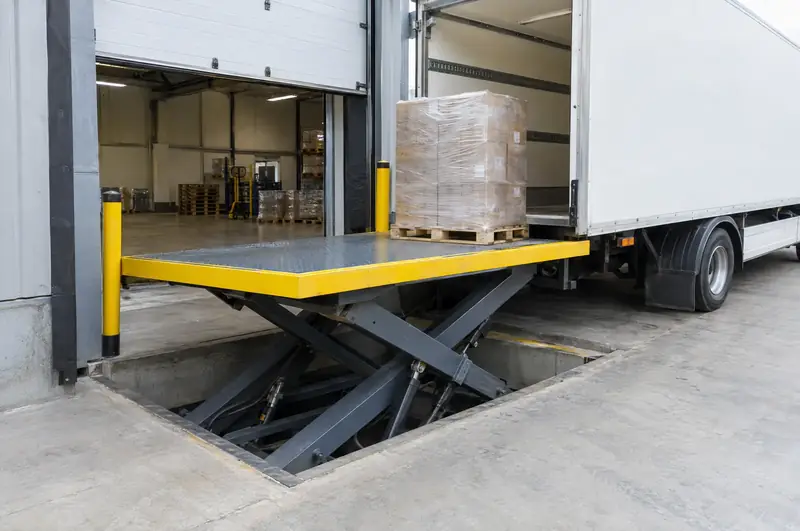
A scissor lift table, often called a dock lift, is a powered platform raised and lowered by a hydraulic scissor mechanism to move goods between two levels. At a loading bay it lifts pallets and pallet trucks from ground level to the height of a trailer bed, making it a practical alternative to a raised dock where forming one is not possible.
How much does a scissor lift table cost?
A scissor lift table for a loading bay typically costs £9,500 to £28,000 per lift, supplied and installed, excluding VAT. Smaller surface-mounted lifts sit towards the lower end; large, high-capacity pit lifts with gates and bridge plates sit towards the top.
What moves the price:
- Capacity: dock lifts are typically rated somewhere between 2,000 and 6,000 kg, and heavier ratings need a stronger mechanism.
- Platform size and travel: larger platforms and greater lift heights cost more.
- Mounting: pit-mounted or surface-mounted with a ramp.
- Safety equipment: bellows or skirts, toe guards, rails, gates and bridge plates.
- Electrics and access: supply to the power pack, delivery access and out-of-hours working.
Forming a pit, drainage and other groundworks are priced separately after survey. Following a free site survey, the written quote is the fixed price. VAT is added at the standard rate.
What inspections does a scissor lift table need under LOLER?
A scissor lift table is lifting equipment, so it needs a thorough examination under the Lifting Operations and Lifting Equipment Regulations 1998 (LOLER) at least every 12 months. If it lifts people, such as an operator riding with a pallet truck, the interval is every 6 months, unless a competent person draws up a written examination scheme instead. Which applies depends on the equipment and how it is used; your insurer or competent person will confirm.
In Northern Ireland the equivalent is LOLER (Northern Ireland) 1999, and the regulator is HSENI rather than HSE.
Thorough examination is separate from routine maintenance. The lift is also work equipment under PUWER, so it must be maintained in a safe condition between examinations.
We specify lift tables to BS EN 1570-1:2024, the current safety standard for lifting tables, and explain the examination regime at handover. Planned loading bay servicing can be arranged to fit around the examination dates.
Should a dock lift be pit-mounted or surface-mounted?
A pit-mounted dock lift is best where pallet trucks need to roll straight on at ground level, while a surface-mounted lift suits sites where digging a pit is impractical or the lift may move later. Both raise goods to trailer height; the difference is how you get on at the bottom.
- Pit-mounted: the lift sits in a concrete pit so the platform is flush with the yard when lowered. Pallet trucks drive straight on. The pit needs drainage, and forming it is a structural job that may need building control approval.
- Surface-mounted: the lift stands on the existing floor and a short ramp leads on to the platform at its lowest height. No excavation, quicker to install and easier to relocate, but the ramp takes space and can be harder work with heavy loads.
Ground conditions, drainage, available space and the weight of your typical load usually decide it. We set out both options at survey where either would work.
Which types and options are available?
Pit-mounted dock lift
Set in a concrete pit so the platform lowers flush with the yard, letting pallet trucks drive straight on. The best choice for frequent, heavy loading at a fixed door.
Surface-mounted lift table
Stands on the existing floor with a short ramp on to the platform at its lowest height. No excavation, a quicker install and easier to relocate later.
Bridge plate
A hinged plate on the platform end that rests on the trailer bed during loading, bridging the gap so pallet trucks can cross smoothly between lift and trailer.
Safety bellows and skirts
A flexible enclosure around the scissor mechanism that keeps hands, feet and debris out of shear and crush points, and helps keep the mechanism clean.
Guard rails and gates
Fixed rails and gated sides around the platform, arranged to suit the goods and how operators and pallet trucks move on and off the lift.
Typical specification
| Typical capacity | typically 2,000 to 6,000 kg, specified to your loads |
|---|---|
| Mounting | pit-mounted flush with the floor, or surface-mounted with a ramp |
| Drive | typically an electro-hydraulic power pack and cylinders |
| Safety features | typically toe guards, bellows or skirts, rails and gates |
| Standard | specified to BS EN 1570-1:2024 |
| Thorough examination | under LOLER, typically every 12 months, or 6 months if lifting people |
| Guide price | £9,500 to £28,000 per lift, ex VAT, supply and fit |
Budget range for supply and fit. Your written quote after a free site survey is the fixed price. See all guide prices.
What safety features should a loading bay lift table have?
A loading bay lift table should protect people from the scissor mechanism, stop if anything is trapped under the platform, and stop people or loads falling from the edges. Lift tables are specified to BS EN 1570-1:2024, and common features include:
- Toe guards: trip bars or sensitive edges around the platform underside that stop the lift descending on contact.
- Safety bellows or skirts: a flexible enclosure that keeps hands, feet and debris out of shear and crush points.
- Guard rails and gates: on open sides, sized to how people and pallet trucks move on and off.
- Bridge plate: a hinged plate that rests on the trailer bed to bridge the gap.
- Hold-to-run controls: the lift only moves while the button is held, with a stop button within reach.
- Hydraulic protection: valves that stop the platform dropping if a hose fails.
- Maintenance props: supports that hold the platform up safely during servicing.
Where are scissor lift tables used at loading bays?
Scissor lift tables are used wherever goods need to move between yard level and trailer height without a raised dock. They are a common answer for buildings that were never designed for articulated trailers.
- Ground-level doors: older units, workshops and retail back doors with no dock.
- Mixed fleets: the same lift can serve a van, a rigid lorry and an articulated trailer at different bed heights, typically from around 900 mm to 1,600 mm.
- Tight sites: where there is no room for a recessed approach ramp in the yard.
- Split levels: inside buildings with floors at different heights.
- Supplementing a dock: one lift beside a row of docks to handle vehicles that do not suit the levellers.
Our guide to converting a ground-level door into a loading dock compares lift tables with the other ways of reaching trailer height.
What happens on site when a dock lift is installed?
Installing a dock lift takes the doorway out of use while any pit is formed and the lift fitted, so an alternative loading point should be planned for that period.
- Pit works: where a pit is needed, the yard is broken out, the pit formed and drained, and the concrete left to cure.
- Delivery and positioning: the lift is offloaded and set in place by forklift or crane, then levelled and fixed.
- Power and controls: the power pack and control station are connected to the supply confirmed at survey.
- Testing: the lift is run through its full travel, safety devices are checked and it is tested under load.
- Handover: operators are shown how to use it, and the documents and examination regime are explained.
We ask you to provide a delivery route, a cleared working area, the electrical supply, any drawings of buried services and a contact on site.
When is this the right choice?
- Your building has ground-level doors and no raised dock, but you receive trailers.
- You load both vans and articulated trailers through the same doorway.
- Goods move between two floor levels inside the building by hand or forklift ramp.
- Forming a recessed approach or loading house is not possible on your site.
- An existing lift table keeps failing inspection or breaking down.
How the job runs
- Site survey
We measure the doorway, yard levels and the vehicles you load, check ground conditions and power, and decide between a pit-mounted and a surface-mounted lift.
- Written quote
You receive a written quote for the lift and its safety equipment, with pit and groundworks priced separately. The survey and quote are free and without obligation.
- Installation
Any pit is formed and cured first, then the lift is positioned, levelled, fixed and connected to its power supply and controls.
- Testing and handover
The lift is tested through its full travel and under load, safety devices are checked and operators are shown how to use it safely.
Scissor lift tables for loading bays: questions
Does a scissor lift table need a pit?
No, a scissor lift table does not always need a pit. Surface-mounted lifts stand on the existing floor with a short ramp at the bottom. A pit lets the platform sit flush with the yard so pallet trucks roll straight on, which suits frequent or heavy loading. We recommend one or the other at survey.
What capacity of dock lift do I need?
A dock lift needs a capacity above the heaviest combined load it will carry, including the goods, the pallet truck and an operator if they ride on it. Loading bay lifts are typically rated somewhere between 2,000 and 6,000 kg. We work out the right rating from your loads at survey.
Can people ride on a dock lift?
Some lift tables are designed to carry an operator with the load, and others are for goods only. If the lift carries people, LOLER thorough examinations are typically needed every 6 months rather than every 12, unless a written examination scheme sets a different interval. Your insurer or competent person will confirm.
Can a forklift drive on to a scissor lift table?
Only if the lift has been designed and rated for forklift traffic. Most loading bay lift tables are built for pallet trucks, and a forklift's weight and wheel loads need a much heavier platform and mechanism. Tell us how you load at survey so the lift is specified correctly.
How often does a lift table need servicing?
A lift table needs routine maintenance as well as its LOLER thorough examinations. Many sites combine the two so the lift is serviced shortly before each examination. The right maintenance frequency depends on how heavily the lift is used, and we agree it with you at handover.
Can a scissor lift table be installed outdoors?
Yes, scissor lift tables are often installed outdoors at the loading door. Outdoor lifts need a drained pit or a suitable base, weather-resistant finishes and controls, and sometimes a canopy over the loading area. A canopy is an external structure that may need planning permission, which we check at survey.
Related equipment and services
Further reading
Scissor lift tables for loading bays by area
England
- Bedfordshire
- Berkshire
- Buckinghamshire
- Cambridgeshire
- Cheshire
- City and County of Bristol
- Cornwall
- County Durham
- Cumbria
- Derbyshire
- Devon
- Dorset
- East Riding of Yorkshire
- East Sussex
- Essex
- Gloucestershire
- Greater London
- Greater Manchester
- Hampshire
- Herefordshire
- Hertfordshire
- Isle of Wight
- Kent
- Lancashire
- Leicestershire
- Lincolnshire
- Merseyside
- Norfolk
- North Yorkshire
- Northamptonshire
- Northumberland
- Nottinghamshire
- Oxfordshire
- Rutland
- Shropshire
- Somerset
- South Yorkshire
- Staffordshire
- Suffolk
- Surrey
- Tyne and Wear
- Warwickshire
- West Midlands
- West Sussex
- West Yorkshire
- Wiltshire
- Worcestershire