
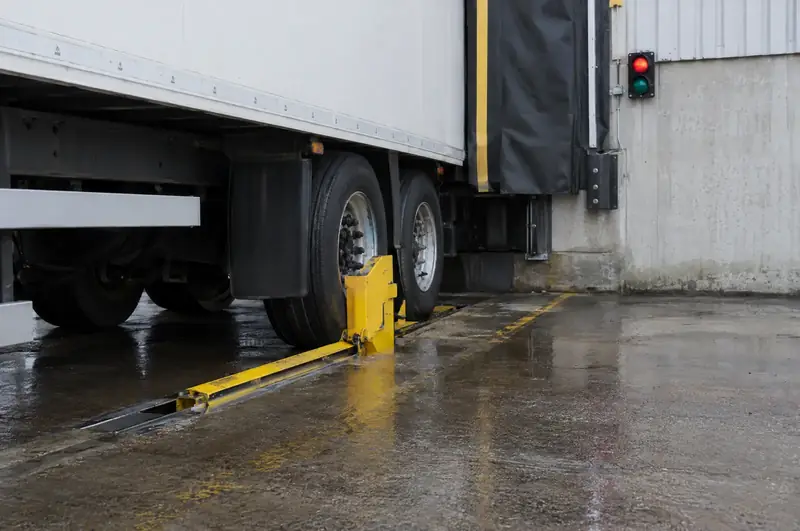
A vehicle restraint is a device at a loading bay that physically holds a trailer against the dock until it is safe to leave. In the UK most systems act on the rear wheel, either as a powered wheel-based restraint or a sensor wheel chock. Restraints guard against early drive-away and trailer creep, and are usually interlocked with the door and dock traffic lights.
Why do sites in Tyne and Wear choose this?
Third-party hauliers visiting sites in Tyne and Wear may not know each site's procedures, so a restraint that holds the wheel removes reliance on every driver following instructions. Restraint systems for sites in Tyne and Wear are surveyed, quoted and installed in the same way as anywhere else in the UK, with a fixed price set out in writing.
Multi-tenant logistics parks around Tyne and Wear can benefit from restraints when several tenants share yard space and trailers from different fleets arrive throughout the day.
It starts with a free site survey in Tyne and Wear, where we measure the openings, check the dock and talk through how the bay is used. You then receive a fixed written quote. Once you accept, we manage the job: specialist installation engineers carry out the work under our management, planned around your deliveries, and out-of-hours working can be arranged. At handover we test everything with you and leave the documentation.
Wheel-based or hook restraint: which suits UK trailers?
Wheel-based restraints and sensor wheel chocks suit most UK trailers, because they act on the rear wheel rather than on the back of the vehicle. Hook restraints, which catch the rear impact guard (sometimes called an ICC bar), are common elsewhere but suit fewer UK fleets.
- Wheel-based restraint: a steel guide rail fixed to the yard, with an arm or chock that moves against the rear wheel, either powered or pushed into place by the operative. It works regardless of tail lifts or underrun guard design.
- Sensor wheel chock: a heavy chock placed in front of the wheel, with a sensor or parking station that tells the dock controls it is in position. Lower cost and minimal groundwork, but it relies on someone placing it each time.
- Hook restraint: mounted on the dock face and hooking the rear guard. UK and European trailers vary widely at the rear, and tail lifts often get in the way, so this type needs checking against your actual fleet.
What is trailer creep and how does a restraint stop it?
Trailer creep is the gradual movement of a parked trailer away from the dock, caused by forklifts braking and accelerating as they drive on and off the trailer bed. Each movement pushes the trailer forward slightly, and over a full load the gap can grow.
Creep is more likely when:
- the trailer is uncoupled from its tractor unit and resting on its landing legs;
- air suspension or brakes have not been set correctly by the driver;
- forklifts are heavy, fast or carrying dense loads such as drinks or building materials;
- the yard falls slightly away from the building.
As the trailer moves, the leveller lip can lose its bearing on the trailer bed, and in the worst case the lip slips off with a forklift on it. A wheel-based restraint holds the wheel against the rail or chock, so the trailer cannot travel forward however many times a forklift drives on and off.
Towns we cover in Tyne and Wear
Choose a town below to see how we handle vehicle restraints in that part of Tyne and Wear.
- Newcastle upon Tyne
- Sunderland
- South Shields
- Gateshead
- Washington
- Tynemouth
- Wallsend
- Newburn
- North Shields
- Whitley Bay
- Houghton-le-Spring
- Felling
- Jarrow
- Gosforth
- Hebburn
- Whickham
- Blaydon-on-Tyne
Budget range for supply and fit. The written quote after a free survey is the fixed price. All guide prices.
Planning, building control and safety law in England
Workplace safety in England is regulated by HSE. For a loading bay in Tyne and Wear, that means doors meeting regulation 18 of the Workplace (Health, Safety and Welfare) Regulations 1992, equipment maintained under PUWER and suitable safeguards against vehicles driving away too early. We check what applies at survey and design the bay accordingly.
Questions
Can you work outside our normal operating hours in Tyne and Wear?
Yes, by arrangement. Evening, night and weekend working can be planned so the installation causes as little disruption as possible to your loading schedule. Out-of-hours work can affect the price, so mention it at the survey and we will include it in the written quote. The agreed times are confirmed in the programme before the job starts.
What warranty comes with new loading bay equipment?
New equipment comes with the manufacturer's warranty, which varies by product. Our workmanship terms are set out in writing in the quote for your Tyne and Wear site, so you can see what is covered before you commit. Check the warranty terms for any servicing conditions, and we can quote for planned maintenance once the installation is complete.
Can a vehicle restraint be fitted to an existing bay?
Yes, restraints are commonly retrofitted to existing bays. The main questions are whether the yard concrete in front of the bay is sound enough to anchor a rail, how cables will reach the dock controls, and whether the existing door and leveller panels can accept interlocks. Sensor chocks are often chosen where groundwork needs to be kept to a minimum.
Will a vehicle restraint slow down loading?
Engaging a restraint adds only a short step to each docking, and once it is part of the interlock sequence it becomes routine for dock staff. Many sites find that a clear sequence actually reduces delays, because there is less confusion about when it is safe to open the door or release the driver.
Other services in Tyne and Wear
Full guide to vehicle restraints · All loading bay services in Tyne and Wear