
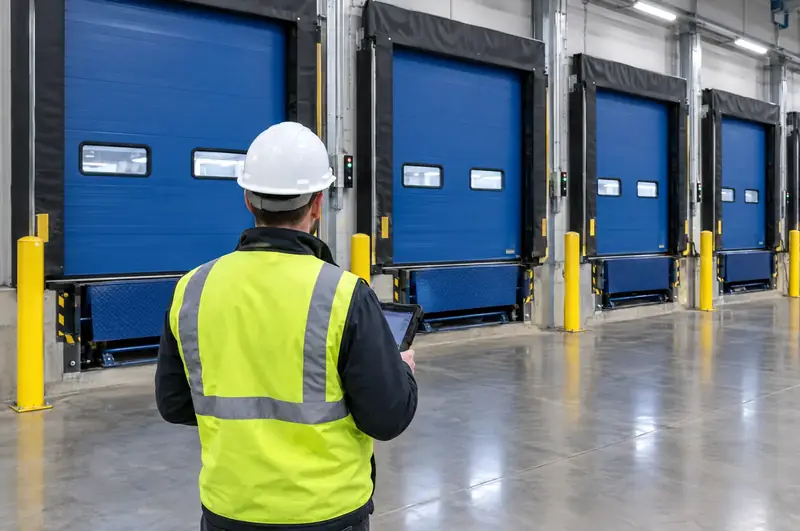
Loading bay servicing covers planned preventive maintenance of dock equipment at agreed intervals. An engineer checks, adjusts and lubricates doors, levellers, shelters, seals, restraints, traffic lights and lift tables, tests safety devices and records defects in a written report. Servicing supports, but is separate from, insurer inspections and the LOLER thorough examinations that some equipment needs.
How much does loading bay servicing cost?
Loading bay servicing typically costs £85 to £180 per item per visit, excluding VAT, where an item is one door, leveller, shelter, restraint or lift table. Simple items such as a dock seal sit towards the lower end; high-speed doors and lift tables sit towards the top.
How the price is agreed:
- You send a list of equipment, with photos or asset labels if you have them.
- We agree the price per item and the visit schedule in writing before the first visit.
- Repairs found during a service are quoted separately and only done once you approve them.
What moves the price:
- Equipment type: powered doors, levellers and lift tables take longer than seals and lights.
- Number of items: larger sites spread travel and set-up across more items.
- Frequency: the number of visits a year.
- Timing: out-of-hours visits cost more.
- Location: remote and island sites carry travel costs, shown in advance.
VAT is added at the standard rate.
What inspections does the law require for loading bay equipment?
Loading bay equipment is work equipment under the Provision and Use of Work Equipment Regulations 1998 (PUWER), so it must be maintained in a safe condition and inspected where deterioration could lead to danger. In Northern Ireland the equivalent is PUWER (Northern Ireland) 1999.
- Insurer inspections: engineering insurers commonly inspect dock levellers under PUWER at 12-month intervals. This is separate from servicing.
- Lift tables: scissor lift tables fall under LOLER 1998, or LOLER (Northern Ireland) 1999, with thorough examination at least every 12 months, every 6 months if they lift people, or to a written examination scheme.
- Levellers and LOLER: most levellers are treated under PUWER, but one designed or used to lift people may fall under LOLER. This depends on the equipment and how it is used; your insurer or competent person will confirm.
- Doors: regulation 18 of the Workplace (Health, Safety and Welfare) Regulations 1992, and the Northern Ireland 1993 equivalent, require fall-back and anti-trap protection, so these devices are tested at every service.
Our guide to dock leveller inspections under PUWER and LOLER explains what applies.
How often should a loading bay be serviced?
Busy loading docks are commonly serviced twice a year, while lightly used bays may only need one visit a year. The right frequency depends on how hard the equipment works and what your risk assessment, the manufacturer's instructions and your insurer expect.
- Twice a year: common for distribution and logistics docks handling trailers through the day.
- Once a year: may suit occasional-use bays, such as a single goods-in door at a manufacturing site.
- More often: worth considering for docks running several shifts, very high door cycle counts, or harsh conditions such as frozen stores.
Insurer inspections and LOLER thorough examinations run on their own schedules. Many sites time a service shortly before each inspection so routine defects are dealt with first.
Our guide to loading bay maintenance sets out what a service covers and how to plan the frequency.
What does the work cover?
Annual service
One planned visit a year, suited to lightly used bays, covering checks, adjustment, lubrication, safety device testing and a written condition report for each item.
Twice-yearly service
Two visits a year, common for busy docks, so wear on springs, hydraulics and shelter curtains is caught before it causes a breakdown at a busy time.
High-use programme
More frequent visits for docks running several shifts or very high trailer numbers, with the interval agreed after reviewing the equipment and how it is used.
Lift table coordination
Servicing of scissor lift tables timed alongside the LOLER thorough examination regime set by your insurer or competent person, so defects are cleared before examination.
Multi-site schedule
One schedule, price list and report format across several sites or units, suited to landlords, managing agents, 3PLs and multi-site operators.
Typical specification
| Equipment covered | doors, levellers, shelters, seals, restraints, lights and lift tables |
|---|---|
| Visit pricing | £85 to £180 per item per visit, ex VAT, agreed before the first visit |
| Typical frequency | commonly twice a year for busy docks |
| Report provided | written report per item with defects graded by priority |
| Repairs | quoted separately and approved before work is done |
| Insurer inspections | separate from servicing, commonly every 12 months for levellers |
| Lift tables | LOLER thorough examination at the interval set for the equipment |
Typical range for this work. The visit price is agreed in writing before anyone attends, and any extra work is quoted before it is done. See all guide prices.
What does a loading bay service visit include?
A loading bay service visit includes checking, adjusting and lubricating each item, testing its safety devices and recording its condition. Typical checks by equipment type:
- Doors: springs, cables, balance, rollers, hinges, tracks, safety edges, photocells, fall-back devices, controls and manual operation.
- Levellers: hydraulic leaks and oil level, hoses, cylinders, lip and hinges, deck condition, toe guards, controls and the maintenance strut.
- Shelters and seals: curtains, frames, pads, covers, airbags and blowers.
- Restraints, lights and interlocks: engagement, sensors and the full interlock sequence.
- Bumpers and wheel guides: wear and fixings.
- Lift tables: toe guards, bellows, hydraulics, controls and gates.
Minor adjustments and lubrication are part of the service. Anything needing parts or more time is recorded and quoted as a repair, so you stay in control of spend.
What happens on site during a service visit?
During a service visit the engineer works through the dock bay by bay, taking each item out of use only while it is being checked. Most of the dock keeps working throughout.
- Agree the order: the engineer meets the dock manager and agrees which bays are released when.
- Isolate: each item is isolated and locked off, and levellers are propped before anyone works underneath.
- Service and test: checks, adjustments and safety device tests are carried out.
- Hand back: each bay is returned to use once tested, with any unsafe item left out of use and reported straight away.
It helps if you can provide an equipment list with asset numbers, previous service and insurer reports, a contact on the day, and bays released as agreed. Out-of-hours visits can be arranged where daytime access is difficult, at a price agreed beforehand.
What happens to defects found during a service?
Defects found during a service are recorded in the written report, graded by priority and quoted as repairs before any work is done. You decide what is repaired and when.
- Unsafe: the item should not be used until repaired. The engineer tells you on the day and the item is left out of use.
- Repair soon: wear or damage that will get worse, such as a weeping hose or a fraying cable.
- Monitor: early wear to check again at the next visit.
Each repair is priced in writing, and parts can be ordered once you approve so the work can often be done on a planned return visit. Keeping service reports alongside insurer reports gives a clear maintenance record for audits, insurers and landlords.
Over time the reports also show which items keep failing, which helps when deciding whether to keep repairing equipment or budget for replacement.
Signs it needs attention
- There is no planned maintenance record for your dock doors and levellers.
- Breakdowns keep stopping bays at the busiest times of day.
- Insurer inspection reports list defects that keep coming back.
- You have taken on a unit with dock equipment of unknown history.
- Door safety edges, photocells and leveller controls have not been tested recently.
How the job runs
- Tell us what you have
Send a list of your doors, levellers, shelters and other dock equipment, with photos or asset labels if possible, plus any recent service or insurer reports.
- Visit price agreed in writing
We agree the price per item, the visit frequency and the first visit date in writing before anyone attends site.
- Attend, service and check
The engineer services each item bay by bay and tests its safety devices. Any repair needed is quoted and only carried out once you approve it.
- Written report
You receive a written report for every item, with defects graded by priority, so you have a clear record for insurers, audits and budgeting.
Loading bay servicing and maintenance: questions
Is loading bay servicing the same as an insurer inspection?
No. Servicing is planned maintenance that keeps equipment working and safe, while an insurer inspection is an independent check, commonly every 12 months for levellers under PUWER. Many sites schedule a service shortly before each inspection, so routine defects are dealt with before the inspector attends.
How often should dock levellers be serviced?
Dock levellers on busy docks are commonly serviced twice a year, while lightly used levellers may only need an annual service. The right interval depends on usage, the manufacturer's instructions and your risk assessment. Insurer inspections and any LOLER examinations run on their own schedules.
Are service visits chargeable?
Yes. Service visits are charged per item per visit, at a price agreed in writing before the first visit. Repairs found during a service are not included in that price; they are quoted separately and only carried out once you have approved them.
Do you service equipment you did not install?
Yes. We service all the common types of loading bay door, leveller, shelter, seal, restraint and lift table, whoever installed them. The first visit records the condition of each item, which gives you a baseline for future planning. Older or obsolete items are flagged in the report so you can budget for them.
What is included in the service price?
The service price covers checking, adjusting and lubricating each item, testing its safety devices and a written report. Parts and repair work are not included; they are quoted separately so you can decide what to approve. Minor adjustments made during the visit are part of the service.
Can servicing be carried out outside operating hours?
Yes, servicing can be arranged for evenings or weekends where daytime access is difficult. Out-of-hours visits cost more, and that price is agreed in writing before the visit. Many sites prefer quieter periods so bays can be released without affecting trailer arrivals.
Related equipment and services
Further reading
Loading bay servicing and maintenance by area
England
- Bedfordshire
- Berkshire
- Buckinghamshire
- Cambridgeshire
- Cheshire
- City and County of Bristol
- Cornwall
- County Durham
- Cumbria
- Derbyshire
- Devon
- Dorset
- East Riding of Yorkshire
- East Sussex
- Essex
- Gloucestershire
- Greater London
- Greater Manchester
- Hampshire
- Herefordshire
- Hertfordshire
- Isle of Wight
- Kent
- Lancashire
- Leicestershire
- Lincolnshire
- Merseyside
- Norfolk
- North Yorkshire
- Northamptonshire
- Northumberland
- Nottinghamshire
- Oxfordshire
- Rutland
- Shropshire
- Somerset
- South Yorkshire
- Staffordshire
- Suffolk
- Surrey
- Tyne and Wear
- Warwickshire
- West Midlands
- West Sussex
- West Yorkshire
- Wiltshire
- Worcestershire