
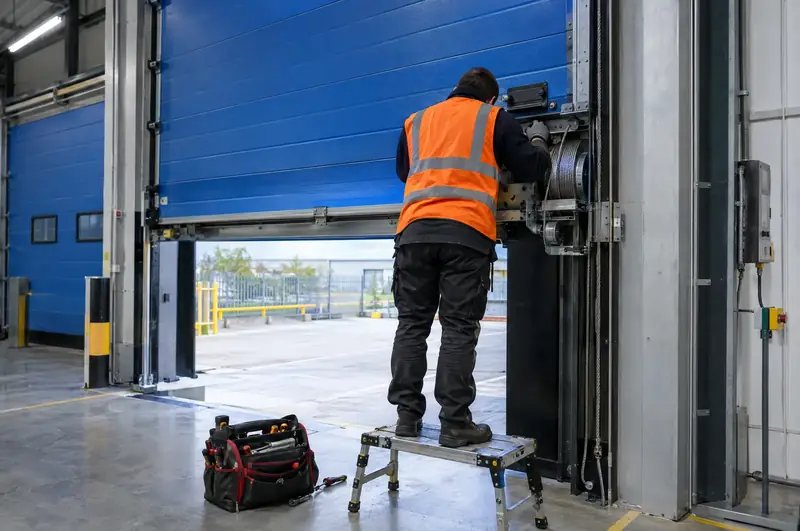
Loading bay door repair covers diagnosing and fixing faults on industrial dock doors, including sectional overhead doors, roller shutters and high-speed fabric doors. Typical work includes replacing broken springs and cables, damaged panels, rollers and hinges, repairing motors and control panels, and restoring safety devices such as safety edges and photocells so the door works safely and closes securely again.
How much does a loading bay door repair cost?
A loading bay door repair typically costs £180 to £1,400 per repair, excluding VAT. A safety edge or photocell fault sits towards the lower end; a pair of springs, several panels or a new motor sits towards the top.
How the price is agreed:
- You describe the fault and send photos if you can.
- We agree the visit price in writing before anyone attends.
- If the engineer finds more work is needed, it is quoted and approved by you before it is done.
What moves the price:
- Parts: springs, cables, panels, motors and control boards vary widely, and matched panels may need ordering.
- Door size and type: larger, heavier doors need bigger springs and more labour.
- Access: high doors may need a powered access platform.
- Out-of-hours working: evening or weekend visits cost more.
- Location: remote and island sites carry travel costs, shown in advance.
VAT is added at the standard rate.
What safety rules apply to loading bay doors?
Loading bay doors are covered by regulation 18 of the Workplace (Health, Safety and Welfare) Regulations 1992 in Great Britain, and by the Workplace (Health, Safety and Welfare) Regulations (Northern Ireland) 1993. Several common repairs relate directly to those duties.
- Fall-back protection: upward-opening doors need a device to stop them falling back. Broken springs and cables put this under strain, so spring and cable safety devices are checked on every repair.
- Trapping protection: powered doors need suitable and effective features to prevent trapping, such as safety edges and photocells. A door whose safety devices do not work should not be used until repaired.
- Manual operation: where needed for health or safety, powered doors must be operable by hand unless they open automatically on power failure.
Doors are also work equipment under PUWER 1998, or PUWER (Northern Ireland) 1999, and must be maintained in a safe condition. BS EN 12453 sets out safety requirements for power-operated doors, and BS EN 13241 is the product standard. The regulator is HSE in Great Britain and HSENI in Northern Ireland.
Why has my loading bay door stopped working?
Most loading bay door failures come down to a handful of causes: a broken spring, a damaged cable, a safety device fault, worn running gear or a motor and control problem. The symptom usually points to the cause.
- Door suddenly heavy, or motor straining: often a broken torsion spring.
- Door hanging lower on one side: a frayed or snapped lift cable, or a cable slipping on its drum.
- Door stops and reverses, or will not close: a dirty, misaligned or damaged photocell or safety edge.
- Grinding, juddering or noisy running: worn rollers or hinges, or a bent track after an impact.
- Motor hums but nothing moves, or no response: motor, gearbox, control board, limit settings or supply.
- High-speed door curtain out of its guides: a breakaway curtain that needs resetting, or a torn curtain.
If a door has a broken spring or cable, stop using it and keep people clear. Do not try to adjust springs yourself: they hold a great deal of stored energy.
What does the work cover?
Spring and cable replacement
Replacing broken torsion springs and frayed or snapped lift cables, rebalancing the door and checking the devices that stop an upward-opening door falling back.
Panel and section replacement
Replacing impact-damaged sectional door panels or roller shutter slats, matched as closely as possible to the existing door, with tracks and hinges checked.
Motor and control repairs
Fault-finding and repairing motors, gearboxes, control panels, limit settings and wiring on powered loading bay doors, including manual override checks.
Safety device repairs
Replacing or realigning safety edges, photocells and light curtains so the door stops and reverses when it should, then testing every device before handover.
High-speed door curtain repairs
Resetting breakaway curtains, replacing torn fabric and repairing guides and drives on fast-acting doors used at docks and internal openings.
Typical specification
| Doors covered | sectional, roller shutter and high-speed loading bay doors |
|---|---|
| Visit pricing | agreed in writing before anyone attends |
| Typical repair price | £180 to £1,400 per repair, ex VAT |
| Extra work | quoted and approved before it is carried out |
| Parts | typically matched to the existing door where available |
| Safety checks | safety edges, photocells and fall-back devices tested after repair |
| Report provided | written report of the fault, work done and any further issues |
Typical range for this work. The visit price is agreed in writing before anyone attends, and any extra work is quoted before it is done. See all guide prices.
What happens when an engineer attends to repair a dock door?
When an engineer attends, the bay is closed, the door is made safe and isolated, and the fault is diagnosed before any repair starts. Only the affected bay needs to stop.
- Isolate the bay: no trailer on the dock, the leveller parked and the area around the door coned off.
- Make safe: the door is electrically isolated and locked off, and spring tension is released or the door supported before work begins.
- Diagnose: the engineer confirms the cause. Anything beyond the agreed scope is quoted before it is done.
- Repair and test: parts are fitted, the door is balanced and every safety device is tested.
If a door cannot be repaired on the first visit, for example because a matched panel must be ordered, it is left secure where possible and a return visit agreed.
It helps if you can provide access to the bay, a contact on site, any labels showing the door size and serial details, and permit-to-work information. To arrange a visit, contact us with a description of the fault.
Should I repair or replace an old loading bay door?
Repair is usually the right choice when the door structure, tracks and most panels are sound and parts are available. Replacement starts to make more sense when faults keep recurring or the door no longer suits the building.
Points that favour repair:
- a single failed component, such as a spring, cable or photocell;
- impact damage limited to one or two panels;
- a door that is otherwise in good condition and suits the operation.
Points that favour replacement:
- parts for an obsolete door are no longer available;
- widespread panel damage, corrosion or distorted tracks;
- repeated breakdowns that cost more than they save;
- an uninsulated door on a heated or chilled building.
In England, a replacement door should meet the Approved Document L limiting U-value of 1.3 W/m²K for large doors; Wales, Scotland and Northern Ireland have their own energy rules. If the written report after a repair recommends replacement, we can quote for it separately.
How can I reduce loading bay door breakdowns?
The most effective way to reduce loading bay door breakdowns is planned maintenance, combined with protecting doors from forklift and trailer impacts. Many failures build up gradually and can be caught early.
- Planned servicing: regular checks of springs, cables, rollers, safety devices and controls find wear before it stops the bay.
- Spring life: springs are rated for a number of opening cycles, so busy doors reach the end of their life sooner. Replacing them in a planned visit avoids a sudden failure.
- Impact protection: bollards, track guards and clear floor markings keep forklifts away from door tracks and frames.
- Use: staff should not drive through a door that is still moving or use the door as a stop.
- Records: keeping a log of faults shows which doors need attention.
Our loading bay servicing covers doors alongside levellers, shelters and restraints.
Signs it needs attention
- The door feels heavy, drops when released or will not stay open.
- One side of the door hangs lower than the other or a cable looks frayed.
- The door stops and reverses for no clear reason, or will not close at all.
- Panels are dented or split after a forklift or trailer strike.
- The motor hums, the door judders or there is grinding from the rollers or track.
How the job runs
- Tell us the fault
Describe what the door is doing, its type and roughly how big it is. Photos or a short video of the fault and any labels help us arrange the right parts.
- Visit price agreed in writing
We confirm the visit price, what it covers and the planned attendance date in writing before anyone attends, so you know the cost in advance.
- Attend, diagnose and repair
The engineer makes the door safe, finds the cause and carries out the repair. Any extra parts or work beyond what was agreed are quoted before they are done.
- Written report
You receive a written report covering the fault, the repair carried out, the safety device checks and any other issues that need attention later.
Loading bay door repairs: questions
Is a loading bay door repair visit chargeable?
Yes, every repair visit is chargeable, and the price is agreed with you in writing before anyone attends. If the engineer finds that more work or extra parts are needed once on site, that work is quoted and only carried out once you have approved it.
Can you repair any type of loading bay door?
We repair all the common types of loading bay door, including sectional overhead doors, roller shutters and high-speed fabric doors. For older or obsolete doors, some parts may no longer be made, so photos of the door and any labels help us check what is available before the visit.
Is it safe to use a door with a broken spring?
No. A door with a broken spring or cable should be taken out of use and the area kept clear, because the door may be heavy, unbalanced or at risk of dropping. Springs store a great deal of energy, so do not try to adjust or remove them yourself.
Can a door repair be carried out outside working hours?
Yes, repairs can be arranged in the evening or at weekends where that suits your operation. Out-of-hours working costs more, and that price is agreed in writing before the visit, in the same way as any other repair. Timing is agreed with you for each job.
Do you replace one spring or both?
On doors with two springs, we normally recommend replacing both at the same time, because they have done the same number of cycles and the second spring is likely to fail soon after the first. We explain the options and prices before any work is done.
What happens if the door cannot be repaired?
If a door cannot be repaired economically, or parts are no longer available, the written report explains why. We make the door as safe and secure as possible in the meantime and can quote separately for a replacement, so you can compare the options.
Related equipment and services
Further reading
Loading bay door repairs by area
England
- Bedfordshire
- Berkshire
- Buckinghamshire
- Cambridgeshire
- Cheshire
- City and County of Bristol
- Cornwall
- County Durham
- Cumbria
- Derbyshire
- Devon
- Dorset
- East Riding of Yorkshire
- East Sussex
- Essex
- Gloucestershire
- Greater London
- Greater Manchester
- Hampshire
- Herefordshire
- Hertfordshire
- Isle of Wight
- Kent
- Lancashire
- Leicestershire
- Lincolnshire
- Merseyside
- Norfolk
- North Yorkshire
- Northamptonshire
- Northumberland
- Nottinghamshire
- Oxfordshire
- Rutland
- Shropshire
- Somerset
- South Yorkshire
- Staffordshire
- Suffolk
- Surrey
- Tyne and Wear
- Warwickshire
- West Midlands
- West Sussex
- West Yorkshire
- Wiltshire
- Worcestershire