
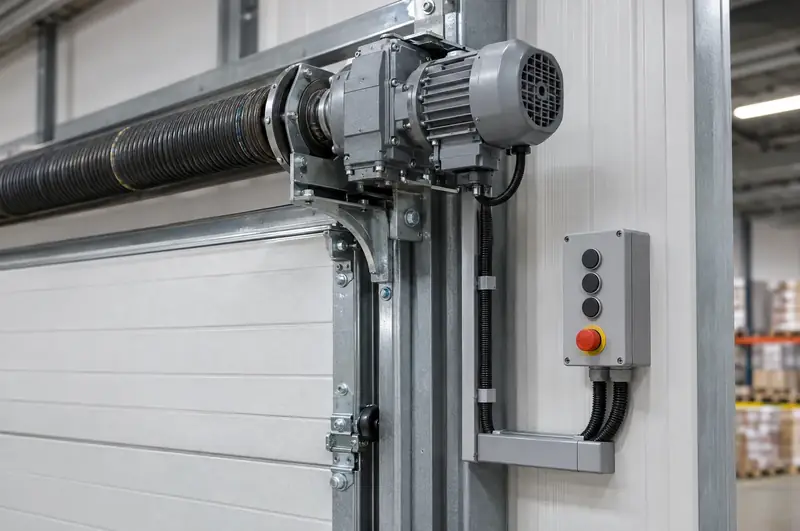
A loading bay door automation package is an electric operator, control panel and set of safety devices fitted to an existing manual sectional door or roller shutter so it opens and closes at the press of a button. Once motorised, the door is a power-operated door, so it needs protection against trapping, such as a safety edge and photocells, and a way to be opened by hand if the power fails.
How much does it cost to motorise a loading bay door?
Automating an existing loading bay door typically costs £1,100 to £2,400 per door, excluding VAT, supply and fit. That covers the operator, control panel, safety devices, wiring at the door and commissioning.
What moves the price:
- Door type and weight: heavy shutters and large sectional doors need more powerful operators.
- Operator type: shaft-mounted, trolley, tubular or external chain-drive.
- Control mode: hold-to-run controls need fewer safety devices than impulse or automatic operation.
- Safety devices: safety edge, photocells and, for automatic closing, additional sensing.
- Extras: remote controls, pull cords, induction loops and interlocks with levellers or traffic lights.
- Power: whether a suitable isolated supply already exists near the door.
If the door needs work before it can be motorised, such as new springs or rollers, we price that separately so you can see each cost. The written quote after a free site survey is the fixed price.
What safety rules apply once a manual door is motorised?
Once a manual door is fitted with a motor it becomes a power-operated door, and the rules for powered doors apply in full. Automation is more than bolting on a motor.
- Workplace law: regulation 18 of the Workplace (Health, Safety and Welfare) Regulations 1992 in Great Britain, and the Workplace (Health, Safety and Welfare) Regulations (Northern Ireland) 1993, require powered doors to have suitable and effective features to prevent trapping, and to be operable by hand where necessary unless they open automatically on power failure.
- Safety in use: BS EN 12453 sets out safety requirements and test methods for power-operated doors, including how closing forces are limited and measured.
- Product standard: BS EN 13241 covers the door as a product.
- Marking: in Great Britain a powered door may carry the UKCA or the CE mark; in Northern Ireland the CE mark, or CE with UKNI, applies.
Enforcement sits with HSE in Great Britain and HSENI in Northern Ireland. The results of the safety checks carried out at commissioning form part of the handover.
Which type of door operator is right for my door?
The right operator depends on the door type, its weight and how many times a day it runs. Matching the operator's duty cycle to real use is what stops motors overheating and failing early.
- Shaft-mounted operator: fits directly on the spring shaft of a sectional door. Compact, strong and suited to heavy, busy dock doors.
- Trolley operator: runs along a rail on the ceiling and pulls the door. Suits lighter sectional doors on quieter bays.
- Tubular motor: sits inside the barrel of a roller shutter, keeping the installation tidy on small and medium shutters.
- External or side-mounted motor: drives a shutter barrel by chain, for larger and heavier shutters.
Every option should include a manual override, either a hand chain or a release, so the door can be used during a power cut. On bays that cycle many times an hour we specify an industrial operator rated for that duty rather than a light-use unit.
Which types and options are available?
Shaft-mounted operator
A compact industrial motor that fits directly onto the spring shaft of a sectional door, suited to heavy dock doors and bays that run many cycles a day.
Tubular or external shutter motor
A motor inside the barrel for small and medium shutters, or a side-mounted chain-drive unit for large, heavy shutters at busy openings.
Safety edge and photocells
A pressure-sensitive or optical edge on the bottom rail plus photocells across the opening, stopping and reversing the door if anything is in its path.
Remote and drive-through controls
Radio remotes, pull cords and induction loops let drivers and forklift operators open the door without stopping, alongside the main push-button panel.
Dock interlocks
Wiring that links the door to levellers, shelters, restraints or traffic lights so the dock can only run in a safe sequence.
Typical specification
| Suitable doors | Typically sound, balanced sectional doors and roller shutters |
|---|---|
| Operator types | Shaft-mounted, trolley, tubular or external chain-drive |
| Power supply | Typically single-phase or three-phase, depending on operator size |
| Control modes | Hold-to-run, impulse, or automatic with full safety sensing |
| Safety devices | Typically safety edge, photocells and manual override |
| Duty rating | Matched to cycles per hour, from light use to continuous duty |
| Standards | BS EN 12453 safety in use; BS EN 13241 product standard |
Budget range for supply and fit. Your written quote after a free site survey is the fixed price. See all guide prices.
What is involved in fitting a motor to an existing dock door?
Fitting a motor to an existing dock door usually takes a few hours to a day per door, and starts with checking that the door itself is safe to automate.
- The door is checked for balance, spring condition, cable wear and track alignment.
- The operator is mounted on the shaft, ceiling rail or barrel bracket.
- The control panel is fixed in a safe position with a clear view of the door.
- A safety edge is fitted to the bottom rail and photocells are set across the opening.
- Limits, forces and controls are set, then the door is tested against the relevant safety checks.
You will need to provide a suitable isolated power supply near the door, or ask us to include it, and keep the door out of use during the work. Single-phase supplies suit many operators, but larger industrial operators may need three-phase power, which we confirm at survey.
Is my existing door suitable for automation?
An existing door is usually suitable for automation if it is structurally sound, correctly balanced and runs smoothly by hand. A motor should never be used to make up for a door that is heavy, stiff or damaged.
Signs a door can be automated:
- It lifts evenly by hand and stays put when released halfway.
- Springs, cables, rollers and tracks are in good order.
- Panels or laths are not badly dented or distorted.
Signs it may be better replaced:
- Springs are near the end of their life or have broken before.
- The door is single skin and the building is now heated.
- Parts are no longer available for the door model.
Where replacement makes more sense, we will say so and can quote for sectional loading bay doors supplied with an operator already fitted, so you can compare the two routes on cost.
How can door controls and interlocks make the dock safer?
Interlocks link the door to the rest of the dock so that each piece of equipment can only move when it is safe, which reduces both accidents and damage.
- Leveller interlock: the leveller cannot be raised until the door is fully open, protecting the door from the lip.
- Restraint or traffic light interlock: the door only opens once the trailer is restrained or the outside light shows red to the driver.
- Shelter interlock: with inflatable shelters, the door opens only once the cushions have inflated.
- Control mode: hold-to-run keeps the operator watching the door, while impulse controls save time but need full safety sensing.
Interlocks are far simpler to add while a door is being automated than as a separate job later. See dock traffic lights and interlocks for how a full dock sequence is set up.
When is this the right choice?
- Staff are hauling a heavy door by hand chain many times a shift.
- Doors are left open all day because opening them by hand takes too long.
- You want the door interlocked with a leveller, restraint or traffic lights.
- Manual operation is causing strain complaints or slowing down loading.
- A door is in good condition but manual operation no longer suits the workload.
How the job runs
- Free site survey
We operate the door by hand to check balance and wear, identify its type and weight, ask how often it runs and check the power supply near the door.
- Written quote
A fixed written price for the operator, controls, safety devices and wiring, with any repairs the door needs before automation shown as separate items.
- Installation
The operator, control panel, safety edge and photocells are fitted and wired, usually within a day, with the door out of use while the work is done.
- Commissioning and handover
Limits and forces are set and tested, safety devices checked, and your staff shown the controls and the manual override for use in a power cut.
Loading bay door automation: questions
How long does it take to automate a dock door?
Most automations are completed within a working day per door, once any repairs to the door itself have been done. Larger shutters, or doors that need a new power supply, can take longer. We plan the work so that only the door being automated is out of use.
Can any manual door be motorised?
No, only doors that are sound, balanced and run smoothly by hand should be motorised. Doors with weak springs, damaged panels, bent laths or obsolete parts may need repair first, or may be better replaced. We check this at survey and tell you which applies before quoting.
What is the difference between hold-to-run and impulse control?
With hold-to-run the operator must keep pressing the button for the door to move, so they watch it throughout. With impulse control a single press opens or closes the door fully, which saves time but requires full safety sensing such as a safety edge and photocells, because no one may be watching.
Will we still be able to open the door in a power cut?
Yes, every automated door should have a manual override, typically a hand chain or a release that lets the door be lifted by hand. We show your team how to use it at handover, and it should be checked at each service visit so it works when needed.
Do we need a three-phase supply?
Not always. Many operators for small and medium doors run on a single-phase supply, while larger industrial operators for heavy dock doors often need three-phase power. We confirm the supply your door needs at survey and can include any electrical work in the written quote.
Can drivers open the door without leaving the forklift?
Yes, pull cords, radio remotes and induction loops in the floor can all open a powered door without the driver getting down. The right choice depends on traffic, and any opening method that does not need a button held must be paired with safety devices so the door cannot close on a vehicle or person.
Related equipment and services
Further reading
Loading bay door automation by area
England
- Bedfordshire
- Berkshire
- Buckinghamshire
- Cambridgeshire
- Cheshire
- City and County of Bristol
- Cornwall
- County Durham
- Cumbria
- Derbyshire
- Devon
- Dorset
- East Riding of Yorkshire
- East Sussex
- Essex
- Gloucestershire
- Greater London
- Greater Manchester
- Hampshire
- Herefordshire
- Hertfordshire
- Isle of Wight
- Kent
- Lancashire
- Leicestershire
- Lincolnshire
- Merseyside
- Norfolk
- North Yorkshire
- Northamptonshire
- Northumberland
- Nottinghamshire
- Oxfordshire
- Rutland
- Shropshire
- Somerset
- South Yorkshire
- Staffordshire
- Suffolk
- Surrey
- Tyne and Wear
- Warwickshire
- West Midlands
- West Sussex
- West Yorkshire
- Wiltshire
- Worcestershire