
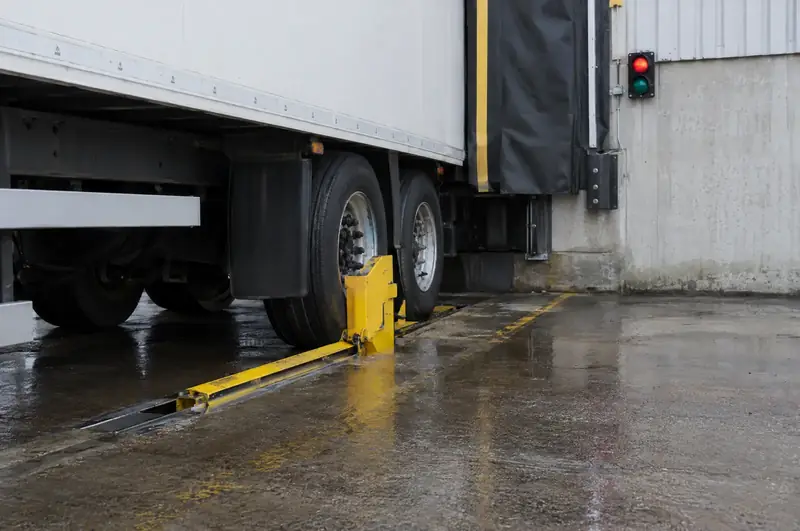
A vehicle restraint is a device at a loading bay that physically holds a trailer against the dock until it is safe to leave. In the UK most systems act on the rear wheel, either as a powered wheel-based restraint or a sensor wheel chock. Restraints guard against early drive-away and trailer creep, and are usually interlocked with the door and dock traffic lights.
What should sites in North Yorkshire consider?
New-build distribution sheds in North Yorkshire can have restraint rails and ducting planned into the yard slab from the start, which is simpler than cutting them in later. Yards around North Yorkshire that park uncoupled trailers at the dock can see trailers creep under forklift traffic, and a wheel-based restraint helps keep the leveller lip on the bed.
Operators in North Yorkshire reviewing their workplace transport risk assessment often look at restraints when key control alone has proved hard to enforce across shifts.
We keep the process simple for sites in North Yorkshire. A free survey tells us what the dock needs; a fixed written quote tells you what it will cost and what is included. We then organise the installation, with specialist engineers under our management and a programme agreed around your shifts. Night and weekend work is available by arrangement. Before we leave, the new equipment is tested, demonstrated and handed over with its documentation.
How does a vehicle restraint work with dock lights and interlocks?
A vehicle restraint is normally linked to the dock traffic lights and the door controls, so engaging the restraint is what allows loading to start.
A typical sequence looks like this:
- The trailer reverses on to the bay with the outside light on green and the door closed.
- The restraint engages the rear wheel. The outside light turns red for the driver and the inside light turns green for dock staff.
- The door can now be opened, and the leveller can only operate once the door is fully open.
- When loading is finished, the leveller is parked and the door closed before the restraint can release.
- The restraint releases, the outside light turns green and the driver can leave.
The exact interlocks depend on your equipment and risk assessment. See dock traffic lights and interlocks for the options on signals and control logic.
What happens on site when a vehicle restraint is installed?
Installing a vehicle restraint takes the bay out of use while the rail or chock station is fixed, cabled and tested, but neighbouring bays can usually keep working.
- Set out: the restraint position is marked in line with the bay so it meets the rear wheels of the trailers you receive.
- Fixing: rail-mounted units are anchored into the concrete apron. If a new concrete base is needed, it must cure before the restraint is fitted.
- Cabling: ducts are cut or laid from the restraint to the dock wall, and the control box is fitted inside next to the door.
- Connection: the restraint is wired into the door, leveller and traffic light controls so the sequence works as designed.
- Commissioning: the system is tested with a trailer on the bay, and dock staff are shown how to engage and release it.
We ask you to release the bay for the agreed period, confirm an electrical supply point, provide a trailer for commissioning and tell us about any buried services in the yard.
Towns we cover in North Yorkshire
We provide vehicle restraints right across North Yorkshire. Pick the town closest to your site from the list below.
Budget range for supply and fit. The written quote after a free survey is the fixed price. All guide prices.
Which rules apply in England?
Powered doors and dock equipment installed in England may carry the UKCA or the CE mark, and doors are covered by the product standard BS EN 13241. We hand over the relevant documentation for each item fitted in North Yorkshire. Planning and Building Regulations questions are never assumed either way: we check what applies at survey, so you know before work is booked.
Questions
Can you work outside our normal operating hours in North Yorkshire?
Yes, by arrangement. Evening, night and weekend working can be planned so the installation causes as little disruption as possible to your loading schedule. Out-of-hours work can affect the price, so mention it at the survey and we will include it in the written quote. The agreed times are confirmed in the programme before the job starts.
Will you deal with building control and planning for a project in North Yorkshire?
We check at survey whether the work is likely to need approval. Forming a new opening or dock pit may need Building Regulations approval, a building warrant or building control approval, depending on the nation, and external structures such as loading houses can need planning permission. Where approval is needed, we explain what is involved, work with your designer or agent, and build it into the programme.
What happens if a powered restraint loses power?
Powered restraints are normally designed with a manual release so a trailer is not trapped on the bay if power is lost. Your site procedure should say who is allowed to use the release and what checks they make first. We explain the release method at handover.
Can a vehicle restraint be fitted to an existing bay?
Yes, restraints are commonly retrofitted to existing bays. The main questions are whether the yard concrete in front of the bay is sound enough to anchor a rail, how cables will reach the dock controls, and whether the existing door and leveller panels can accept interlocks. Sensor chocks are often chosen where groundwork needs to be kept to a minimum.
Other services in North Yorkshire
Full guide to vehicle restraints · All loading bay services in North Yorkshire