
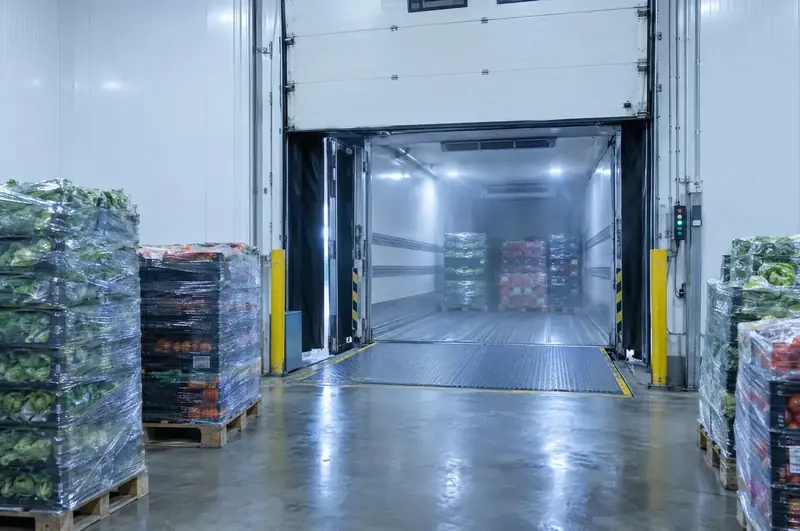
A cold store dock door is an insulated loading bay door built for chilled or frozen buildings, usually a sectional door with thick insulated panels or a high-speed door with an insulated curtain. It differs from a standard dock door in its thermal breaks, extra seals and, on freezer docks, heating in the frame or seals so that ice cannot lock the door shut or tear the seals.
How much does a cold store dock door cost?
A cold store dock door typically costs £4,800 to £9,500 per door, excluding VAT, supply and fit. Chilled docks usually sit lower in that range than freezer docks, because freezer doors need more insulation and frame heating.
Price is mainly driven by:
- Operating temperature: chilled, frozen, or a door between two temperature zones.
- Door type: insulated sectional, insulated high-speed, or both at one opening.
- Heating: heated frames, heated bottom seals or threshold heating to stop ice forming.
- Panel thickness and thermal breaks: thicker panels and better breaks reduce condensation and heat gain.
- Controls: faster operators, interlocks with shelters and levellers, and automatic closing.
- Working conditions: installing in a live cold store often means out-of-hours work and temporary screening.
We price each door after a free site survey, and the written quote fixes the cost.
Do cold store dock doors have to meet building regulations?
Yes, a new or replacement cold store dock door is still a vehicle access door, so building energy rules apply alongside workplace safety law and product standards.
- England: Approved Document L (2021) Volume 2 limits the U-value of vehicle access and similar large doors to 1.3 W/m²K in new and replacement work. Cold store doors are normally specified to perform better than that to protect the store.
- Wales, Scotland and Northern Ireland: Approved Document L for Wales, Section 6 of the Scottish Building Standards Technical Handbook and Technical Booklet F2 in Northern Ireland apply. We confirm the figure for your nation and project.
- Power failure: under the Workplace (Health, Safety and Welfare) Regulations 1992 in Great Britain, or the 1993 Northern Ireland regulations, a powered door must be operable by hand where needed for health or safety, unless it opens automatically when power fails.
- Standards: BS EN 13241 for the door and BS EN 12453 for powered operation.
How should a door be specified for a chilled dock compared with a freezer dock?
A chilled dock needs a well-insulated, well-sealed door, while a freezer dock also needs heating to stop ice forming in the frame and seals. The temperature difference across the door drives most specification choices.
- Chilled docks: an insulated sectional door at the thicker end of the common 40 to 80 mm panel range, good perimeter seals and a shelter or seal outside usually do the job.
- Freezer docks: thick panels, thermal breaks in the panel joints, heated side frames and a heated bottom seal, plus a fast operator to cut open time.
- Doors between zones: an insulated high-speed door often suits openings between a chilled marshalling area and a freezer, where traffic is constant.
- Vision panels: possible, but they reduce insulation and can mist, so many freezer docks leave them out.
A cold store door is only as good as the seal around the trailer, which is why we specify the door, shelter and leveller together.
Which types and options are available?
Insulated sectional cold store door
Thick insulated panels with thermal breaks and full perimeter seals, the usual choice for chilled and frozen external dock openings that also need to be secure overnight.
Insulated high-speed door
A fast door with an insulated curtain for busy openings between temperature zones, where cutting open time matters more than maximum insulation.
Heated frames and seals
Low-power heating in the side frames, bottom seal or threshold that keeps contact surfaces above freezing so the door does not ice up or tear its seals.
Dock interlocks
Controls that link the door to the shelter, leveller and restraint so the door only opens when a trailer is docked and sealed against the building.
Typical specification
| Typical use | Chilled and frozen loading bays and doors between temperature zones |
|---|---|
| Panel thickness | Typically at the thicker end of the common 40 to 80 mm range |
| Thermal breaks | Typically in panel joints and frames to reduce cold bridging |
| Ice prevention | Heated side frames, heated bottom seal or threshold heating on freezer docks |
| Operation | Typically electric, with fast opening and interlocks |
| Seals | Typically full perimeter seals, often doubled at the bottom |
| Standards | BS EN 13241; BS EN 12453 for powered doors |
Budget range for supply and fit. Your written quote after a free site survey is the fixed price. See all guide prices.
How can a cold store door be replaced without losing temperature?
A cold store door can be replaced with very little temperature loss if the work is planned around the store, with the opening screened and the fitting done in one continuous visit.
On a live cold store we usually:
- schedule the work for the quietest period, often overnight or at a weekend,
- fit a temporary insulated screen or strip curtain while the opening is exposed,
- remove ice from the old frame and threshold before fixing the new door,
- pre-assemble as much as possible so the opening is exposed for the shortest time.
From your side we need product moved back from the opening, any site permits for working in cold areas, and power for the operator and frame heaters. Heated frames typically need their own supply, which we set out in the quote. Our cold store loading bays guide covers planning the work in more depth.
Why does ice form around a freezer dock door, and how is it stopped?
Ice forms when warm, moist outside air meets the cold surfaces of the door, frame and floor, and the moisture freezes. Over time it builds up in the seals and guides until the door jams or tears its seals.
Ice is controlled by tackling both the cold surfaces and the warm air:
- Heated frames and seals: low-power heating in the side frames and bottom seal keeps those surfaces above freezing.
- Threshold heating: stops the door freezing to the floor.
- A tight seal at the trailer: an inflatable dock shelter or a well-fitted seal keeps outside air away from the opening.
- Short open times: fast operators and interlocks mean the door is only open while a trailer is sealed to the dock.
Condensation dripping inside the store near the door is an early sign of the same problem and worth raising at survey.
How does a cold store door work with the shelter and leveller?
On a cold store dock the door, shelter and leveller should work as one system, with the door opening only once the trailer is sealed against the building and closing before the seal is released.
A typical sequence is:
- The trailer reverses onto the bumpers and is held by a restraint, or the driver's keys are taken.
- The shelter inflates or the seal compresses around the trailer.
- The door opens and the leveller lip is lowered onto the trailer bed.
- Loading takes place inside a sealed link between store and trailer.
- The leveller is stored, the door closes, then the shelter releases.
Interlocks make this sequence automatic, so the door cannot be left open with no trailer present. Insulated leveller platforms and seals around the pit also reduce cold loss through the floor of the bay.
When is this the right choice?
- Ice is building up in the frame, guides or bottom seal of a freezer dock door.
- The door freezes to the floor and has to be forced open on cold mornings.
- Condensation drips inside the store near the dock door during loading.
- Panels are dented or seals torn, letting warm air into a chilled area.
- You are converting an ambient warehouse to chilled or frozen storage.
How the job runs
- Free site survey
We record store temperature, door type and condition, ice and condensation problems, traffic, power supply and how the door, shelter and leveller work together now.
- Written quote
Your fixed written price covers the door, insulation, frame heating, controls, interlocks, temporary screening and any out-of-hours working needed to protect the store.
- Installation
The old door is removed and the frame de-iced, then the new door, heaters and operator are fitted in one planned visit with the opening screened throughout.
- Testing and handover
Heaters, seals, operator, safety devices and interlocks are tested together, and your team is shown the manual operation for use during a power cut.
Cold store dock doors: questions
Can a standard sectional door be used on a chilled dock?
A standard insulated sectional door can work on a chilled dock if its panels are thick enough and its seals are in good condition. For frozen docks it is not usually suitable, because it lacks the thermal breaks and frame heating needed to stop ice forming. We advise on the right specification after surveying the store.
Do cold store doors need more frequent servicing?
Yes, cold store doors generally benefit from more frequent servicing than ambient dock doors. Low temperatures stiffen seals, stress springs and cables, and hide early ice build-up. Checking heaters, seals and operator settings before winter is particularly worthwhile. Servicing visits are chargeable and agreed in advance.
What happens to a cold store door in a power cut?
In a power cut the door stops where it is and the frame heating switches off, so it must be possible to operate the door by hand. Powered dock doors normally have a hand chain, crank or release for this. We show your team how to use it at handover so the store can be closed up quickly.
Will a new door reduce our refrigeration load?
A better-sealed, better-insulated door that stays shut except when a trailer is docked reduces the warm air entering the store, which is a significant source of load at a cold store dock. We cannot promise a figure, because results depend on your store, traffic and the rest of the dock, but the mechanism is well understood.
Can a cold store door be paired with a high-speed door?
Yes, cold store docks often pair an insulated sectional door on the outside with a fast door just inside it, or use an insulated high-speed door as the only door between zones. The right arrangement depends on traffic, security and how much space there is around the opening.
Do heated door frames use a lot of power?
Frame and seal heaters are low-power elements designed to keep surfaces just above freezing rather than to heat the dock. Many can be controlled by a thermostat so they only run when needed. We set out the supply required in the written quote so it can be planned before installation.
Related equipment and services
Further reading
Cold store dock doors by area
England
- Bedfordshire
- Berkshire
- Buckinghamshire
- Cambridgeshire
- Cheshire
- City and County of Bristol
- Cornwall
- County Durham
- Cumbria
- Derbyshire
- Devon
- Dorset
- East Riding of Yorkshire
- East Sussex
- Essex
- Gloucestershire
- Greater London
- Greater Manchester
- Hampshire
- Herefordshire
- Hertfordshire
- Isle of Wight
- Kent
- Lancashire
- Leicestershire
- Lincolnshire
- Merseyside
- Norfolk
- North Yorkshire
- Northamptonshire
- Northumberland
- Nottinghamshire
- Oxfordshire
- Rutland
- Shropshire
- Somerset
- South Yorkshire
- Staffordshire
- Suffolk
- Surrey
- Tyne and Wear
- Warwickshire
- West Midlands
- West Sussex
- West Yorkshire
- Wiltshire
- Worcestershire