
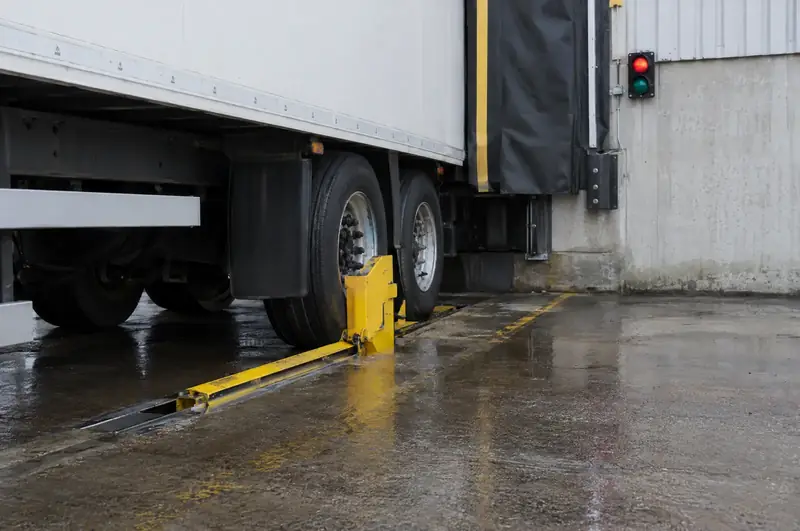
A vehicle restraint is a device at a loading bay that physically holds a trailer against the dock until it is safe to leave. In the UK most systems act on the rear wheel, either as a powered wheel-based restraint or a sensor wheel chock. Restraints guard against early drive-away and trailer creep, and are usually interlocked with the door and dock traffic lights.
How does this suit sites in Powys?
Operators in Powys reviewing their workplace transport risk assessment often look at restraints when key control alone has proved hard to enforce across shifts. Busy cross-dock and parcel operations in Powys with frequent trailer swaps have more chances for an early drive-away, which is where a physical restraint adds real protection.
A warehouse in Powys that already uses traffic lights may want to add restraints so the door cannot open until the trailer is physically held in place.
The survey is free, the quote is written and the price is fixed: that is how every installation in Powys begins. We then manage the work from start to finish. Fitting is carried out by specialist installers under our management, phased so the operation keeps moving, and nights or weekends can be booked by arrangement. On the final day we test the equipment with you and hand over the operating and maintenance information.
What is trailer creep and how does a restraint stop it?
Trailer creep is the gradual movement of a parked trailer away from the dock, caused by forklifts braking and accelerating as they drive on and off the trailer bed. Each movement pushes the trailer forward slightly, and over a full load the gap can grow.
Creep is more likely when:
- the trailer is uncoupled from its tractor unit and resting on its landing legs;
- air suspension or brakes have not been set correctly by the driver;
- forklifts are heavy, fast or carrying dense loads such as drinks or building materials;
- the yard falls slightly away from the building.
As the trailer moves, the leveller lip can lose its bearing on the trailer bed, and in the worst case the lip slips off with a forklift on it. A wheel-based restraint holds the wheel against the rail or chock, so the trailer cannot travel forward however many times a forklift drives on and off.
Wheel-based or hook restraint: which suits UK trailers?
Wheel-based restraints and sensor wheel chocks suit most UK trailers, because they act on the rear wheel rather than on the back of the vehicle. Hook restraints, which catch the rear impact guard (sometimes called an ICC bar), are common elsewhere but suit fewer UK fleets.
- Wheel-based restraint: a steel guide rail fixed to the yard, with an arm or chock that moves against the rear wheel, either powered or pushed into place by the operative. It works regardless of tail lifts or underrun guard design.
- Sensor wheel chock: a heavy chock placed in front of the wheel, with a sensor or parking station that tells the dock controls it is in position. Lower cost and minimal groundwork, but it relies on someone placing it each time.
- Hook restraint: mounted on the dock face and hooking the rear guard. UK and European trailers vary widely at the rear, and tail lifts often get in the way, so this type needs checking against your actual fleet.
Towns we cover in Powys
Choose a town below to see how we handle vehicle restraints in that part of Powys.
Budget range for supply and fit. The written quote after a free survey is the fixed price. All guide prices.
What do the rules in Wales mean for the work?
Equipment fitted in Wales may carry the UKCA or the CE mark. For each door, leveller or shelter installed in Powys, we hand over the documentation that comes with it. Permissions are never assumed either way: whether planning permission or Building Regulations approval is needed, we check what applies at survey and tell you before dates are agreed.
Questions
How long does installation take at a site in Powys?
It depends on the equipment, the number of bays, the condition of the dock and whether any building or electrical work is needed. We agree a programme with you after the survey, setting out which bays are out of use and when. Larger jobs are usually phased so that part of the dock stays open, and out-of-hours working can be arranged.
Is the site survey in Powys free?
Yes. For new installations, replacements, upgrades, conversions and complete bays, the site survey and written quote are free and come with no obligation. The survey lets us measure the openings, check the dock and structure, and understand how the bay is used, so the quote reflects your site. Repair and servicing visits are different: they are chargeable, with the price agreed before anyone attends.
Do vehicle restraints work with all trailers?
Wheel-based restraints and sensor chocks work with most trailers, because they act on the rear wheel rather than on the back of the vehicle. Vehicles with unusual wheel positions or very small wheels need checking, so we look at the vehicles you receive during the survey.
What happens if a powered restraint loses power?
Powered restraints are normally designed with a manual release so a trailer is not trapped on the bay if power is lost. Your site procedure should say who is allowed to use the release and what checks they make first. We explain the release method at handover.
Other services in Powys
Full guide to vehicle restraints · All loading bay services in Powys