
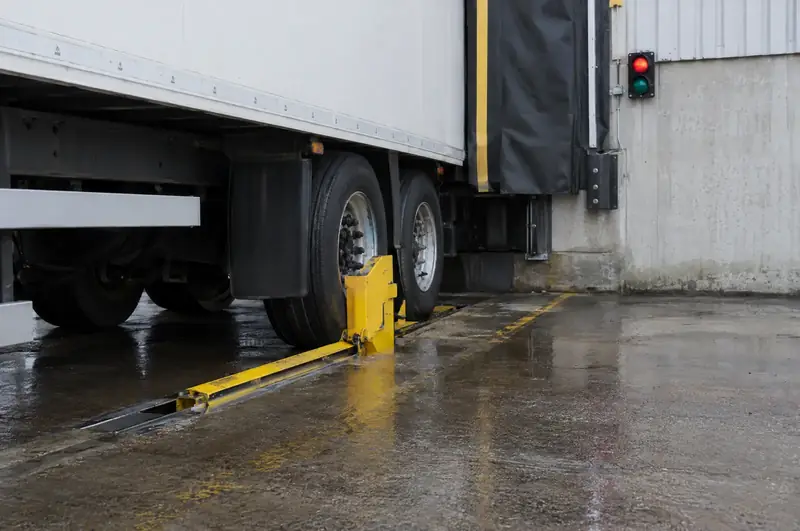
A vehicle restraint is a device at a loading bay that physically holds a trailer against the dock until it is safe to leave. In the UK most systems act on the rear wheel, either as a powered wheel-based restraint or a sensor wheel chock. Restraints guard against early drive-away and trailer creep, and are usually interlocked with the door and dock traffic lights.
Is this right for your site in Essex?
Third-party hauliers visiting sites in Essex may not know each site's procedures, so a restraint that holds the wheel removes reliance on every driver following instructions. Busy cross-dock and parcel operations in Essex with frequent trailer swaps have more chances for an early drive-away, which is where a physical restraint adds real protection.
Yards around Essex that park uncoupled trailers at the dock can see trailers creep under forklift traffic, and a wheel-based restraint helps keep the leveller lip on the bed.
Step one is a survey at your site in Essex, which costs nothing and carries no obligation. Step two is a written quote with a fixed price and a clear scope. Step three is installation, scheduled around your operation and carried out by specialist installation engineers working under our management, including evenings or weekends if agreed. Step four is handover, when the equipment is tested in front of you and the paperwork is passed over.
How does a vehicle restraint work with dock lights and interlocks?
A vehicle restraint is normally linked to the dock traffic lights and the door controls, so engaging the restraint is what allows loading to start.
A typical sequence looks like this:
- The trailer reverses on to the bay with the outside light on green and the door closed.
- The restraint engages the rear wheel. The outside light turns red for the driver and the inside light turns green for dock staff.
- The door can now be opened, and the leveller can only operate once the door is fully open.
- When loading is finished, the leveller is parked and the door closed before the restraint can release.
- The restraint releases, the outside light turns green and the driver can leave.
The exact interlocks depend on your equipment and risk assessment. See dock traffic lights and interlocks for the options on signals and control logic.
What is trailer creep and how does a restraint stop it?
Trailer creep is the gradual movement of a parked trailer away from the dock, caused by forklifts braking and accelerating as they drive on and off the trailer bed. Each movement pushes the trailer forward slightly, and over a full load the gap can grow.
Creep is more likely when:
- the trailer is uncoupled from its tractor unit and resting on its landing legs;
- air suspension or brakes have not been set correctly by the driver;
- forklifts are heavy, fast or carrying dense loads such as drinks or building materials;
- the yard falls slightly away from the building.
As the trailer moves, the leveller lip can lose its bearing on the trailer bed, and in the worst case the lip slips off with a forklift on it. A wheel-based restraint holds the wheel against the rail or chock, so the trailer cannot travel forward however many times a forklift drives on and off.
Towns we cover in Essex
We cover vehicle restraints throughout Essex, and the towns below each have their own page. If yours is not listed, get in touch anyway.
- Southend-on-Sea
- Basildon
- Colchester
- Chelmsford
- Harlow
- Grays
- Braintree
- Brentwood
- Clacton-on-Sea
- South Benfleet
- Canvey Island
- Billericay
- Rayleigh
- Stanford-le-Hope
- Wickford
- Witham
- Maldon
- Waltham Abbey
- South Ockendon
- Harwich
- Hadleigh
- Tilbury
Budget range for supply and fit. The written quote after a free survey is the fixed price. All guide prices.
Planning, building control and safety law in England
Powered doors and dock equipment installed in England may carry the UKCA or the CE mark, and doors are covered by the product standard BS EN 13241. We hand over the relevant documentation for each item fitted in Essex. Planning and Building Regulations questions are never assumed either way: we check what applies at survey, so you know before work is booked.
Questions
Can you work outside our normal operating hours in Essex?
Yes, by arrangement. Evening, night and weekend working can be planned so the installation causes as little disruption as possible to your loading schedule. Out-of-hours work can affect the price, so mention it at the survey and we will include it in the written quote. The agreed times are confirmed in the programme before the job starts.
How do you price vehicle restraints for a site in Essex?
Guide budgets for supply and fit are £4,200 to £9,800 per bay, excluding VAT. The figure moves with size, insulation, the operator, electrics, access, any pit or groundworks and out-of-hours working. Where levellers are involved, the guide assumes an existing, sound pit. After the free survey you receive a fixed written quote, and that is the price for the agreed scope.
Do vehicle restraints work with all trailers?
Wheel-based restraints and sensor chocks work with most trailers, because they act on the rear wheel rather than on the back of the vehicle. Vehicles with unusual wheel positions or very small wheels need checking, so we look at the vehicles you receive during the survey.
Is a vehicle restraint a legal requirement?
Not in every case: HSE guidance (followed by HSENI in Northern Ireland) says there should be safeguards against drivers driving away too early, and a vehicle restraint is one of the measures it lists. Traffic lights and the person in charge keeping keys or paperwork are the others. Which measures you use should follow your risk assessment. In Northern Ireland the regulator is HSENI.
Other services in Essex
Full guide to vehicle restraints · All loading bay services in Essex