
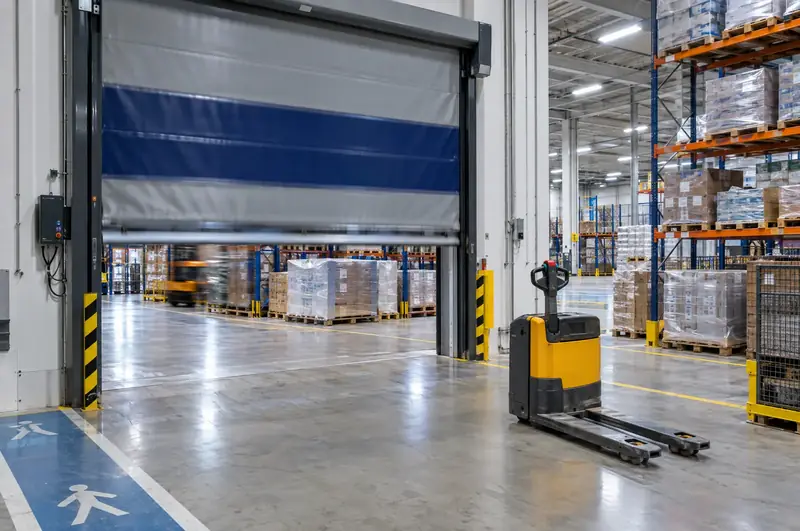
A high-speed dock door is a power-operated door with a flexible PVC fabric curtain that opens and closes much faster than a conventional sectional door or shutter, usually driven by a frequency-controlled motor. Many versions use a self-repairing curtain or breakaway bottom bar, so a forklift strike pushes the curtain out of its guides instead of wrecking it, and the door re-engages itself on the next cycle.
What does a high-speed dock door cost, and why does the price vary so much?
A high-speed dock door typically costs £6,500 to £14,500 per door, excluding VAT, supply and fit. The range is wide because each door is built to order, and an internal door between two zones is a very different product from one facing an exposed yard.
The main things that move the price are:
- Size and wind exposure: large external openings need reinforced curtains, wind bars or belts and heavier side frames.
- Curtain type: single-skin fabric costs less than an insulated double-skin curtain.
- Self-repair and breakaway features: worth paying for wherever forklifts pass through.
- Activation: radar, induction loops or pull cords, and how many control points are needed.
- Interlocks: links to an outer door, a leveller or traffic lights.
- Site works: power supply, removing an old door or strip curtain, and access equipment.
Our loading bay costs guide sets these figures alongside other dock equipment. After a free site survey you receive a fixed written price.
Which safety rules and standards apply to a high-speed door?
A high-speed door is a power-operated door, so it must protect people from being struck or trapped, and it should be designed and tested to the product and safety-in-use standards for powered doors.
- Workplace law: regulation 18 of the Workplace (Health, Safety and Welfare) Regulations 1992 in Great Britain, and the Workplace (Health, Safety and Welfare) Regulations (Northern Ireland) 1993, require powered doors to have suitable and effective features to prevent trapping. Where needed for health or safety, the door must be operable by hand unless it opens automatically on power failure.
- Standards: BS EN 13241 is the product standard for industrial doors, and BS EN 12453 covers safety in use of power-operated doors, including test methods.
- Marking: in Great Britain the door may carry the UKCA or the CE mark. In Northern Ireland the CE mark, or CE with UKNI, applies.
In practice that means a light curtain or photocells across the opening, a safe bottom edge and a manual release or crank. HSE enforces these duties in Great Britain, and HSENI in Northern Ireland.
Can a high-speed door be used on an external dock opening?
Yes, provided it is specified for the wind and weather the opening faces. Many high-speed doors are designed for internal openings, so an external dock door needs a reinforced build.
- Wind resistance: external doors use stronger curtains, horizontal wind bars or tensioned belts, and deeper side guides so the curtain stays put in gusts.
- Insulation: a double-skin curtain reduces heat loss, though fabric does not insulate as well as a thick sectional door.
- Security: fabric doors are not security doors, so many sites keep a sectional door or shutter outside for closing at night.
- Impact protection: a self-repairing curtain re-engages after a knock, which matters at a busy dock.
For openings that are mainly internal, such as between goods-in and a chilled zone, a lighter single-skin door with vision panels is usually enough. We match the build to the exposure at survey.
Which types and options are available?
Self-repairing curtain
If a forklift strikes the door, the curtain or bottom bar pulls out of the side guides without damage and re-engages on the next cycle, keeping the opening in use.
Insulated double-skin curtain
Two layers of fabric with an air gap or insulation between them, reducing heat or chill loss at openings between temperature zones or at external docks.
Wind-reinforced external build
Wind bars, tensioned belts and deeper guides keep the curtain in place at exposed external openings, so the door stays reliable when the yard is windy.
Radar, loop and pull-cord activation
Radar opens the door for approaching forklifts, induction loops respond to vehicles, and pull cords let drivers trigger the door without leaving the truck.
Vision panels
Clear sections set into the curtain so drivers and pedestrians can see each other through the closed door, which matters where forklift routes cross walkways.
Typical specification
| Opening speed | Typically around 1 to 2 m per second, depending on size and model |
|---|---|
| Curtain | Typically reinforced PVC fabric, single or double skin |
| Drive | Typically a frequency-controlled motor with soft start and stop |
| Safety devices | Typically a light curtain in the frame, safe bottom edge and manual release |
| Activation | Push button, pull cord, radar, induction loop or remote |
| Impact protection | Self-repairing curtain or breakaway bottom bar |
| Standards | BS EN 13241 product standard and BS EN 12453 safety in use |
Budget range for supply and fit. Your written quote after a free site survey is the fixed price. See all guide prices.
What does a high-speed door installation need from our site?
A high-speed door installation needs a sound opening to fix the side frames to, a suitable power supply near the door, and the opening taken out of use on the day of fitting.
Before we attend, please make sure:
- a dedicated supply with a local isolator is in place near the door head, or is included in our quote,
- the floor at the threshold is level, as the bottom edge needs a consistent landing,
- stock, racking and vehicles are cleared from both sides of the opening,
- your team has agreed where push buttons, pull cords or radar sensors should sit, based on traffic routes.
On site, engineers working under our management fit the frames and drive unit, hang the curtain, wire the control panel and light curtain, then set opening heights and speeds. Where the door sits behind an existing sectional door, we also wire the interlock so the two doors work in sequence.
Should a high-speed door replace our strip curtain or work alongside our dock door?
At very busy openings a high-speed door often replaces a strip curtain, and at external docks it usually works alongside a slower insulated door rather than replacing it.
Strip curtains are inexpensive, but they slow forklifts, scratch quickly and can hide a pedestrian on the other side. A high-speed door clears the opening fully, closes again within seconds and keeps a clear view through its vision panels. See PVC strip curtains if you are weighing up the two.
At external docks, a common arrangement is:
- an insulated sectional door on the outside for security and closing at night,
- a high-speed door just inside it for daytime traffic,
- an interlock so the high-speed door only runs when the outer door is open.
This pairing keeps the building secure out of hours while cutting the time the opening stands open during the working day.
What keeps a high-speed door reliable at a busy dock?
Servicing matched to the number of cycles is what keeps a high-speed door reliable, because these doors can open and close far more often in a shift than a conventional door.
- Duty cycle: check the drive is rated for the openings per hour your site actually runs, including peaks.
- Safety devices: the light curtain, photocells and bottom edge should be tested at every service.
- Curtain and guides: worn guide brushes, a stretched curtain or a damaged bottom bar cause misalignment and stoppages.
- Activation: poorly set radar can open the door for passing traffic, adding needless cycles and wear.
- Impact: repeated knocks shorten curtain life even when the door self-repairs, so look at traffic routes and driver habits.
Planned maintenance visits are chargeable and agreed in advance. Keeping a log of faults and knocks helps the engineer spot patterns before they stop the door.
When is this the right choice?
- Forklifts queue at an opening while a slow door or shutter finishes opening.
- Strip curtains are scratched, cloudy or torn and drivers cannot see through them.
- Heat or chill is escaping because a busy door stands open most of the shift.
- Your current fast door is damaged by impacts and has no self-repairing feature.
- You need to separate temperature zones without slowing internal forklift traffic.
How the job runs
- Free site survey
We look at opening size, wind exposure, traffic volumes and routes, power supply and any existing door or strip curtain, and how forklifts and pedestrians share the opening.
- Written quote
A fixed written price setting out curtain type, wind reinforcement, activation, safety devices, interlocks, power works and removal of any old door or curtain.
- Installation
Side frames, drive and curtain are fitted, the control panel and light curtain wired, and any interlock with an outer door connected, usually with the opening closed for a day.
- Testing and handover
Speeds, opening heights and activation zones are set and tested, safety devices checked, and your team shown how to use the manual release if the power fails.
High-speed dock doors: questions
How fast does a high-speed door open?
Many dock and internal high-speed doors open at around 1 to 2 metres per second, so a typical opening clears in a few seconds. Speed depends on the size, the drive and whether the door is built for wind. Closing speed is usually set slower than opening for safety, and both are adjusted at handover.
What happens if a forklift hits a high-speed door?
On a door with a self-repairing curtain or breakaway bottom bar, the curtain is pushed out of its guides and re-engages on the next cycle, usually with no repair needed. Repeated hard impacts still wear the curtain and guides, so knocks should be logged and checked at the next service visit.
Can a high-speed door be opened in a power cut?
Yes, a high-speed door should have a manual release, crank or counterbalance so it can be opened if the power fails. This reflects the workplace rule that powered doors must be operable by hand where needed for health or safety, unless they open automatically on power failure.
Is a high-speed door secure enough to be the only door at a dock?
Usually not on an external dock. Fabric curtains are designed for speed and draught control rather than security, so most sites keep an insulated sectional door or shutter on the outside for closing at night. Some rigid high-speed designs give more security, and we can discuss them where a single door is needed.
Do high-speed doors help with temperature control?
Yes, by cutting the time the opening is left open, a high-speed door reduces the warm or chilled air that escapes. It closes behind each forklift instead of standing open between movements. An insulated curtain adds some thermal resistance, but the main gain comes from shorter open times rather than the curtain itself.
How often should a high-speed door be serviced?
Service frequency should follow how hard the door works, and a busy high-speed door usually needs more visits than a quiet sectional door. We agree a schedule based on cycles per day, the manufacturer's recommendations and any history of impacts. Every visit should include a check of the light curtain, photocells and bottom edge.
Related equipment and services
Further reading
High-speed dock doors by area
England
- Bedfordshire
- Berkshire
- Buckinghamshire
- Cambridgeshire
- Cheshire
- City and County of Bristol
- Cornwall
- County Durham
- Cumbria
- Derbyshire
- Devon
- Dorset
- East Riding of Yorkshire
- East Sussex
- Essex
- Gloucestershire
- Greater London
- Greater Manchester
- Hampshire
- Herefordshire
- Hertfordshire
- Isle of Wight
- Kent
- Lancashire
- Leicestershire
- Lincolnshire
- Merseyside
- Norfolk
- North Yorkshire
- Northamptonshire
- Northumberland
- Nottinghamshire
- Oxfordshire
- Rutland
- Shropshire
- Somerset
- South Yorkshire
- Staffordshire
- Suffolk
- Surrey
- Tyne and Wear
- Warwickshire
- West Midlands
- West Sussex
- West Yorkshire
- Wiltshire
- Worcestershire