
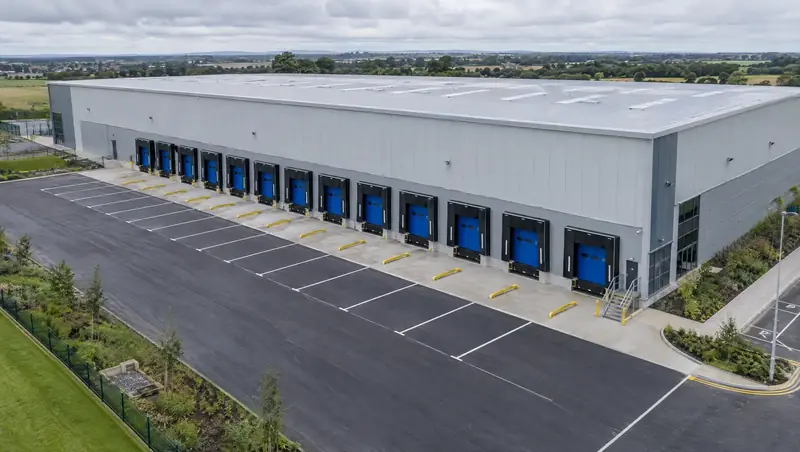
A complete loading bay installation is the supply and fitting of every item a dock needs as one coordinated package: typically an insulated door, a dock leveller, a shelter or seal, bumpers, wheel guides, a dock light and traffic lights or interlocks. One party manages the design, sequence and commissioning, so the parts fit together and work as a single system.
How much does a complete loading bay cost?
A complete loading bay typically costs £13,500 to £26,000 per bay, supplied and installed, excluding VAT. That covers the door, leveller, shelter or seal and core safety items, and assumes a sound structural opening and an existing or separately formed leveller pit.
What moves the price:
- Door type: an insulated sectional door costs less than a high-speed or cold store door.
- Leveller type: telescopic-lip levellers cost more than swing-lip.
- Shelter or seal: inflatable shelters sit at the top of the range.
- Safety package: restraints, traffic lights and interlocks add to the base bay.
- Number of bays: repeat bays on one project lower the cost per bay.
- Programme: phased or out-of-hours working in a live building adds cost.
New pits, pit repairs, concrete and groundworks are priced separately after survey. Following a free site survey, the written quote is the fixed price. VAT is added at the standard rate.
What regulations and standards apply to a new loading bay?
A new loading bay has to meet door safety law, work equipment law and, for the door, energy rules. The main references are:
- Doors: regulation 18 of the Workplace (Health, Safety and Welfare) Regulations 1992 (Northern Ireland: the 1993 equivalent). Upward-opening doors need a device to stop them falling back, and powered doors need features to prevent trapping. Doors are made to BS EN 13241, with powered door safety covered by BS EN 12453.
- Levellers: BS EN 1398:2009, the dock leveller safety standard.
- All dock equipment: PUWER 1998, or PUWER (Northern Ireland) 1999, requiring suitable, maintained and inspected work equipment.
- Drive-away: HSE guidance (HSG136) says there should be safeguards against early drive-away, such as traffic lights, restraints or key control.
- Energy: in England, Approved Document L (2021) Volume 2 sets a limiting U-value of 1.3 W/m²K for vehicle access doors. Other nations have their own rules, and we confirm the figure for your project.
Equipment in Great Britain may carry UKCA or CE marking; in Northern Ireland, CE or CE with UKNI.
How do you choose the right equipment for each bay?
The right equipment for each bay comes from three questions: what vehicles arrive, what goods move through the door, and how many trailers the bay handles each day. The answers drive each choice:
- Vehicles: trailer bed heights commonly range from about 900 to 1,600 mm, which sets leveller length. Trailers that cannot reverse tight to the dock, or need end-loading, suit a telescopic lip.
- Goods: chilled and frozen goods need a well-insulated door and a tight seal or inflatable shelter; ambient goods usually suit a retractable shelter.
- Traffic: very busy bays may justify faster doors and heavier-duty levellers, plus restraints and interlocks.
- Building: a pit leveller, an edge-of-dock leveller or a loading house, depending on floor height and space.
Not every bay on a site needs the same kit. One bay with a lift table or a telescopic lip can handle the awkward vehicles. Our guide to specifying the dock package for a new warehouse walks through the decisions.
Which types and options are available?
Standard ambient bay
Insulated sectional door, hydraulic swing-lip leveller, retractable shelter, bumpers, wheel guides and a dock light. Suits general distribution and manufacturing docks handling mixed trailer types.
Chilled or frozen bay
A well-insulated door, inflatable shelter or foam seal and a leveller suited to low temperatures, specified to keep cold air in and warm, moist air out.
High-throughput bay
A faster door, telescopic-lip leveller and vehicle restraint with interlocked traffic lights, for docks handling many trailers a day and where drive-away risk is high.
Safety pack add-on
Vehicle restraint, inside and outside traffic lights and interlocks between door, leveller and restraint, added to any bay specification as part of the same package.
Typical specification
| Typical scope | door, leveller, shelter or seal, bumpers, wheel guides and dock light |
|---|---|
| Door | typically an insulated sectional door around 3.0 m wide |
| Leveller | typically a hydraulic swing-lip or telescopic-lip leveller |
| Pit and groundworks | priced separately after survey unless already in place |
| Controls | typically a combined bay panel with optional interlocks |
| Handover | commissioning and test records with operating information for each bay |
| Guide price | £13,500 to £26,000 per bay, ex VAT, supply and fit |
Budget range for supply and fit. Your written quote after a free site survey is the fixed price. See all guide prices.
How is a complete bay coordinated with civils and electrics?
A complete bay is coordinated by issuing pit, dock face and electrical details early, so the groundworker, main contractor and electrician build exactly what the equipment needs. Most problems on new docks come from mismatches between trades, not from the equipment itself.
- Drawings: we provide pit dimensions, steel edge details, drainage points and dock face levels for each bay.
- Civils: the groundworker forms the pits, approach and dock face to those drawings, or the leveller is set in place for concrete to be poured around it.
- Building envelope: the main contractor forms the openings and cladding to suit the door and shelter sizes.
- Electrics: the electrician brings a supply to the agreed control panel position at each bay.
- Equipment: leveller, door, shelter and safety items are fitted in sequence, then commissioned together.
The quote states clearly which items are ours and which belong to other trades. See our guide to loading bay design for dock heights, widths and approaches.
What happens on site during a complete bay installation?
On a new build, a complete bay is installed to the main contractor's programme once the pits, openings and supplies are ready. In an operating warehouse, bays are replaced one at a time so the rest of the dock keeps working.
- Isolation: each bay is closed to trailers and its old equipment isolated and removed.
- Security: the opening is kept secure, either by fitting the new door early or with temporary hoarding.
- Lifting and deliveries: levellers and door sections need a clear delivery area and safe lifting.
- Commissioning: the door, leveller, shelter and controls are tested together, including any interlocks.
We ask you to provide access and a delivery area, power and welfare arrangements on construction sites, permit-to-work and induction details, and an agreed order for releasing bays. At handover you receive commissioning and test records, operating instructions and maintenance requirements. Equipment comes with the manufacturer's warranty, and workmanship terms are set out in writing in the quote.
Why buy the door, leveller and shelter as one package?
Buying the door, leveller and shelter as one package gives a single point of responsibility for how the bay works as a whole. When three suppliers each fit their own item, the gaps between them are nobody's job.
Typical problems a package avoids:
- a shelter head curtain that does not line up with the door header;
- a leveller width that does not suit the door opening or the trailers;
- bumper projection that leaves the dock seal too loose or crushed flat;
- door and leveller controls that cannot be interlocked because they were never designed to talk to each other;
- several handover packs and service schedules for one bay.
A package also makes multi-bay sites consistent. Every bay works the same way, staff learn one routine, and planned maintenance can cover the whole dock in one visit. For new warehouses it gives the main contractor one specialist to coordinate with instead of several.
When is this the right choice?
- You are fitting out a new warehouse or unit and need every dock specified together.
- An existing bay has a door, leveller and shelter all near the end of their life.
- Previous trades left gaps, such as shelters that do not match the door opening.
- You want one quote, one programme and one handover for several identical bays.
- Your operation is changing, for example moving from ambient to chilled goods.
How the job runs
- Site survey
We review drawings or the existing building, the vehicles and goods you handle and the programme, then agree an equipment schedule for every bay.
- Written quote
You receive a written quote and drawings for each bay, showing what is included and what other trades provide. The survey and quote are free and without obligation.
- Installation
Equipment is fitted in sequence once pits, openings and supplies are ready, bay by bay in live buildings so the dock keeps running.
- Testing and handover
Door, leveller, shelter and controls are commissioned together, staff are shown the routine and records and operating information are handed over for each bay.
Complete loading bay installation: questions
What is included in a complete loading bay package?
A complete loading bay package typically includes the door, leveller, shelter or seal, bumpers, wheel guides and a dock light. Vehicle restraints, traffic lights and interlocks can be added. Pits, concrete and groundworks are priced separately unless agreed otherwise, and the quote lists exactly what is included.
Do you work with main contractors on new builds?
Yes. On new warehouses we work as the specialist dock package contractor to the main contractor's programme. We provide pit, dock face and electrical details early so the groundworks and building envelope are built to suit the equipment, then install and commission each bay.
Can you replace a whole bay in an operating warehouse?
Yes. In a live building we replace one bay at a time, keeping the opening secure and the neighbouring bays working. The order and timing of each bay are agreed with you so the dock keeps enough capacity throughout the works.
Who forms the leveller pit?
The leveller pit is usually formed by the groundworker or main contractor to our drawings. Where there is no groundworker on site, we can arrange the pit works as part of the project, priced separately after survey. Either way, the pit details come from the leveller chosen for the bay.
Do all bays on a site need the same equipment?
No. Many sites keep most bays on a standard specification and fit one or two bays differently, for example with a telescopic lip for end-loading or a lift table for vans. Keeping a common door, control and shelter type where possible makes training and servicing simpler.
What paperwork do we receive at handover?
At handover you receive commissioning and test records, operating instructions and the maintenance requirements for each item. Equipment comes with the manufacturer's warranty, and our workmanship terms are those set out in writing in the quote. These records also help with insurer inspections later.
Related equipment and services
Further reading
Complete loading bay installation by area
England
- Bedfordshire
- Berkshire
- Buckinghamshire
- Cambridgeshire
- Cheshire
- City and County of Bristol
- Cornwall
- County Durham
- Cumbria
- Derbyshire
- Devon
- Dorset
- East Riding of Yorkshire
- East Sussex
- Essex
- Gloucestershire
- Greater London
- Greater Manchester
- Hampshire
- Herefordshire
- Hertfordshire
- Isle of Wight
- Kent
- Lancashire
- Leicestershire
- Lincolnshire
- Merseyside
- Norfolk
- North Yorkshire
- Northamptonshire
- Northumberland
- Nottinghamshire
- Oxfordshire
- Rutland
- Shropshire
- Somerset
- South Yorkshire
- Staffordshire
- Suffolk
- Surrey
- Tyne and Wear
- Warwickshire
- West Midlands
- West Sussex
- West Yorkshire
- Wiltshire
- Worcestershire