
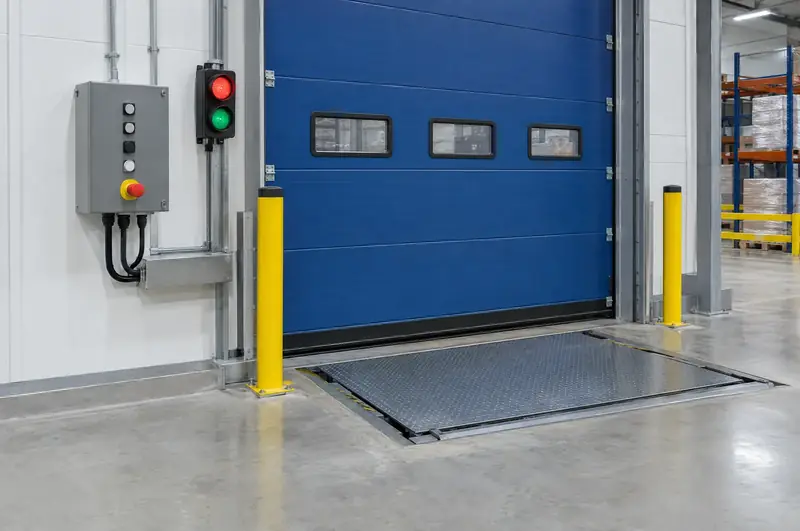
Dock traffic lights are red and green signals mounted outside and inside a loading bay to tell the driver and dock staff when it is safe to move or load. Interlocks are control links that stop equipment operating out of sequence, for example preventing the door opening until the trailer is restrained, or the leveller operating until the door is fully open.
How much do dock traffic lights and interlocks cost?
Dock traffic lights and interlocks typically cost £650 to £3,400 per bay, supplied and fitted, excluding VAT. A pair of manually switched LED signals sits at the lower end, while a full interlock panel linking door, leveller, restraint and shelter sits towards the top.
What moves the price:
- Level of control: standalone lights, door-linked lights or a full interlocked sequence.
- Existing control panels: modern door and leveller panels often accept interlocks directly; older panels may need replacing with a combined bay panel.
- Sensors: door position switches, trailer presence sensors and restraint signals each add parts and wiring.
- Cable runs: distances between lights, panels and the power supply.
- Number of bays and timing: repeat bays reduce the cost per bay, while out-of-hours working adds to it.
These are guide budgets. After a free site survey we send a written quote, and that quote is the fixed price. VAT is added at the standard rate.
What does HSE guidance say about stopping drivers leaving too early?
HSE guidance (followed by HSENI in Northern Ireland) says there should be safeguards against drivers driving away from a loading bay too early, and it names traffic lights as one of the measures. Vehicle or trailer restraints, and the person in charge keeping keys or paperwork until it is safe, are the others listed in HSE's guide to workplace transport safety (HSG136) and its loading factsheet.
Traffic lights are a signal, not a physical barrier, so they work best as part of a clear procedure or alongside a restraint. Your risk assessment should decide the combination. In Northern Ireland the regulator is HSENI.
Interlocks also touch on door safety law. Under regulation 18 of the Workplace (Health, Safety and Welfare) Regulations 1992, or the Northern Ireland 1993 equivalent, powered doors need suitable and effective features to prevent them trapping anyone. Interlocks must never bypass those features, and door control work should respect BS EN 12453, the standard for safety in use of power-operated doors.
Read more in our guide to preventing drive-away and trailer creep.
How do inside and outside dock traffic lights work together?
Inside and outside dock lights always show opposite colours: when the driver sees red, dock staff see green, and the other way round. Each light is aimed at a different person, so each one only ever gives one instruction.
- Outside light, facing the driver: red means stay on the bay because loading is in progress; green means the bay is clear to leave or to reverse on to.
- Inside light, facing dock staff: green means the trailer is in place and it is safe to open the door and load; red means do not open the door or enter the trailer.
Lights can be switched in three main ways:
- Manually, by a switch beside the door, relying on dock staff to change it at the right moment.
- By door position, so opening the door automatically turns the outside light red.
- By the restraint, so the light only changes when the trailer is physically held.
Which types and options are available?
Standalone LED traffic lights
A red and green pair for each bay, one outside for the driver and one inside for dock staff, switched manually from a control beside the door.
Door-linked lights
Lights that change automatically with the door position, using a door switch or a signal from the door control panel, so the outside light turns red as the door opens.
Restraint interlock package
Door, lights and vehicle restraint tied together so the door only opens once the trailer is held and the restraint only releases when loading is finished.
Full bay interlock panel
A single control panel that runs the door, leveller, restraint and shelter in the correct sequence, with indicators showing which step is active or blocked.
Trailer presence sensors
Sensors that detect a trailer on the bay, used to switch lights, enable the door or trigger an inflatable shelter where no restraint is fitted.
Typical specification
| Lamp type | typically LED red and green signals |
|---|---|
| Signals per bay | typically one outside for the driver and one inside for dock staff |
| Switching | typically manual, door-linked or restraint-linked |
| Interlocks available | door, leveller, vehicle restraint and inflatable shelter |
| Control panel | typically a combined bay panel or links into existing door and leveller panels |
| Driver signage | typically a sign beside the outside light explaining each colour |
| Guide price | £650 to £3,400 per bay, ex VAT, supply and fit |
Budget range for supply and fit. Your written quote after a free site survey is the fixed price. See all guide prices.
Which interlocks should a loading bay have?
The most useful loading bay interlocks stop the door opening until the trailer is in place or restrained, and stop the leveller operating until the door is fully open. Beyond that, the right set depends on the equipment fitted and your risk assessment.
- Door to restraint: the door cannot open until the restraint is engaged or a trailer is detected.
- Leveller to door: the leveller cannot be raised until the door is fully open, which prevents the lip hitting door panels.
- Door to leveller: the door cannot close until the leveller is back in its parked position.
- Restraint release: the restraint only releases once the door is closed and the leveller parked.
- Shelter to trailer: an inflatable shelter only inflates when a trailer is docked.
On a bay without a restraint, a trailer presence sensor can take its place in the door logic, although it confirms a trailer is there rather than holding it. Combining interlocks with vehicle restraints gives the strongest protection against drive-away.
What happens on site when traffic lights and interlocks are fitted?
Fitting lights and interlocks is mainly electrical work, and each bay is out of use while its controls are connected and tested. Working bay by bay keeps the rest of the dock running.
- Fix the signals: the outside light is mounted on brackets at a height drivers can see, and the inside light beside the door.
- Run the cables: wiring is run in conduit or trunking between lights, sensors and control panels.
- Isolate and connect: the door and leveller supplies are isolated and locked off while the interlock wiring is connected, or a new bay panel is fitted.
- Test every sequence: each interlock is tested, including what happens if a step is attempted out of order.
- Brief staff: dock staff are shown the new sequence, and signs are fitted for drivers.
It helps if you can provide any electrical drawings for the dock, access to the distribution board, a person who can authorise isolations and an agreed order for releasing bays.
Can traffic lights and interlocks be added to older loading bays?
Yes, traffic lights and interlocks can be added to most older loading bays, although some need new control panels before the interlocks can work.
- Manual doors: a door position switch can confirm the door is fully open or closed, which lets lights and leveller interlocks work even without a motor.
- Older powered doors and levellers: basic control boxes may not have connections for interlocks, so a combined bay panel can replace separate controls.
- Mixed equipment: doors and levellers from different suppliers can usually be brought under one interlock panel, so every bay works the same way.
Interlocks cannot make faulty equipment safe. If a door or leveller has a defect, it should be repaired before interlocks are added, and the survey will flag anything we find. Upgrading lights and interlocks at the same time as replacing a door or leveller is often the most economical moment to do it.
When is this the right choice?
- Drivers rely on hand signals or knocks on the cab to know when they can pull away.
- Your dock door can be opened before a trailer is in place or restrained.
- Levellers have been raised with the door only part open, damaging door panels.
- You are fitting vehicle restraints and need signals that confirm the trailer is held.
- An insurer, auditor or risk assessment has asked for clearer loading bay controls.
How the job runs
- Site survey
We check each bay's door, leveller and any restraint, look inside the existing control panels and agree where lights and sensors need to go for drivers and staff.
- Written quote
You receive a written quote setting out the lights, interlocks and any new panels for each bay. The site survey and quote are free and without obligation.
- Installation
Signals are fixed, cables run and each bay is isolated in turn while the interlocks are connected, so the rest of the dock keeps working.
- Testing and handover
Every interlock is tested in and out of sequence, dock staff are briefed on the new routine and driver signs are fitted before the bay reopens.
Dock traffic lights and interlocks: questions
Are dock traffic lights enough on their own to stop drive-away?
Traffic lights on their own are a signal, not a physical barrier, so they depend on drivers obeying them. HSE lists traffic lights among the measures against early drive-away, and many sites combine them with key or paperwork control or with a vehicle restraint. The right combination should come from your workplace transport risk assessment.
Which way round do the inside and outside lights work?
The inside and outside lights always show opposite colours. While a trailer is being loaded, the outside light is red so the driver stays put and the inside light is green so staff can work. When loading is finished and the door is closed, the inside light turns red and the outside light turns green for the driver.
Can interlocks be fitted to a manual loading bay door?
Yes. A door position switch fitted to a manual door can confirm when it is fully open or fully closed. That signal lets the traffic lights change automatically and stops the leveller being raised until the door is out of the way.
Will interlocks slow down my loading operation?
Interlocks add a fixed sequence, but each step takes only moments and staff soon get used to it. In practice many sites find the sequence saves time overall, because there are fewer arguments about when to open the door and less damage from levellers being raised into part-open doors.
Do traffic lights and interlocks need maintenance?
Yes. Lights, sensors and interlocks should be checked at each planned service visit, including testing the full sequence and confirming that steps attempted out of order are blocked. As part of the dock equipment they fall under PUWER, which requires work equipment to be maintained in a safe condition.
Can you add lights and interlocks across a whole dock in one project?
Yes. A whole-dock project is usually phased bay by bay so most doors stay in use, and every bay ends up on the same control standard. That consistency makes training easier for staff and drivers, and it simplifies servicing because every bay behaves in the same way.
Related equipment and services
Further reading
Dock traffic lights and interlocks by area
England
- Bedfordshire
- Berkshire
- Buckinghamshire
- Cambridgeshire
- Cheshire
- City and County of Bristol
- Cornwall
- County Durham
- Cumbria
- Derbyshire
- Devon
- Dorset
- East Riding of Yorkshire
- East Sussex
- Essex
- Gloucestershire
- Greater London
- Greater Manchester
- Hampshire
- Herefordshire
- Hertfordshire
- Isle of Wight
- Kent
- Lancashire
- Leicestershire
- Lincolnshire
- Merseyside
- Norfolk
- North Yorkshire
- Northamptonshire
- Northumberland
- Nottinghamshire
- Oxfordshire
- Rutland
- Shropshire
- Somerset
- South Yorkshire
- Staffordshire
- Suffolk
- Surrey
- Tyne and Wear
- Warwickshire
- West Midlands
- West Sussex
- West Yorkshire
- Wiltshire
- Worcestershire