
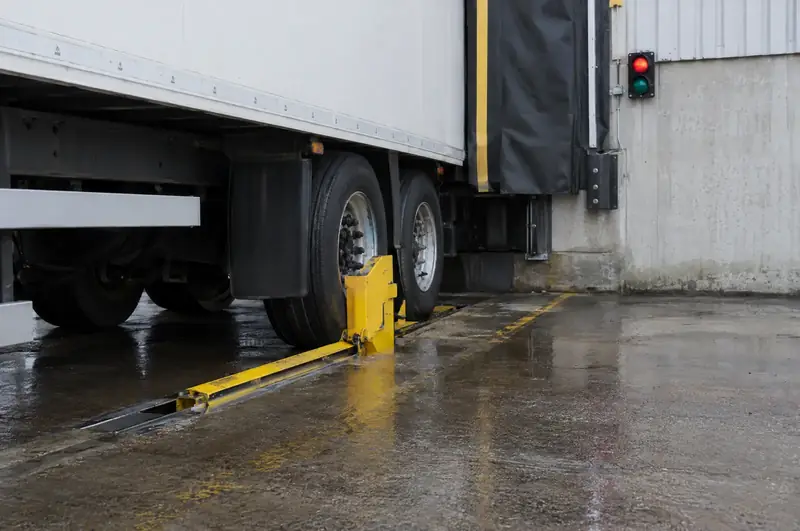
A vehicle restraint is a device at a loading bay that physically holds a trailer against the dock until it is safe to leave. In the UK most systems act on the rear wheel, either as a powered wheel-based restraint or a sensor wheel chock. Restraints guard against early drive-away and trailer creep, and are usually interlocked with the door and dock traffic lights.
Why do sites in Greater London choose this?
Multi-tenant logistics parks around Greater London can benefit from restraints when several tenants share yard space and trailers from different fleets arrive throughout the day. Busy cross-dock and parcel operations in Greater London with frequent trailer swaps have more chances for an early drive-away, which is where a physical restraint adds real protection.
Yards around Greater London that park uncoupled trailers at the dock can see trailers creep under forklift traffic, and a wheel-based restraint helps keep the leveller lip on the bed.
For vehicle restraints in Greater London, we begin with a free site survey and a fixed written quote, so you know the scope and cost before committing. We take responsibility for managing the job, and specialist installation engineers carry it out under our supervision. Bays are taken out of use in a planned sequence so the rest of the dock keeps working, and evening or weekend work can be arranged. Each item is tested at handover and the documentation is left with you.
What does HSE guidance say about preventing drive-away?
HSE guidance says there must be safeguards to stop drivers driving away from a loading bay too early, and it lists vehicle or trailer restraints as one of the measures. The others it names are traffic lights and the person in charge keeping the vehicle keys or paperwork until it is safe to leave.
This comes from HSE's guide to workplace transport safety (HSG136) and its loading and unloading factsheet. The guidance sets out the outcome rather than one fixed solution, so the right combination for your site should follow your own risk assessment.
Once fitted, a restraint is work equipment under the Provision and Use of Work Equipment Regulations 1998 (PUWER), so it must be suitable, maintained in a safe condition and inspected where deterioration could lead to danger. In Northern Ireland the equivalent is PUWER (Northern Ireland) 1999, and the regulator is HSENI rather than HSE.
Our guide to preventing drive-away and trailer creep compares the options side by side.
How much does a vehicle restraint cost?
A vehicle restraint typically costs £4,200 to £9,800 per bay, supplied and installed, excluding VAT. Sensor wheel chocks linked to the dock controls usually sit towards the lower end, and fully automatic wheel-based restraints with rail and interlocks towards the upper end.
What moves the price:
- Restraint type: a sensor chock needs far less hardware and groundwork than a powered, rail-mounted wheel restraint.
- Yard condition: rail-mounted units need a sound, level concrete apron. Broken concrete or tarmac may need a new base, priced after survey.
- Cabling: the distance from the restraint to the dock control panel, and whether ducts must be cut into the yard.
- Integration: linking to existing door and leveller controls is simpler on modern panels; older panels may need replacing.
- Number of bays and working hours: several bays in one project spread set-up costs, while out-of-hours work adds cost.
All figures are guide budgets. After a free site survey we send a written quote, and that quote is the fixed price. VAT is added at the standard rate.
Towns we cover in Greater London
We take enquiries about vehicle restraints from across Greater London. These are the towns with their own pages:
- Barking
- Sutton
- Croydon
- Ilford
- Enfield
- Harrow
- Tottenham
- Walthamstow
- Dagenham
- Romford
- Hayes
- Wembley
- Edmonton
- Southall
- Uxbridge
- Hounslow
- Feltham
- Acton
- Greenford
- Thamesmead
- Barnet
- South Ruislip
- Harringay
- Enfield Lock
- Stepney
- Worcester Park
- Beckton
- Erith
- Park Royal
- Rainham
Budget range for supply and fit. The written quote after a free survey is the fixed price. All guide prices.
Which rules apply in England?
Powered doors and dock equipment installed in England may carry the UKCA or the CE mark, and doors are covered by the product standard BS EN 13241. We hand over the relevant documentation for each item fitted in Greater London. Planning and Building Regulations questions are never assumed either way: we check what applies at survey, so you know before work is booked.
Questions
Is the site survey in Greater London free?
Yes. For new installations, replacements, upgrades, conversions and complete bays, the site survey and written quote are free and come with no obligation. The survey lets us measure the openings, check the dock and structure, and understand how the bay is used, so the quote reflects your site. Repair and servicing visits are different: they are chargeable, with the price agreed before anyone attends.
What details do you need from us to quote for vehicle restraints?
To get started, send the site address in Greater London, the number of bays or openings, approximate sizes, and photos of the dock from inside and outside. Tell us what vehicles you load, what goods you handle and any temperature requirements. Drawings help on new builds. We then arrange the free survey and confirm the details before the written quote is issued.
Is a vehicle restraint a legal requirement?
Not in every case: HSE guidance (followed by HSENI in Northern Ireland) says there should be safeguards against drivers driving away too early, and a vehicle restraint is one of the measures it lists. Traffic lights and the person in charge keeping keys or paperwork are the others. Which measures you use should follow your risk assessment. In Northern Ireland the regulator is HSENI.
Do vehicle restraints work with all trailers?
Wheel-based restraints and sensor chocks work with most trailers, because they act on the rear wheel rather than on the back of the vehicle. Vehicles with unusual wheel positions or very small wheels need checking, so we look at the vehicles you receive during the survey.
Other services in Greater London
Full guide to vehicle restraints · All loading bay services in Greater London