
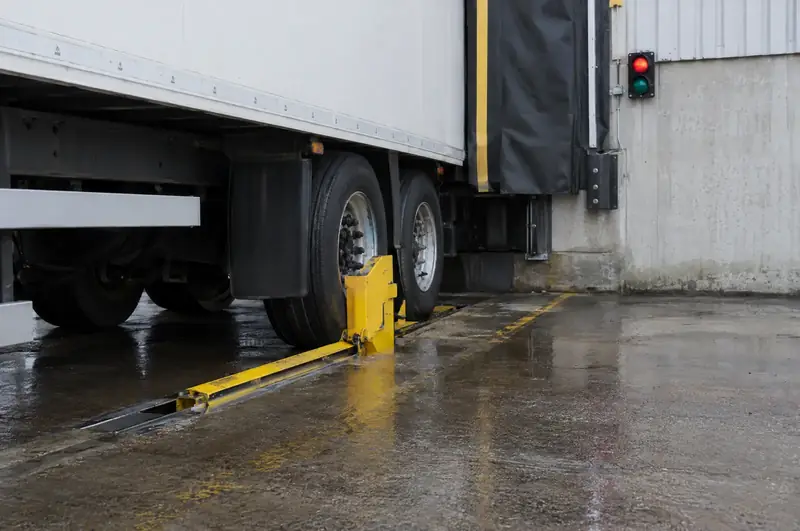
A vehicle restraint is a device at a loading bay that physically holds a trailer against the dock until it is safe to leave. In the UK most systems act on the rear wheel, either as a powered wheel-based restraint or a sensor wheel chock. Restraints guard against early drive-away and trailer creep, and are usually interlocked with the door and dock traffic lights.
What should sites in Devon consider?
Third-party hauliers visiting sites in Devon may not know each site's procedures, so a restraint that holds the wheel removes reliance on every driver following instructions. Restraint systems for sites in Devon are surveyed, quoted and installed in the same way as anywhere else in the UK, with a fixed price set out in writing.
Operators in Devon reviewing their workplace transport risk assessment often look at restraints when key control alone has proved hard to enforce across shifts.
If you are planning vehicle restraints for a site in Devon, expect four stages. A free survey and fixed written quote come first. We then agree a programme with you, including any out-of-hours work. Specialist installation engineers carry out the installation under our management, with us as your single point of contact. Finally, the equipment is tested, your staff are shown how it works and everything is handed over with its documentation.
How much does a vehicle restraint cost?
A vehicle restraint typically costs £4,200 to £9,800 per bay, supplied and installed, excluding VAT. Sensor wheel chocks linked to the dock controls usually sit towards the lower end, and fully automatic wheel-based restraints with rail and interlocks towards the upper end.
What moves the price:
- Restraint type: a sensor chock needs far less hardware and groundwork than a powered, rail-mounted wheel restraint.
- Yard condition: rail-mounted units need a sound, level concrete apron. Broken concrete or tarmac may need a new base, priced after survey.
- Cabling: the distance from the restraint to the dock control panel, and whether ducts must be cut into the yard.
- Integration: linking to existing door and leveller controls is simpler on modern panels; older panels may need replacing.
- Number of bays and working hours: several bays in one project spread set-up costs, while out-of-hours work adds cost.
All figures are guide budgets. After a free site survey we send a written quote, and that quote is the fixed price. VAT is added at the standard rate.
How does a vehicle restraint work with dock lights and interlocks?
A vehicle restraint is normally linked to the dock traffic lights and the door controls, so engaging the restraint is what allows loading to start.
A typical sequence looks like this:
- The trailer reverses on to the bay with the outside light on green and the door closed.
- The restraint engages the rear wheel. The outside light turns red for the driver and the inside light turns green for dock staff.
- The door can now be opened, and the leveller can only operate once the door is fully open.
- When loading is finished, the leveller is parked and the door closed before the restraint can release.
- The restraint releases, the outside light turns green and the driver can leave.
The exact interlocks depend on your equipment and risk assessment. See dock traffic lights and interlocks for the options on signals and control logic.
Towns we cover in Devon
Find your town in the list below for details of vehicle restraints across Devon, or contact us if your location is not shown.
Budget range for supply and fit. The written quote after a free survey is the fixed price. All guide prices.
Regulations and approvals in England
Workplace safety in England is regulated by HSE. For a loading bay in Devon, that means doors meeting regulation 18 of the Workplace (Health, Safety and Welfare) Regulations 1992, equipment maintained under PUWER and suitable safeguards against vehicles driving away too early. We check what applies at survey and design the bay accordingly.
Questions
Can you work outside our normal operating hours in Devon?
Yes, by arrangement. Evening, night and weekend working can be planned so the installation causes as little disruption as possible to your loading schedule. Out-of-hours work can affect the price, so mention it at the survey and we will include it in the written quote. The agreed times are confirmed in the programme before the job starts.
Will you deal with building control and planning for a project in Devon?
We check at survey whether the work is likely to need approval. Forming a new opening or dock pit may need Building Regulations approval, a building warrant or building control approval, depending on the nation, and external structures such as loading houses can need planning permission. Where approval is needed, we explain what is involved, work with your designer or agent, and build it into the programme.
Is a vehicle restraint a legal requirement?
Not in every case: HSE guidance (followed by HSENI in Northern Ireland) says there should be safeguards against drivers driving away too early, and a vehicle restraint is one of the measures it lists. Traffic lights and the person in charge keeping keys or paperwork are the others. Which measures you use should follow your risk assessment. In Northern Ireland the regulator is HSENI.
Can a vehicle restraint be fitted to an existing bay?
Yes, restraints are commonly retrofitted to existing bays. The main questions are whether the yard concrete in front of the bay is sound enough to anchor a rail, how cables will reach the dock controls, and whether the existing door and leveller panels can accept interlocks. Sensor chocks are often chosen where groundwork needs to be kept to a minimum.
Other services in Devon
Full guide to vehicle restraints · All loading bay services in Devon