
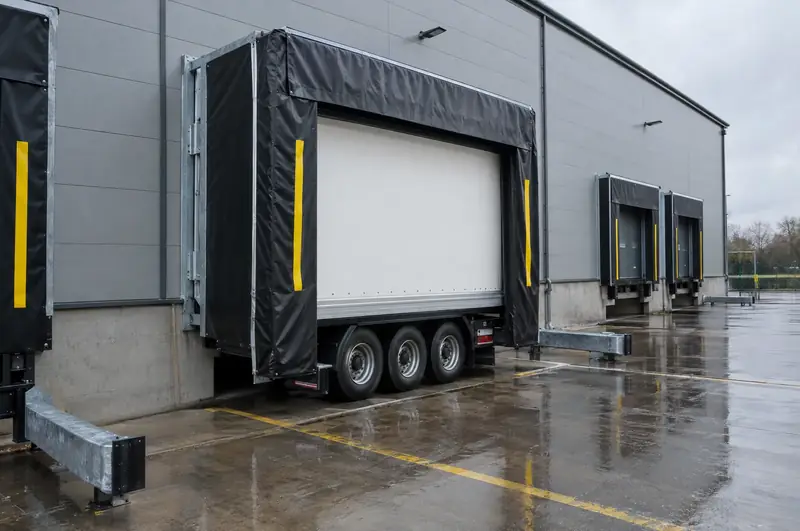
A retractable dock shelter is a fabric shelter fixed to the building around a loading bay door, with flexible top and side curtains carried on a sprung or pantograph steel frame. When a trailer reverses in, the frame retracts and the curtains drape against the trailer's sides and roof, closing most of the gap while leaving the full width of the trailer opening clear for loading.
How much does a retractable dock shelter cost?
A retractable dock shelter typically costs £1,900 to £4,400 per shelter, excluding VAT, supply and fit. Most of the variation comes from size, projection and the curtain specification.
- Size: width and height, set by your door and the largest trailers you receive.
- Projection: deeper shelters cost more but leave room for opened trailer doors and the leveller lip.
- Curtains: heavier-grade fabrics, slit side curtains, adjustable top curtains and guide stripes.
- Frame: sprung, pantograph or rigid, in a galvanised or painted finish.
- Fixings: fixing to cladding usually needs a steel subframe or spreader plates.
- Access and removal: powered access equipment in the yard, and taking down an old shelter.
On an older shelter with a sound frame, new curtains may be all that is needed, and we will say so if that is the case. Every price is fixed in the written quote after a free site survey.
What regulations and permissions apply to a dock shelter?
A dock shelter is work equipment, so it must be suitable and kept in a safe condition, and on some projects planning, building control or landlord consent also needs checking. What applies depends on the nation and the scope of work.
- Equipment duties: PUWER 1998 in Great Britain, and PUWER (Northern Ireland) 1999, require shelters, like other dock equipment, to be suitable, maintained and inspected where deterioration could lead to danger. A damaged frame or loose curtain can strike a driver or vehicle.
- Regulator: HSE in Great Britain and HSENI in Northern Ireland.
- Planning: external structures such as loading houses, canopies or new dock approaches can need planning permission. If a shelter is part of wider external works, we check this at survey.
- Building control: forming a new opening for a door and shelter may need Building Regulations approval in England and Wales, a building warrant in Scotland or building control approval in Northern Ireland.
- Your lease: landlords often require consent for fixings to the building.
How do I size a retractable shelter for my trailers?
Size a retractable shelter to the largest trailer you receive, with a projection deep enough for opened trailer doors and the leveller lip, and curtains that still reach the smallest vehicles. The trailer mix sets almost every dimension.
- Width: wider than the trailer, so the side curtains drape along its sides rather than across the opening.
- Height: high enough for the tallest trailers, with a top curtain deep enough to reach the roof of the lowest.
- Projection: deep enough for the rear doors, folded back along the trailer sides, to sit inside the curtains.
- Curtain cut-outs: vertical slits let the side curtains wrap around hinges and rear fittings without tearing.
- Guide stripes: contrasting stripes on the curtains help drivers centre the trailer.
If your fleet is uniform, a seal may give a tighter fit. Our guide to shelters and seals sets out the trade-offs.
Which types and options are available?
Sprung-frame shelter
Side frames on springs that fold back when a trailer pushes in and recover when it leaves, a robust choice for busy docks and mixed fleets.
Rigid frame with long curtains
A fixed frame carrying long flexible curtains, useful where the trailer only needs to touch the curtains and the frame can stay clear of impact.
Adjustable top curtain
A top curtain that can be lowered or raised to suit the height of the trailers you receive, closing the gap above lower vehicles.
Slit side curtains
Vertical cuts in the side curtains that let them wrap around trailer door hinges and rear fittings without tearing, extending curtain life.
Guide stripes
Contrasting high-visibility stripes on the curtains that give drivers a clear target to aim for when reversing onto the bay.
Typical specification
| Typical projection | Commonly around 500 to 1,000 mm, depending on trailers and leveller |
|---|---|
| Frame | Sprung, pantograph or rigid steel, typically galvanised |
| Curtains | Typically heavy-duty coated fabric, with slits and guide stripes |
| Top curtain | Typically fixed or adjustable depth to suit trailer heights |
| Power needed | Not required |
| Fixing | To masonry or steel frame, or to cladding via a subframe |
| Typical use | Mixed fleets where trailer widths, heights and hinge positions vary |
Budget range for supply and fit. Your written quote after a free site survey is the fixed price. See all guide prices.
How is a retractable dock shelter installed?
A retractable shelter is fixed to the outside face of the building around the dock door, working from powered access equipment in the yard. A single shelter usually takes a few hours to a day, depending on its size and the wall it fixes to.
- The wall is checked for fixing points; on cladding, a steel subframe or spreader plates are often needed.
- The frame is fixed and set level, centred on the door and leveller.
- Top and side curtains are hung and trimmed to meet the trailers you receive.
- Bumpers are checked, since they set how far the trailer pushes into the shelter.
- The shelter is tested with a trailer reversing in where possible.
You will need to keep the yard area in front of the bay clear for access equipment and take the bay out of use during fitting. No power supply is needed, and neighbouring bays can keep working while each shelter goes up.
Why do trailer door hinges matter when choosing a shelter?
Trailer door hinges matter because the rear doors are opened and folded back along the trailer sides before reversing, and the shelter has to accommodate them. If the shelter is too shallow, the hinges and doors sit outside it, leaving gaps or snagging the curtains.
A shelter handles this better than a seal:
- its side curtains drape over the opened doors and hinges rather than pressing against them,
- the full width of the trailer opening stays clear, because nothing protrudes in front of the trailer's rear frame,
- slit curtains wrap around hinge blocks without tearing.
By contrast, a dock seal presses against the rear of the trailer, so gaps at the hinges can remain, and poorly sized side pads can intrude into the opening. That is why shelters are generally favoured for mixed fleets, where hinge positions and trailer widths vary from one vehicle to the next.
How can I stop dock shelter curtains being torn?
Most curtain damage comes from trailers reversing in off-centre or too far, so better guidance for drivers and correctly set bumpers prevent most tears. Worn curtains can then be replaced individually without changing the frame.
- Wheel guides: steel guides on the approach steer the trailer into the centre of the bay.
- Guide stripes and lights: high-visibility stripes on the curtains and dock lights help drivers line up.
- Bumpers: worn bumpers let trailers push too far into the shelter and strain the frame.
- Frame springs: weak springs leave the frame unable to retract and recover.
- Curtain grade: heavier fabric and reinforced edges last longer at busy docks.
Checking curtains, frame and fixings at each planned service picks up damage early, before a loose curtain starts flapping in the wind and tears completely.
When is this the right choice?
- Rain and wind blow into the dock around the sides and roof of trailers.
- Your fleet varies in width and height, ruling out a tight-fitting seal.
- Shelter curtains are torn, faded or hanging loose from the frame.
- The frame no longer recovers properly after a trailer leaves the bay.
- You need full access to the trailer width for loading wide pallets.
How the job runs
- Free site survey
We measure the door and wall, record your trailer heights and widths, check bumper projection and the leveller, and assess the wall for fixings.
- Written quote
A fixed written price stating shelter size, projection, frame type, curtain grade, fixing method and removal of any old shelter.
- Installation
The frame is fixed to the building from the yard using powered access equipment, then curtains are hung and trimmed to suit your trailers.
- Testing and handover
We check the curtains meet a docked trailer, confirm the frame retracts and recovers, and explain how to report damage before it spreads.
Retractable dock shelters: questions
Can I replace just the curtains on an old shelter?
Yes, if the frame and fixings are sound, new top and side curtains can be fitted to an existing shelter, which is often the most economical way to restore it. The frame and springs are checked first, because new curtains on a failing frame will not last. This is handled as a repair, with the visit price agreed beforehand.
Does a dock shelter keep a building warm?
A shelter reduces the draughts and rain entering the dock around a trailer, which helps keep the loading area warmer. It does not seal as closely as a dock seal or inflatable shelter, so for chilled and frozen docks those options are usually preferred.
Can a shelter be fixed to a cladded wall?
Yes, but cladding on its own is not usually strong enough to carry a shelter. We fix through to the building's steel frame behind the cladding, or use a steel subframe or spreader plates to spread the load, and confirm the method after inspecting the wall.
What projection should a dock shelter have?
Projection should be deep enough to clear opened trailer doors and hinges and to suit the leveller lip and bumpers. Shelters are commonly made with projections from around 500 to 1,000 mm, and we recommend a depth once we know your trailers and leveller.
Will a shelter work with curtain-sided trailers?
Yes, retractable shelters suit curtain-siders well, as the side curtains drape along the trailer body. Where curtain-siders are loaded from the rear, the shelter closes the gaps around the sides and roof while leaving the full rear opening clear for forklifts and pallet trucks.
How do drivers know where to stop?
Bumpers set the stopping point, and many sites add dock lights, wheel guides and guide stripes on the shelter curtains to help drivers line up and reverse squarely. Traffic lights at the bay tell drivers when it is safe to reverse in and when they may leave.
Related equipment and services
Further reading
Retractable dock shelters by area
England
- Bedfordshire
- Berkshire
- Buckinghamshire
- Cambridgeshire
- Cheshire
- City and County of Bristol
- Cornwall
- County Durham
- Cumbria
- Derbyshire
- Devon
- Dorset
- East Riding of Yorkshire
- East Sussex
- Essex
- Gloucestershire
- Greater London
- Greater Manchester
- Hampshire
- Herefordshire
- Hertfordshire
- Isle of Wight
- Kent
- Lancashire
- Leicestershire
- Lincolnshire
- Merseyside
- Norfolk
- North Yorkshire
- Northamptonshire
- Northumberland
- Nottinghamshire
- Oxfordshire
- Rutland
- Shropshire
- Somerset
- South Yorkshire
- Staffordshire
- Suffolk
- Surrey
- Tyne and Wear
- Warwickshire
- West Midlands
- West Sussex
- West Yorkshire
- Wiltshire
- Worcestershire