
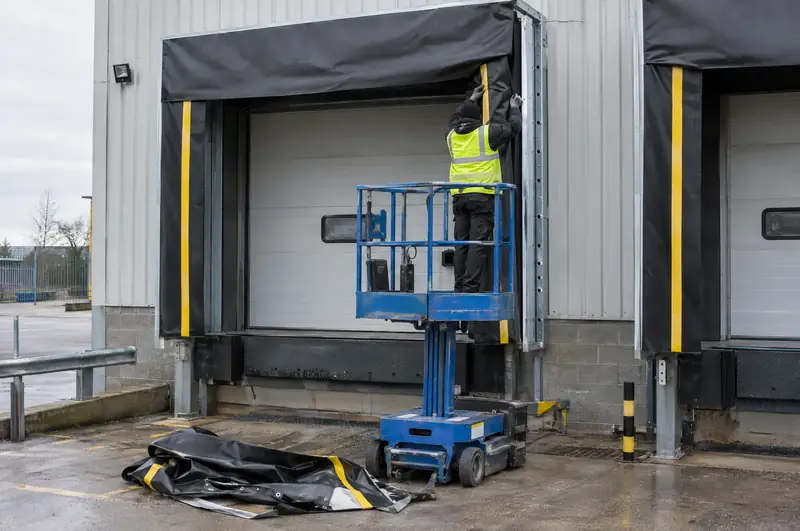
Dock shelter and seal repair covers restoring the weather seal around a docked trailer. Typical work includes replacing torn side and head curtains, worn foam seal pads and their covers, top pads and guide strips, repairing or replacing airbags and blowers on inflatable shelters, and straightening or replacing bent shelter frames, so the bay closes the gap between building and trailer again.
How much does a dock shelter or seal repair cost?
A dock shelter or seal repair typically costs £380 to £1,800 per repair, excluding VAT. A pair of side curtains or seal pad covers sits towards the lower end; a full curtain set, a new frame or a set of airbags with a blower sits towards the top.
How the price is agreed:
- You describe the damage and send photos, ideally with a trailer docked.
- We agree the visit price in writing before anyone attends. Where parts are made to measure, that may cover a measuring visit and a fitting visit.
- Any extra work found on site is quoted and approved by you before it is done.
What moves the price:
- Parts: curtains, pads, airbags, blowers and frames differ widely in cost.
- Size: taller and wider shelters need more material.
- Access: head curtains and top pads may need powered access equipment.
- Number of bays and timing: several bays together lower the cost per bay; out-of-hours work adds to it.
VAT is added at the standard rate.
Why is my dock shelter or seal letting in draughts?
A dock shelter or seal lets in draughts when the material that should press against the trailer is torn, worn, too short or no longer in the right place. Daylight around a docked trailer is the clearest sign.
- Torn or shrunk curtains: side curtains no longer overlap the trailer sides.
- Short head curtain: taller trailers than the shelter was sized for leave a gap across the top.
- Flattened seal pads: foam that has lost its spring no longer closes the gap.
- Worn pad covers: exposed foam soaks up water and breaks down faster.
- Bent frame: a retractable shelter frame that no longer returns square.
- Airbag or blower fault: inflatable shelters that inflate slowly or lose pressure.
- Trailer position: off-centre parking or worn bumpers that let trailers crush one side.
On chilled docks, gaps also show up as condensation, ice on the dock floor or frost around the door.
Do dock shelters and seals fall under PUWER?
Yes. Dock shelters and seals are work equipment under the Provision and Use of Work Equipment Regulations 1998 (PUWER), so they must be suitable, maintained in a safe condition and inspected where deterioration could lead to danger. In Northern Ireland the equivalent is PUWER (Northern Ireland) 1999.
Shelter and seal damage is often treated as a comfort or energy issue, but some faults are safety issues too:
- loose head curtains, top pads or fixings that could fall;
- bent or broken frame arms with sharp edges at head height;
- wet or icy dock floors caused by gaps around the trailer;
- electrical faults on inflatable shelter blowers.
The regulator is HSE in Great Britain and HSENI in Northern Ireland. Including shelters and seals in planned maintenance, and recording what is found, shows they are being kept in a safe condition. Problems found during servicing are quoted as repairs before any work is done.
What does the work cover?
Curtain replacement
New side and head curtains for retractable shelters, made to measure in hard-wearing coated fabric, with slits and overlaps set to suit the trailers you receive.
Seal pad refurbishment
Replacing worn foam pads, or just their covers where the foam is still sound, including tougher facings on the areas where trailers rub most.
Airbag and blower repairs
Repairing or replacing torn airbags, failed blower motors and controls on inflatable shelters so the bags inflate fully and seal around the trailer again.
Frame repairs
Straightening or replacing bent arms, springs and frames on retractable shelters damaged by off-centre trailers, so the shelter returns square after each docking.
Top pad and guide strip replacement
Renewing head pads, top seals and high-visibility guide strips that close the gap above the trailer and help drivers line up on the bay.
Typical specification
| Equipment covered | retractable shelters, inflatable shelters and foam dock seals |
|---|---|
| Visit pricing | agreed in writing before anyone attends |
| Typical repair price | £380 to £1,800 per repair, ex VAT |
| Parts | typically made to measure for your shelter or seal |
| Extra work | quoted and approved before it is carried out |
| Access | typically from yard level, with access equipment where needed |
| Report provided | written report of the work done and the condition found |
Typical range for this work. The visit price is agreed in writing before anyone attends, and any extra work is quoted before it is done. See all guide prices.
What happens on site during a shelter or seal repair?
During a shelter or seal repair the bay is closed to trailers while the engineer works from the yard, often using access equipment for the head curtain and top pad. Neighbouring bays can usually keep working, although access equipment may need space in front of them.
- Measure: where parts are made to measure, the shelter or seal is measured first and the parts ordered.
- Close the bay: no trailer on the dock and the yard area coned off.
- Isolate: on inflatable shelters, the blower supply is isolated and locked off.
- Replace parts: old curtains, pads or airbags are removed and new ones fitted, with frames straightened or replaced as agreed.
- Check the seal: overlap and compression are checked, with a trailer docked if one is available.
It helps if you can provide photos with a trailer docked, yard space for access equipment, a contact who can arrange electrical isolation and an agreed time when the bay can be released.
Should I repair my dock shelter or change to a different type?
Repair is usually right when the shelter or seal still suits your trailers and the damage is wear and tear. Changing type is worth considering when the same damage keeps recurring because the equipment no longer suits the vehicles arriving.
- Repair: curtains torn by normal use, worn pad covers, a failed blower or a single bent frame arm.
- Resize: head curtains or pads that are too short for taller trailers now in your fleet.
- Seal to shelter: foam seals suit consistent trailer sizes; a mixed fleet or curtain-siders may need a shelter instead.
- Retractable to inflatable: chilled or frozen docks that need a tighter seal around varied trailers.
- Frame type: shelters repeatedly bent by trailers may suit a retractable frame that gives on impact.
Any change of type is quoted separately from the repair. Our guide to dock shelters vs dock seals explains how each type works and which trailers it suits.
How can I make shelter curtains and seal pads last longer?
Shelter curtains and seal pads last longest when trailers arrive straight, stop at the right distance and the parts are checked regularly. Most premature damage comes from how trailers are parked rather than from the material itself.
- Wheel guides: keep trailers centred so they do not drag one side curtain or crush one pad.
- Bumpers: worn bumpers let trailers reverse too far in and over-compress seals.
- Guide markings: clear centre lines on curtains and the dock help drivers line up.
- Early repairs: a small tear repaired early is cheaper than a full curtain later.
- Wear-resistant facings: seal pads can be specified with tougher covers where trailers rub most.
- Blower care: keeping blower intakes clear helps inflatable shelters inflate fully.
Our loading bay servicing includes shelters and seals, so wear is picked up alongside doors and levellers.
Signs it needs attention
- Daylight is visible around the trailer when it is docked at the bay.
- Curtains are torn, shrunk or hanging loose from the shelter frame.
- Seal pads stay flattened, or foam is showing through worn covers.
- An inflatable shelter is slow to inflate, loses pressure or the blower is noisy.
- Rain, wind or condensation is reaching the dock floor during loading.
How the job runs
- Tell us the fault
Describe the damage and send photos, ideally with a trailer docked, plus approximate sizes. Photos help us decide whether parts can be ordered before the visit.
- Visit price agreed in writing
We confirm the visit price in writing before anyone attends, including any separate measuring visit where curtains or pads must be made to measure.
- Attend, diagnose and repair
The engineer closes the bay, checks the cause of the damage and fits the agreed parts. Any extra work found on site is quoted before it is done.
- Written report
You receive a written report of the parts replaced, the condition of the shelter or seal and any wider causes, such as worn bumpers.
Dock shelter and seal repairs: questions
Can you replace just the curtains on a dock shelter?
Yes. If the frame is still sound, the side and head curtains can be replaced on their own, which is the most common shelter repair. Curtains are usually made to measure, so the shelter is measured first and the new curtains fitted on a second visit, with both visits priced in advance.
Can worn dock seal covers be replaced without new foam?
Often, yes. If the foam inside a seal pad still springs back, a new cover can be fitted over it. If the foam has stayed compressed or soaked up water, the pad is usually replaced complete. Photos of the pads, front and side, help us judge which applies.
How is the price for a shelter or seal repair agreed?
You describe the damage and send photos, and we agree the visit price in writing before anyone attends. For made-to-measure parts that may include a measuring visit. Any extra work found on site is quoted and only carried out once you approve it.
Do you repair inflatable dock shelters?
Yes. We repair and replace torn airbags, failed blower motors, controls and fixings on inflatable shelters. Where the shelter is interlocked with the dock controls so it only inflates with a trailer present, that link is checked as part of the repair.
Why do shelter curtains keep tearing?
Shelter curtains usually keep tearing because trailers arrive off-centre, the curtains are too short or tight for the trailers now in use, or worn bumpers let trailers reverse too far in. Fixing the cause, for example with wheel guides or resized curtains, stops repeat damage.
Can repairs help a chilled loading bay?
Yes. Gaps around a docked trailer let chilled air escape and warm, moist air in, which causes condensation and ice on the dock floor. Restoring the curtains, pads or airbags closes those gaps, helping keep the dock drier and safer to work in.
Related equipment and services
Further reading
Dock shelter and seal repairs by area
England
- Bedfordshire
- Berkshire
- Buckinghamshire
- Cambridgeshire
- Cheshire
- City and County of Bristol
- Cornwall
- County Durham
- Cumbria
- Derbyshire
- Devon
- Dorset
- East Riding of Yorkshire
- East Sussex
- Essex
- Gloucestershire
- Greater London
- Greater Manchester
- Hampshire
- Herefordshire
- Hertfordshire
- Isle of Wight
- Kent
- Lancashire
- Leicestershire
- Lincolnshire
- Merseyside
- Norfolk
- North Yorkshire
- Northamptonshire
- Northumberland
- Nottinghamshire
- Oxfordshire
- Rutland
- Shropshire
- Somerset
- South Yorkshire
- Staffordshire
- Suffolk
- Surrey
- Tyne and Wear
- Warwickshire
- West Midlands
- West Sussex
- West Yorkshire
- Wiltshire
- Worcestershire