
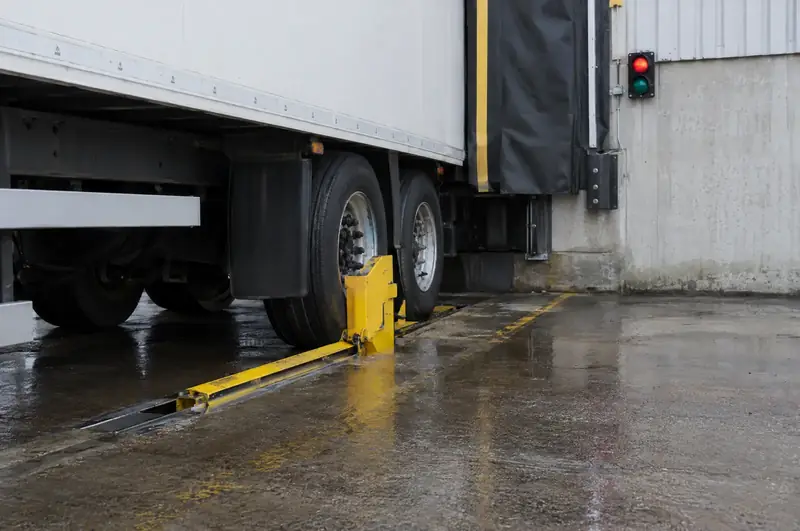
A vehicle restraint is a device at a loading bay that physically holds a trailer against the dock until it is safe to leave. In the UK most systems act on the rear wheel, either as a powered wheel-based restraint or a sensor wheel chock. Restraints guard against early drive-away and trailer creep, and are usually interlocked with the door and dock traffic lights.
How does this suit sites in Herefordshire?
Third-party hauliers visiting sites in Herefordshire may not know each site's procedures, so a restraint that holds the wheel removes reliance on every driver following instructions. Operators in Herefordshire reviewing their workplace transport risk assessment often look at restraints when key control alone has proved hard to enforce across shifts.
Busy cross-dock and parcel operations in Herefordshire with frequent trailer swaps have more chances for an early drive-away, which is where a physical restraint adds real protection.
A single contact at Loading Bay Doors handles your project in Herefordshire from start to finish. The free site survey and fixed written quote come first, with no obligation to proceed. We then book the installation for times that suit the operation, including out of hours by arrangement, and manage the specialist engineers on site. At the end we commission and test the equipment, walk your team through it and provide the documentation.
Wheel-based or hook restraint: which suits UK trailers?
Wheel-based restraints and sensor wheel chocks suit most UK trailers, because they act on the rear wheel rather than on the back of the vehicle. Hook restraints, which catch the rear impact guard (sometimes called an ICC bar), are common elsewhere but suit fewer UK fleets.
- Wheel-based restraint: a steel guide rail fixed to the yard, with an arm or chock that moves against the rear wheel, either powered or pushed into place by the operative. It works regardless of tail lifts or underrun guard design.
- Sensor wheel chock: a heavy chock placed in front of the wheel, with a sensor or parking station that tells the dock controls it is in position. Lower cost and minimal groundwork, but it relies on someone placing it each time.
- Hook restraint: mounted on the dock face and hooking the rear guard. UK and European trailers vary widely at the rear, and tail lifts often get in the way, so this type needs checking against your actual fleet.
How does a vehicle restraint work with dock lights and interlocks?
A vehicle restraint is normally linked to the dock traffic lights and the door controls, so engaging the restraint is what allows loading to start.
A typical sequence looks like this:
- The trailer reverses on to the bay with the outside light on green and the door closed.
- The restraint engages the rear wheel. The outside light turns red for the driver and the inside light turns green for dock staff.
- The door can now be opened, and the leveller can only operate once the door is fully open.
- When loading is finished, the leveller is parked and the door closed before the restraint can release.
- The restraint releases, the outside light turns green and the driver can leave.
The exact interlocks depend on your equipment and risk assessment. See dock traffic lights and interlocks for the options on signals and control logic.
Towns we cover in Herefordshire
Below is a list of towns in Herefordshire for vehicle restraints. Each page explains our approach for sites in that town.
Budget range for supply and fit. The written quote after a free survey is the fixed price. All guide prices.
Regulations and approvals in England
Workplace safety in England is regulated by HSE. For a loading bay in Herefordshire, that means doors meeting regulation 18 of the Workplace (Health, Safety and Welfare) Regulations 1992, equipment maintained under PUWER and suitable safeguards against vehicles driving away too early. We check what applies at survey and design the bay accordingly.
Questions
Do you remove and dispose of the old equipment?
Yes, where it is part of the scope. When we replace doors, levellers, shelters or seals at a site in Herefordshire, removal and disposal of the old equipment can be included and is itemised in the quote, so it is clear what is covered. If anything should be kept, such as a frame or motor that is still serviceable, we agree that at survey.
Which building and safety rules apply to a site in Herefordshire?
It depends on which UK nation the site is in. England and Wales use Building Regulations approval, Scotland uses building warrants and Northern Ireland uses building control approval from the council. Workplace safety is regulated by HSE in Great Britain and HSENI in Northern Ireland, and energy rules differ between nations. For your site in Herefordshire, we check what applies at survey and design to it.
Will a vehicle restraint slow down loading?
Engaging a restraint adds only a short step to each docking, and once it is part of the interlock sequence it becomes routine for dock staff. Many sites find that a clear sequence actually reduces delays, because there is less confusion about when it is safe to open the door or release the driver.
Is a vehicle restraint a legal requirement?
Not in every case: HSE guidance (followed by HSENI in Northern Ireland) says there should be safeguards against drivers driving away too early, and a vehicle restraint is one of the measures it lists. Traffic lights and the person in charge keeping keys or paperwork are the others. Which measures you use should follow your risk assessment. In Northern Ireland the regulator is HSENI.
Other services in Herefordshire
Full guide to vehicle restraints · All loading bay services in Herefordshire