
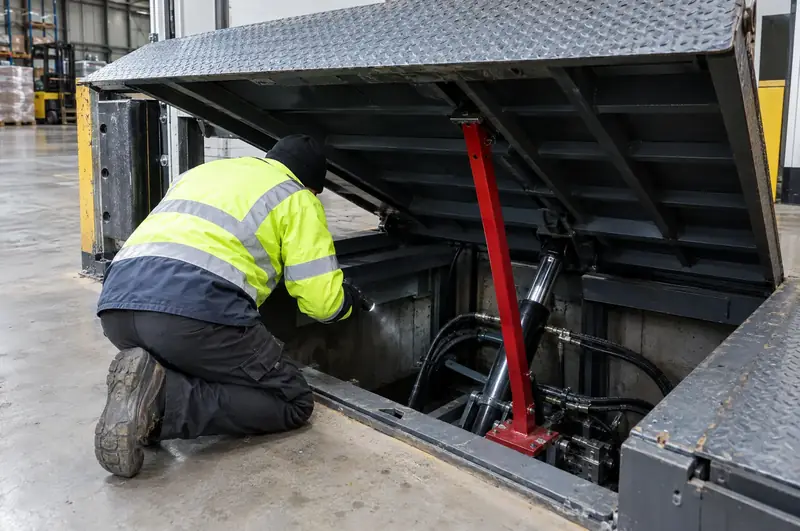
Dock leveller repair covers finding and fixing faults on the bridge between the dock and the trailer bed, including hydraulic cylinders, hoses and power packs, safety and check valves, lip hinges and lip cylinders, platform and lip damage, toe guards and control panels. It applies to swing-lip, telescopic-lip, mechanical and edge-of-dock levellers, with the aim of returning each one to safe working order.
How much does a dock leveller repair cost?
A dock leveller repair typically costs £220 to £2,600 per repair, excluding VAT. Replacing a hose or limit switch sits towards the lower end; a new power pack, cylinder set or rebuilt lip hinge sits towards the top.
How the price is agreed:
- You describe the fault, ideally with photos of the leveller, the pit and any labels.
- We agree the visit price in writing before anyone attends.
- Anything found on site beyond that scope is quoted and approved by you before it is done.
What moves the price:
- Parts: cylinders, power packs, valves and hinge components vary widely in cost.
- Welding and fabrication: cracked decks, broken hinge knuckles and bent lips take more time.
- Hydraulic work: an oil change and bleeding the system add to cylinder or hose repairs.
- Pit condition: heavy debris or standing water must be cleared first.
- Out-of-hours working and location: both are agreed in the visit price.
VAT is added at the standard rate.
What inspection rules apply to dock levellers?
Dock levellers are work equipment under the Provision and Use of Work Equipment Regulations 1998 (PUWER), so they must be maintained in a safe condition and inspected where deterioration could lead to danger. In Northern Ireland the equivalent is PUWER (Northern Ireland) 1999.
Engineering insurers commonly inspect dock levellers under PUWER at 12-month intervals. Their reports list defects, sometimes marked for action before further use, and repairs are often needed to clear them.
Most levellers are treated as work equipment under PUWER. A leveller designed or used to lift people may fall under the Lifting Operations and Lifting Equipment Regulations (LOLER), with 6-monthly thorough examination. This depends on the equipment and how it is used; your insurer or competent person will confirm.
Levellers are made to BS EN 1398:2009, the dock leveller safety standard. HSE guidance notes that guards or skirting may be needed where something could be caught, so damaged toe guards are repaired as part of the job. See our guide to dock leveller inspections under PUWER and LOLER.
What are the most common dock leveller faults?
The most common dock leveller faults are hydraulic leaks, power pack failures, lip and hinge damage, and control faults. The way the leveller behaves usually points to the cause.
- Will not rise, or rises slowly: power pack motor or pump, low oil, a failed contactor or a control fault.
- Sinks under load or drifts down when parked: leaking cylinder seals or a faulty check valve.
- Drops suddenly, then locks: the safety valve doing its job after a hose or fitting failure.
- Lip will not extend or falls short: a lip cylinder fault, a sequence valve problem or a seized lip hinge.
- Oil in the pit: a leaking hose, fitting or cylinder.
- Jerky or noisy movement: air in the hydraulics or worn pivots.
- Cracked deck, bent lip or broken hinge knuckles: impact damage or fatigue.
A leveller showing any of these faults should be taken out of use until it has been checked.
What does the work cover?
Hydraulic repairs
Cylinders resealed or replaced, hoses and fittings renewed, check and safety valves tested, and the system refilled with fresh oil and bled so the platform moves smoothly again.
Power pack repairs
Motor, pump, valve block and contactor faults diagnosed and repaired, or the whole power pack replaced as a unit where that is the more economical option.
Lip and hinge repairs
Seized or worn lip hinges rebuilt, hinge pins replaced, bent lips straightened or replaced, and lip cylinders repaired so the lip extends fully on to the trailer bed.
Structural and weld repairs
Cracked deck plates, broken welds and damaged front sections repaired by welding or with fabricated replacement parts, restoring the platform's strength.
Control and safety repairs
Control panels, push buttons, limit switches, maintenance struts, toe guards and side skirts repaired or replaced so the leveller operates and parks safely.
Typical specification
| Levellers covered | swing-lip, telescopic-lip, mechanical and edge-of-dock |
|---|---|
| Visit pricing | agreed in writing before anyone attends |
| Typical repair price | £220 to £2,600 per repair, ex VAT |
| Extra work | quoted and approved before it is carried out |
| Hydraulic work | cylinders, hoses, power packs and valves |
| Insurer defects | repairs priced against inspection report items |
| Report provided | written report of faults, repairs and any remaining defects |
Typical range for this work. The visit price is agreed in writing before anyone attends, and any extra work is quoted before it is done. See all guide prices.
What happens on site during a dock leveller repair?
During a leveller repair the bay is closed, the leveller is isolated and propped, and the engineer works from the pit or deck to diagnose and repair the fault. Neighbouring bays normally keep working.
- Close the bay: no trailer on the dock, the door closed and forklifts kept away.
- Isolate and prop: the leveller is electrically isolated and locked off, and the platform raised and supported on its maintenance strut before anyone goes underneath.
- Clean and inspect: debris and spilt oil are cleared from the pit so the fault can be traced.
- Repair: parts are fitted or welded. Anything beyond the agreed scope is quoted first.
- Test: the leveller is cycled, the lip checked and controls tested before the bay reopens.
It helps if you can provide a clear bay, a contact on site, photos or labels showing the leveller type and size, and any insurer inspection report that lists the defect.
Should a dock leveller be repaired or replaced?
A dock leveller is usually worth repairing when the platform, lip and hinges are structurally sound and the fault is in the hydraulics, controls or a single component. Replacement is worth considering when the structure is fatigued or the leveller no longer suits your trailers.
Repair is likely to be the better option when:
- the fault is a hose, cylinder, valve or power pack;
- lip or hinge damage is limited to one area and can be welded or rebuilt;
- the leveller is the right length for your trailer height range.
Replacement is worth pricing when:
- the deck or hinge structure is cracking in several places;
- hydraulic failures keep recurring despite repairs;
- an old mechanical leveller needs major parts that are hard to find;
- trailers now arrive at heights the leveller cannot reach at a safe gradient.
Our guide to dock leveller repair or replace covers the signs in more detail.
Can you repair defects listed on an insurer inspection report?
Yes. Repairing defects from an engineering insurer's inspection report is one of the most common reasons for a leveller repair visit. Sending us the report is the quickest way to get an accurate price.
How it works:
- Send the report: we read each defect against the leveller it refers to, with any photos you can add.
- Price each item: we agree the visit price in writing, listing the defects it covers.
- Repair: the engineer carries out the listed repairs, and any further defects found are quoted before work.
- Record: the written report shows which defects were cleared and how, which you can keep with the insurer's report.
Any re-inspection by the insurer is arranged between you and them. If a defect is marked as dangerous, the leveller should stay out of use until it has been repaired.
Grouping several levellers' defects into one visit usually keeps the cost per item down.
Signs it needs attention
- The leveller rises slowly, will not rise at all or the motor runs without movement.
- The platform sinks under a forklift or drifts down when parked.
- Hydraulic oil is pooling in the pit or weeping from hoses and fittings.
- The lip will not extend fully, falls short of the trailer bed or hangs crooked.
- An insurer inspection report lists leveller defects that need repair.
How the job runs
- Tell us the fault
Describe what the leveller is doing and send photos of the leveller, pit and any labels, plus any insurer report listing defects, so we can plan parts.
- Visit price agreed in writing
We confirm the visit price, the work it covers and the planned attendance date in writing before anyone attends site.
- Attend, diagnose and repair
The engineer isolates and props the leveller, traces the fault and repairs it. Any further work found is quoted and approved before it is carried out.
- Written report
You receive a written report of the faults found, the repairs completed, test results and any remaining defects that need attention later.
Dock leveller repairs: questions
Is it safe to keep using a leaking dock leveller?
No. A dock leveller leaking hydraulic oil should be taken out of use until it has been checked, because the leak may affect how the platform holds its position under load. Oil in the pit is also a slip and environmental hazard. Describe the leak and send photos so we can plan the repair.
How is the price for a leveller repair agreed?
You describe the fault and send photos, and we agree the visit price in writing before anyone attends. If the engineer finds more work is needed, it is quoted and only carried out once you approve it. The visit is chargeable, and the price is always agreed first.
Do you repair mechanical dock levellers?
Yes, where parts are still available. Mechanical levellers use springs and a hold-down mechanism rather than hydraulics, and common repairs include springs, release mechanisms and lip hinges. Where parts are hard to find or faults keep recurring, the report may suggest pricing a hydraulic replacement.
Can a leveller be repaired without disturbing the pit?
Usually yes. Most leveller repairs are carried out in place, working from the deck or from the pit with the platform propped. If the pit itself is cracked, broken at the edges or holding water, that is noted in the report and any pit repair is priced separately.
Can leveller repairs be done outside operating hours?
Yes, leveller repairs can be arranged for evenings or weekends where that suits your operation. Out-of-hours working costs more, and that is included in the visit price agreed in writing beforehand. Timing for each repair is agreed with you, and neighbouring bays can usually keep working.
Will the repair clear an insurer's defect notice?
A repair addresses the defect listed, and our written report records what was found and what was done, which you can keep with the insurer's report. Whether the insurer needs to re-inspect is between you and them. Any further defects found during the repair are quoted before work.
Related equipment and services
Further reading
Dock leveller repairs by area
England
- Bedfordshire
- Berkshire
- Buckinghamshire
- Cambridgeshire
- Cheshire
- City and County of Bristol
- Cornwall
- County Durham
- Cumbria
- Derbyshire
- Devon
- Dorset
- East Riding of Yorkshire
- East Sussex
- Essex
- Gloucestershire
- Greater London
- Greater Manchester
- Hampshire
- Herefordshire
- Hertfordshire
- Isle of Wight
- Kent
- Lancashire
- Leicestershire
- Lincolnshire
- Merseyside
- Norfolk
- North Yorkshire
- Northamptonshire
- Northumberland
- Nottinghamshire
- Oxfordshire
- Rutland
- Shropshire
- Somerset
- South Yorkshire
- Staffordshire
- Suffolk
- Surrey
- Tyne and Wear
- Warwickshire
- West Midlands
- West Sussex
- West Yorkshire
- Wiltshire
- Worcestershire