
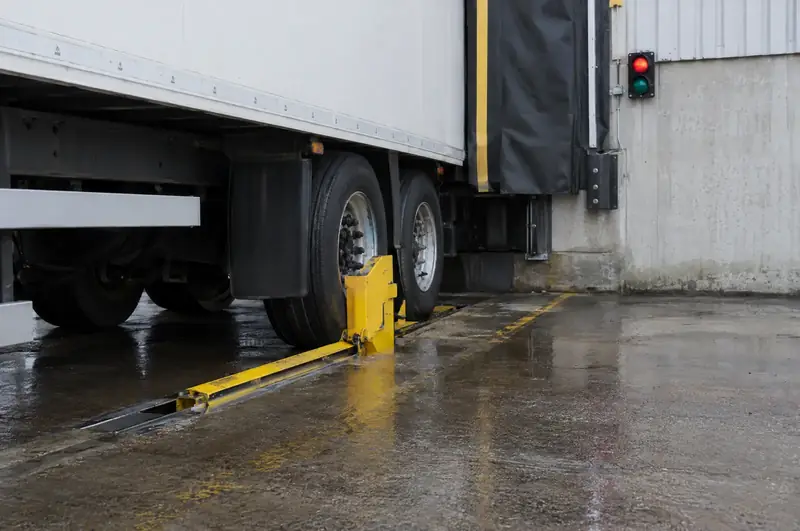
A vehicle restraint is a device at a loading bay that physically holds a trailer against the dock until it is safe to leave. In the UK most systems act on the rear wheel, either as a powered wheel-based restraint or a sensor wheel chock. Restraints guard against early drive-away and trailer creep, and are usually interlocked with the door and dock traffic lights.
Is this right for your site in Glasgow and Dunbartonshire?
New-build distribution sheds in Glasgow and Dunbartonshire can have restraint rails and ducting planned into the yard slab from the start, which is simpler than cutting them in later. Operators in Glasgow and Dunbartonshire reviewing their workplace transport risk assessment often look at restraints when key control alone has proved hard to enforce across shifts.
Yards around Glasgow and Dunbartonshire that park uncoupled trailers at the dock can see trailers creep under forklift traffic, and a wheel-based restraint helps keep the leveller lip on the bed.
Before anything is ordered, we visit your site in Glasgow and Dunbartonshire for a free survey and then send a written quote with a fixed price. From that point we manage the installation, coordinating delivery, access and any other trades. Fitting is done by specialist installation engineers engaged and managed by us, at times that suit your operation, including out of hours where agreed. You get a tested installation, a demonstration for your team and the manufacturer documentation.
What happens on site when a vehicle restraint is installed?
Installing a vehicle restraint takes the bay out of use while the rail or chock station is fixed, cabled and tested, but neighbouring bays can usually keep working.
- Set out: the restraint position is marked in line with the bay so it meets the rear wheels of the trailers you receive.
- Fixing: rail-mounted units are anchored into the concrete apron. If a new concrete base is needed, it must cure before the restraint is fitted.
- Cabling: ducts are cut or laid from the restraint to the dock wall, and the control box is fitted inside next to the door.
- Connection: the restraint is wired into the door, leveller and traffic light controls so the sequence works as designed.
- Commissioning: the system is tested with a trailer on the bay, and dock staff are shown how to engage and release it.
We ask you to release the bay for the agreed period, confirm an electrical supply point, provide a trailer for commissioning and tell us about any buried services in the yard.
What is trailer creep and how does a restraint stop it?
Trailer creep is the gradual movement of a parked trailer away from the dock, caused by forklifts braking and accelerating as they drive on and off the trailer bed. Each movement pushes the trailer forward slightly, and over a full load the gap can grow.
Creep is more likely when:
- the trailer is uncoupled from its tractor unit and resting on its landing legs;
- air suspension or brakes have not been set correctly by the driver;
- forklifts are heavy, fast or carrying dense loads such as drinks or building materials;
- the yard falls slightly away from the building.
As the trailer moves, the leveller lip can lose its bearing on the trailer bed, and in the worst case the lip slips off with a forklift on it. A wheel-based restraint holds the wheel against the rail or chock, so the trailer cannot travel forward however many times a forklift drives on and off.
Towns we cover in Glasgow and Dunbartonshire
We provide vehicle restraints right across Glasgow and Dunbartonshire. Pick the town closest to your site from the list below.
Budget range for supply and fit. The written quote after a free survey is the fixed price. All guide prices.
What do the rules in Scotland mean for the work?
Doors and dock equipment installed in Scotland may carry the UKCA or the CE mark, and we pass on the documentation for everything fitted in Glasgow and Dunbartonshire. Because building warrant and planning questions can affect the programme, we check what applies at survey and raise any approvals early rather than assuming none are needed.
Questions
What details do you need from us to quote for vehicle restraints?
To get started, send the site address in Glasgow and Dunbartonshire, the number of bays or openings, approximate sizes, and photos of the dock from inside and outside. Tell us what vehicles you load, what goods you handle and any temperature requirements. Drawings help on new builds. We then arrange the free survey and confirm the details before the written quote is issued.
Is VAT included in your guide prices for vehicle restraints?
No. Our customers are businesses, so guide prices exclude VAT, which is added at the standard rate. The same guide range applies in Glasgow and Dunbartonshire as everywhere else: for vehicle restraints, it is £4,200 to £9,800 per bay, excluding VAT. It covers supply and fit for a typical installation. Your fixed written quote after the free survey shows the net price, the VAT and exactly what is included.
Will a vehicle restraint slow down loading?
Engaging a restraint adds only a short step to each docking, and once it is part of the interlock sequence it becomes routine for dock staff. Many sites find that a clear sequence actually reduces delays, because there is less confusion about when it is safe to open the door or release the driver.
Do vehicle restraints work with all trailers?
Wheel-based restraints and sensor chocks work with most trailers, because they act on the rear wheel rather than on the back of the vehicle. Vehicles with unusual wheel positions or very small wheels need checking, so we look at the vehicles you receive during the survey.
Other services in Glasgow and Dunbartonshire
Full guide to vehicle restraints · All loading bay services in Glasgow and Dunbartonshire