
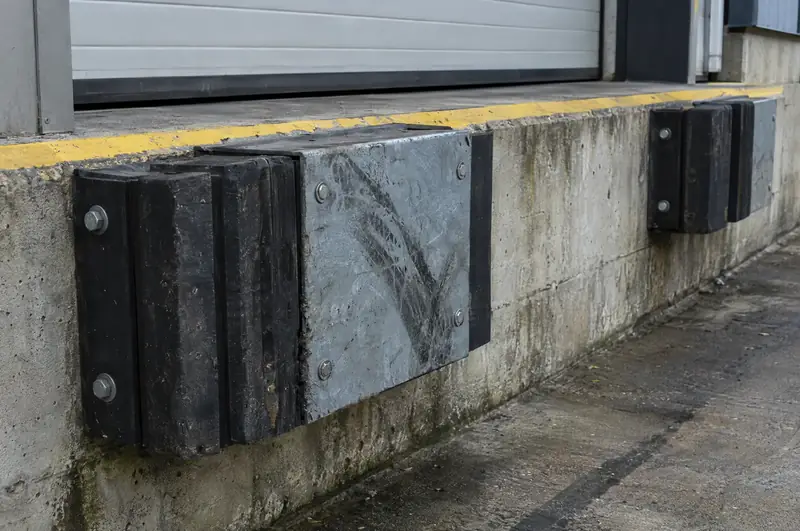
Dock bumpers are rubber or rubber-and-steel buffers fixed to the face of a loading dock, either side of the leveller, to absorb the impact of reversing vehicles. They hold the trailer a set distance from the building, protect the dock wall, leveller and door, and help a dock seal or shelter compress evenly. Most bays use two bumpers, replaced as they wear.
How much do dock bumpers cost?
Dock bumpers typically cost £120 to £480 per bumper, supplied and fitted, excluding VAT. Most bays need two, so the cost per dock depends mainly on the type of bumper and how it is fixed.
The main things that move the price are:
- Bumper type: laminated rubber is the most economical; moulded, steel-faced and vertical sliding designs cost more.
- Size and projection: deeper or taller bumpers use more material and heavier fixings.
- Fixing method: anchoring into sound concrete is simpler than welding to steel embeds or repairing a broken dock face first.
- Number of bays: doing several docks in one visit spreads access and travel costs.
- Working hours and location: out-of-hours working and remote or island sites add cost, and any travel cost is shown in the quote.
These are guide budgets. After a free site survey we send a written quote, and that quote is the fixed price. VAT is added at the standard rate.
Which dock bumper is best: laminated, moulded or steel-faced?
Laminated rubber bumpers suit most general docks, steel-faced bumpers suit busy bays where trailers rise and fall during loading, and moulded bumpers suit lighter vehicles and compact installations.
- Laminated rubber: layers of fabric-reinforced rubber pressed between steel angles on threaded bars. They absorb impact well, are economical and are the standard choice for many bays.
- Moulded rubber: solid rubber blocks in rectangular or curved profiles. They are neat and quick to fit, and work well for vans, rigid vehicles and lower-impact docks.
- Steel-faced: a rubber body behind a steel plate. As forklifts drive on and off, the trailer bed moves up and down and scrubs the bumper; the steel face takes that wear instead of the rubber.
- Vertical sliding: a face that travels up and down with the trailer, reducing abrasion on very busy bays.
Where a design has replaceable faces, worn plates can be changed without removing the whole bumper. Our guide to choosing dock bumpers and wheel guides covers projection and positioning in more detail.
Do dock bumpers need inspecting under PUWER?
Dock bumpers should be checked whenever the loading bay is serviced, because they protect equipment that the Provision and Use of Work Equipment Regulations 1998 (PUWER) apply to. In Northern Ireland the equivalent is PUWER (Northern Ireland) 1999.
PUWER requires work equipment, including dock levellers, loading bay doors and shelters, to be suitable, maintained in a safe condition and inspected where deterioration could lead to danger. A bumper worn down to its backing lets trailers strike the leveller lip and front plate, which can crack welds, bend hinges and leave a leveller that is no longer safe to drive across.
Engineering insurers commonly inspect dock levellers under PUWER at 12-month intervals. Replacing a worn bumper usually costs far less than repairing the leveller it should have protected.
The health and safety regulator is HSE in Great Britain and HSENI in Northern Ireland. Including bumpers in planned maintenance checks shows the dock is being looked after.
Which types and options are available?
Laminated rubber bumpers
Layers of fabric-reinforced rubber clamped between steel angles. Economical and good at absorbing impact, they are the standard choice for many general-purpose loading docks.
Moulded rubber bumpers
Solid moulded rubber blocks in rectangular or curved profiles. Compact and tidy, they suit vans, rigid vehicles and docks with lighter or less frequent traffic.
Steel-faced bumpers
A rubber body behind a steel face plate that resists scuffing as the trailer bed moves during loading. Suited to busy bays with heavy forklift traffic.
Vertical sliding bumpers
A face that rides up and down with the trailer instead of rubbing against it, reducing wear on very high-throughput docks.
Replacement faces and fixings
New face plates, rubber inserts and anchors for existing bumpers where the body and backing are still sound, keeping replacement costs down on worn bays.
Typical specification
| Typical projection | typically around 100 mm from the dock face |
|---|---|
| Bumpers per bay | typically two, one either side of the leveller |
| Common materials | laminated or moulded rubber, with steel face plates on heavy-duty types |
| Fixing method | typically resin or mechanical anchors into concrete, or welded to steel |
| Steel finish | typically galvanised or painted backing and fixings |
| Guide price | £120 to £480 per bumper, ex VAT, supply and fit |
| Bay downtime | typically one bay at a time, with neighbouring docks kept running |
Budget range for supply and fit. Your written quote after a free site survey is the fixed price. See all guide prices.
What happens on site when dock bumpers are fitted?
Fitting dock bumpers is a short job carried out from yard level, and only the bay being worked on is taken out of use.
- Isolate the bay: no trailer on the dock, the leveller parked and the door closed, with the yard area in front coned off.
- Remove the old bumpers: worn units and corroded fixings are taken off and the dock face is checked for cracked or spalled concrete.
- Fix the new bumpers: holes are drilled and the bumpers secured with resin or mechanical anchors, or welded to existing steelwork where that gives the better fixing.
- Allow cure time: resin anchors need time to cure before a trailer is reversed on to them, and the engineer will confirm when the bay can reopen.
We ask you to provide a clear bay, safe access to the yard, a named contact on the day and details of any permit-to-work or site induction. If the dock face needs concrete repair first, that is identified at survey and priced in the quote rather than discovered on the day.
Where should dock bumpers be positioned on the dock face?
Dock bumpers are normally fixed either side of the leveller, at a height that catches the rear of the trailer before anything else touches the building.
- Height: typical UK dock height is around 1,200 mm, but trailer bed heights vary from roughly 900 to 1,600 mm, so bumpers must cover the range of vehicles you receive.
- Projection: bumpers commonly stand about 100 mm proud of the dock face. Too little and trailers hit the wall; too much and a swing lip of about 400 to 500 mm may not reach far enough on to the trailer bed.
- Spacing: bumpers should line up with the trailer chassis and sit clear of the leveller lip.
- Seals and shelters: projection controls how far a dock seal compresses, so it is set with the seal depth in mind.
Pairing bumpers with steel wheel guides helps drivers reverse square, so both bumpers take an equal share of each impact.
When should dock bumpers be replaced?
Dock bumpers should be replaced when the rubber is worn close to the steel backing, split, missing layers or loose on its fixings. At that point the bumper no longer stops the trailer before it reaches the dock wall or leveller.
Common signs include:
- Rubber worn into a curve or step where trailer chassis rub against it.
- Laminated layers missing or bowed out between the steel angles.
- Loose bolts, cracked concrete or rust staining around the fixings.
- Uneven compression on a dock seal, showing trailers are sitting off-square.
Replace bumpers in pairs where possible, so the trailer is held square and both sides compress evenly. Steel-faced designs with replaceable faces can often be refreshed by changing the face plate alone, which keeps costs down on very busy bays.
When is this the right choice?
- Existing bumpers are worn down to the steel backing or have layers missing.
- Trailers are leaving scuff marks or cracks on the dock wall around the leveller.
- The leveller lip or front plate is being struck by reversing vehicles.
- Dock seals are being crushed flat because trailers reverse too far in.
- You are fitting out a new bay and need the right projection for the seal or shelter.
How the job runs
- Site survey
We look at the dock face, existing bumpers, leveller and the vehicles you handle, then measure heights and projection so new bumpers suit your fleet and any seal or shelter.
- Written quote
You receive a written quote listing bumper type, quantity, fixing method and any dock face repairs. The survey and quote are free and without obligation.
- Installation
One bay is isolated at a time. Old bumpers are removed, the dock face is checked and the new bumpers are fixed with anchors or welding as specified.
- Handover and checks
Fixings are checked, anchor cure times are confirmed and the bay is handed back, with a note of any other wear we spotted at the dock.
Dock bumpers: questions
How many dock bumpers does a loading bay need?
Most loading bays need two dock bumpers, one fixed either side of the leveller. Docks receiving a wide mix of vehicles sometimes need taller bumpers or an extra lower pair so every vehicle meets rubber before it meets the wall. We confirm the number and layout at survey.
How long do dock bumpers last?
There is no fixed lifespan for a dock bumper, because wear depends on how many trailers use the bay, how hard drivers reverse and how much the trailer moves during loading. A quiet dock may keep the same bumpers for many years, while a busy distribution bay can wear through the rubber much sooner. Checking them at each service visit catches wear early.
Can you replace just the face of a dock bumper?
Yes, on bumpers designed with replaceable faces. Steel-faced and some moulded designs let the worn face plate or rubber insert be changed while the backing stays bolted to the dock. Older laminated bumpers usually have to be replaced as a complete unit, which is still a modest cost compared with repairing impact damage to a leveller.
Can dock bumpers be fitted with an edge-of-dock leveller?
Yes. With an edge-of-dock leveller, bumpers are usually fixed to the dock face either side of the unit, or to the leveller's own mounting frame where it is designed for that. Their projection has to suit the short lip so it still reaches on to the trailer bed, which we check at survey.
Do you replace dock bumpers without changing other equipment?
Yes. Bumper replacement is often a standalone job, and we can fit new bumpers to existing docks without touching the door, leveller or shelter. If we notice other wear on site, such as a damaged seal or a struck leveller lip, we note it for you.
Are dock bumpers included in a complete bay package?
Yes. When we supply a complete loading bay, dock bumpers are specified alongside the leveller, door and shelter or seal so that projection, height and seal compression all work together. Bumpers can also be ordered with wheel guides and dock lights as part of a smaller safety upgrade on an existing bay.
Related equipment and services
Further reading
Dock bumpers by area
England
- Bedfordshire
- Berkshire
- Buckinghamshire
- Cambridgeshire
- Cheshire
- City and County of Bristol
- Cornwall
- County Durham
- Cumbria
- Derbyshire
- Devon
- Dorset
- East Riding of Yorkshire
- East Sussex
- Essex
- Gloucestershire
- Greater London
- Greater Manchester
- Hampshire
- Herefordshire
- Hertfordshire
- Isle of Wight
- Kent
- Lancashire
- Leicestershire
- Lincolnshire
- Merseyside
- Norfolk
- North Yorkshire
- Northamptonshire
- Northumberland
- Nottinghamshire
- Oxfordshire
- Rutland
- Shropshire
- Somerset
- South Yorkshire
- Staffordshire
- Suffolk
- Surrey
- Tyne and Wear
- Warwickshire
- West Midlands
- West Sussex
- West Yorkshire
- Wiltshire
- Worcestershire