
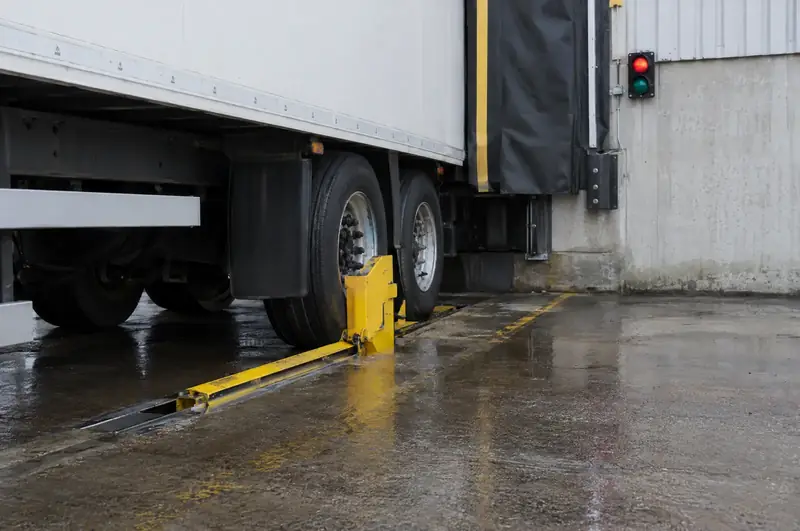
A vehicle restraint is a device at a loading bay that physically holds a trailer against the dock until it is safe to leave. In the UK most systems act on the rear wheel, either as a powered wheel-based restraint or a sensor wheel chock. Restraints guard against early drive-away and trailer creep, and are usually interlocked with the door and dock traffic lights.
Where does this fit at a dock in County Fermanagh?
Restraint systems for sites in County Fermanagh are surveyed, quoted and installed in the same way as anywhere else in the UK, with a fixed price set out in writing. Operators in County Fermanagh reviewing their workplace transport risk assessment often look at restraints when key control alone has proved hard to enforce across shifts.
Third-party hauliers visiting sites in County Fermanagh may not know each site's procedures, so a restraint that holds the wheel removes reliance on every driver following instructions.
For vehicle restraints in County Fermanagh, we begin with a free site survey and a fixed written quote, so you know the scope and cost before committing. We take responsibility for managing the job, and specialist installation engineers carry it out under our supervision. Bays are taken out of use in a planned sequence so the rest of the dock keeps working, and evening or weekend work can be arranged. Each item is tested at handover and the documentation is left with you.
What happens on site when a vehicle restraint is installed?
Installing a vehicle restraint takes the bay out of use while the rail or chock station is fixed, cabled and tested, but neighbouring bays can usually keep working.
- Set out: the restraint position is marked in line with the bay so it meets the rear wheels of the trailers you receive.
- Fixing: rail-mounted units are anchored into the concrete apron. If a new concrete base is needed, it must cure before the restraint is fitted.
- Cabling: ducts are cut or laid from the restraint to the dock wall, and the control box is fitted inside next to the door.
- Connection: the restraint is wired into the door, leveller and traffic light controls so the sequence works as designed.
- Commissioning: the system is tested with a trailer on the bay, and dock staff are shown how to engage and release it.
We ask you to release the bay for the agreed period, confirm an electrical supply point, provide a trailer for commissioning and tell us about any buried services in the yard.
What does HSE guidance say about preventing drive-away?
HSE guidance says there must be safeguards to stop drivers driving away from a loading bay too early, and it lists vehicle or trailer restraints as one of the measures. The others it names are traffic lights and the person in charge keeping the vehicle keys or paperwork until it is safe to leave.
This comes from HSE's guide to workplace transport safety (HSG136) and its loading and unloading factsheet. The guidance sets out the outcome rather than one fixed solution, so the right combination for your site should follow your own risk assessment.
Once fitted, a restraint is work equipment under the Provision and Use of Work Equipment Regulations 1998 (PUWER), so it must be suitable, maintained in a safe condition and inspected where deterioration could lead to danger. In Northern Ireland the equivalent is PUWER (Northern Ireland) 1999, and the regulator is HSENI rather than HSE.
Our guide to preventing drive-away and trailer creep compares the options side by side.
Towns we cover in County Fermanagh
Each of the following towns in County Fermanagh has its own page on vehicle restraints, covering how we work and what to send us.
Budget range for supply and fit. The written quote after a free survey is the fixed price. All guide prices.
Which rules apply in Northern Ireland?
Energy requirements for non-dwellings in Northern Ireland are set by Technical Booklet F2. For new or replacement loading bay doors in County Fermanagh, we confirm the figure that applies to your project and check what applies at survey, rather than working to rules from elsewhere in the UK.
Questions
Will you deal with building control and planning for a project in County Fermanagh?
We check at survey whether the work is likely to need approval. Forming a new opening or dock pit may need Building Regulations approval, a building warrant or building control approval, depending on the nation, and external structures such as loading houses can need planning permission. Where approval is needed, we explain what is involved, work with your designer or agent, and build it into the programme.
What warranty comes with new loading bay equipment?
New equipment comes with the manufacturer's warranty, which varies by product. Our workmanship terms are set out in writing in the quote for your County Fermanagh site, so you can see what is covered before you commit. Check the warranty terms for any servicing conditions, and we can quote for planned maintenance once the installation is complete.
Do vehicle restraints work with all trailers?
Wheel-based restraints and sensor chocks work with most trailers, because they act on the rear wheel rather than on the back of the vehicle. Vehicles with unusual wheel positions or very small wheels need checking, so we look at the vehicles you receive during the survey.
Will a vehicle restraint slow down loading?
Engaging a restraint adds only a short step to each docking, and once it is part of the interlock sequence it becomes routine for dock staff. Many sites find that a clear sequence actually reduces delays, because there is less confusion about when it is safe to open the door or release the driver.
Other services in County Fermanagh
Full guide to vehicle restraints · All loading bay services in County Fermanagh