
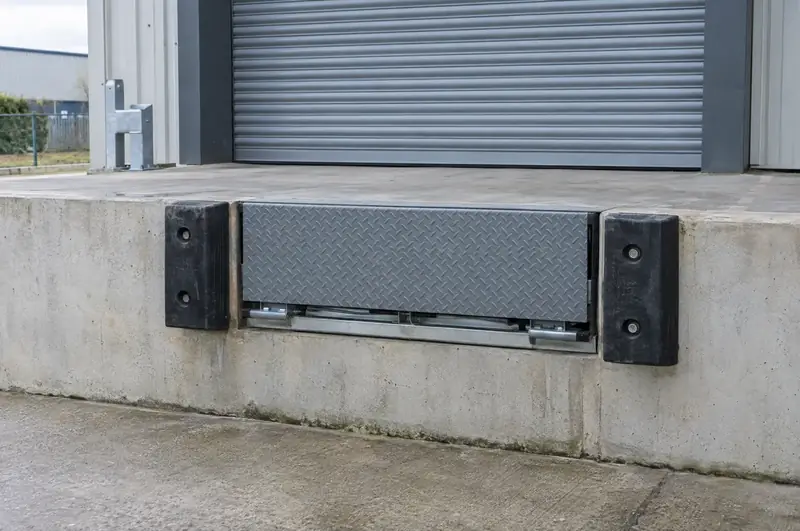
An edge-of-dock leveller is a compact leveller mounted on the front face or top edge of a loading dock, with no pit needed. A short hinged plate and lip bridge the gap between dock and trailer, but it can only cover a small height difference above and below dock level, so it suits sites where trailer bed heights are consistent.
How much does an edge-of-dock leveller cost?
An edge-of-dock leveller typically costs £1,800 to £4,400 per leveller, excluding VAT, supply and fit. That is considerably less than a pit leveller, because there is no pit to form or maintain and the unit itself is smaller.
The price depends on:
- Operation: mechanical units with a lever and spring assistance cost less than hydraulic push-button units.
- Width and capacity: wider plates and higher ratings for heavier forklifts.
- Fixing method: bolting to sound concrete, welding to an existing steel edge, or fitting a new edge angle first.
- Dock face condition: spalled or damaged concrete may need repair before fixing.
- Bumpers: often replaced or repositioned at the same time.
- Power: hydraulic units need a supply at the bay.
Concrete repairs or new edge steel are priced as separate items after survey, so you can see exactly what the leveller costs on its own. The written quote is the fixed price.
Do edge-of-dock levellers need the same inspections as pit levellers?
Yes, an edge-of-dock leveller is work equipment just like a pit leveller, so it must be kept in a safe condition and inspected where deterioration could lead to danger. Its small size does not exempt it.
- Great Britain: PUWER 1998 applies, with HSE as the regulator.
- Northern Ireland: PUWER (Northern Ireland) 1999 applies, with HSENI as the regulator.
- Insurer inspections: engineering insurers commonly inspect dock levellers under PUWER at 12-month intervals, so ask your insurer to confirm edge-of-dock units are on the schedule.
- Standard: the dock leveller safety standard is BS EN 1398:2009, which is current and under review.
- Trapping points: HSE guidance notes that guards or skirting may be needed on dock levellers where something could be caught, so hinge areas and plate edges are checked.
Mechanical units rely on springs and hinges that wear, so an inspection should cover these as carefully as the hydraulics on a powered unit.
Should I choose a mechanical or hydraulic edge-of-dock leveller?
Choose a mechanical edge-of-dock leveller for occasional use and simple sites, and a hydraulic one where the bay is busy or operators need push-button control. Both bridge a similar small height range.
- Mechanical: the operator pulls a lever or handle and the lip lifts and drops onto the bed with spring assistance. No power is needed and there is little to go wrong, but it takes some physical effort.
- Hydraulic: a push button raises the plate and extends the lip, then lowers it onto the trailer. It is easier and quicker for frequent use and can be interlocked with the dock door and traffic lights.
Other choices include plate width, which should suit the wheel track of your pallet trucks and forklifts, and capacity, which must cover the truck and its heaviest load. On exposed external docks, a galvanised or well-painted finish helps the unit cope with rain, frost and road salt.
Which types and options are available?
Mechanical edge-of-dock leveller
Lever-operated with spring assistance and no power supply needed. Suits low-volume bays and sites with consistent trailers where simplicity matters most.
Hydraulic edge-of-dock leveller
Push-button operation with a compact power pack, easier for frequent use and able to be interlocked with dock doors and traffic lights.
Wider or heavy-duty plate
A wider plate or higher rating for larger forklifts, heavy loads or pallet trucks with a wide wheel track, specified after we look at your equipment.
New edge steel and bumpers
A replacement steel edge angle and correctly positioned bumpers to give a sound fixing and protect the leveller from trailer impact.
Typical specification
| Height range | Typically around 75 to 150 mm above and below dock level |
|---|---|
| Pit required | No |
| Operation | Mechanical lever or electro-hydraulic push button |
| Typical width | Commonly about 1.8 to 2.1 m |
| Capacity | Typically matched to your forklift and heaviest load, as rated by the manufacturer |
| Fixing | Bolted or welded to the dock face or edge steel |
| Standard | BS EN 1398:2009 |
Budget range for supply and fit. Your written quote after a free site survey is the fixed price. See all guide prices.
How is an edge-of-dock leveller fitted to an existing dock?
An edge-of-dock leveller is fixed to the front face or top edge of the dock from the yard side, and installation usually takes around half a day to a day per bay. No digging is involved.
- The dock face is inspected, and damaged concrete or worn edge steel is repaired or replaced first if needed.
- The leveller is positioned centrally on the door opening and bolted or welded in place.
- Bumpers are fitted or repositioned so trailers stop at the right distance from the plate.
- On hydraulic units, the power pack and controls are connected.
- The leveller is tested across its working range.
You will need to keep the yard approach to the bay clear, take the bay out of use and, for hydraulic units, provide a power supply near the door or ask us to include one. Because the work is outside, very wet or freezing weather can affect welding and fixing, so we keep the date flexible where we can.
How much height difference can an edge-of-dock leveller handle?
An edge-of-dock leveller can only handle a small height difference, typically in the region of 75 to 150 mm above and below dock level depending on the model. That is enough where trailers are consistent, but not where bed heights vary widely.
Typical UK docks are around 1,200 mm above yard level, while trailer bed heights can range from roughly 900 to 1,600 mm across rigid, curtain-sider, refrigerated, double-deck and container chassis. If your trailers sit outside the leveller's range, the plate becomes too steep to use safely.
- Good fit: dedicated fleets or regular suppliers with similar trailers.
- Poor fit: sites receiving everything from low rigids to high double-deck trailers.
Where trailer heights vary, a pit leveller such as a swing-lip dock leveller gives a much longer, gentler ramp. We record your trailer heights at survey to confirm which suits.
Where does an edge-of-dock leveller work best?
An edge-of-dock leveller works best where trailer heights are consistent, a pit is impractical, or the budget rules out a pit leveller. It is a practical choice for many smaller operations and for adding capacity at larger ones.
- Leased units: where the lease or landlord does not allow a pit to be cut into the slab.
- Dedicated fleets: sites loading their own vehicles of a known bed height.
- Extra bays: adding loading positions at a dock where most bays already have pit levellers.
- Difficult slabs: where drainage, services or the structure would make a pit costly.
- Low-volume docks: occasional deliveries that do not justify a pit leveller.
Our guide on how to choose a dock leveller compares edge-of-dock, swing-lip and telescopic units in more detail, including the trailer and equipment questions to answer before deciding.
When is this the right choice?
- Your trailers arrive at consistent bed heights close to your dock height.
- Forming a pit is not allowed under your lease or would hit drains or services.
- Staff are using loose bridge plates that slip or must be carried into place.
- You need an extra loading position at low cost alongside existing pit levellers.
- An old mechanical edge leveller has a damaged lip, weak springs or cracked welds.
How the job runs
- Free site survey
We check the dock face and edge steel, measure dock height and record your trailer bed heights to confirm they sit within an edge-of-dock leveller's range.
- Written quote
A fixed written price for the leveller, fixing, bumpers and any controls, with concrete repairs or new edge steel listed separately if they are needed.
- Installation
The unit is fixed to the dock face from the yard, bumpers set and any hydraulic controls connected, typically within half a day to a day per bay.
- Testing and handover
The leveller is tested across its working range, fixings and bumpers checked, and staff shown how to operate and store it safely.
Edge-of-dock levellers: questions
Can an edge-of-dock leveller be fitted to any dock?
Most docks can take one if the dock face or edge steel is sound enough to fix to. Damaged concrete or worn edge angles may need repair first. The more important question is whether your trailer heights fall within the leveller's small working range, which we check at survey.
Is an edge-of-dock leveller better than a loose dock plate?
For regular use, usually yes. A fixed edge-of-dock leveller cannot slide out of position or be dropped, and it does not need carrying between bays. Loose plates still have a place for occasional use, but they bring handling and slipping risks that a fixed unit avoids.
Does the dock door still close with the leveller fitted?
Yes, in most layouts. Edge-of-dock levellers sit at the outer edge of the dock and store with the lip raised or folded, so the door closes behind them as normal. We check the clearance between the door, its bottom seal and the stored leveller at survey.
Can edge-of-dock levellers be used with vans?
Usually not. Edge-of-dock levellers are designed for trailers whose beds sit close to dock height, and many vans sit well below a typical dock, beyond the leveller's range. A lift table or a ground-level door is normally the better way to handle vans.
How long does an edge-of-dock leveller take to install?
Usually half a day to a day per bay, as there is no pit to form. Concrete or edge steel repairs add time, and hydraulic units also need connecting to power. We plan the work so the rest of the dock keeps operating while each bay is fitted.
Do edge-of-dock levellers need servicing?
Yes, they should be serviced and inspected like any leveller. Mechanical units need their springs, hinges and lip checked and lubricated, and hydraulic units also need hoses and the power pack inspected. Service visits are chargeable and agreed before anyone attends.
Related equipment and services
Further reading
Edge-of-dock levellers by area
England
- Bedfordshire
- Berkshire
- Buckinghamshire
- Cambridgeshire
- Cheshire
- City and County of Bristol
- Cornwall
- County Durham
- Cumbria
- Derbyshire
- Devon
- Dorset
- East Riding of Yorkshire
- East Sussex
- Essex
- Gloucestershire
- Greater London
- Greater Manchester
- Hampshire
- Herefordshire
- Hertfordshire
- Isle of Wight
- Kent
- Lancashire
- Leicestershire
- Lincolnshire
- Merseyside
- Norfolk
- North Yorkshire
- Northamptonshire
- Northumberland
- Nottinghamshire
- Oxfordshire
- Rutland
- Shropshire
- Somerset
- South Yorkshire
- Staffordshire
- Suffolk
- Surrey
- Tyne and Wear
- Warwickshire
- West Midlands
- West Sussex
- West Yorkshire
- Wiltshire
- Worcestershire