
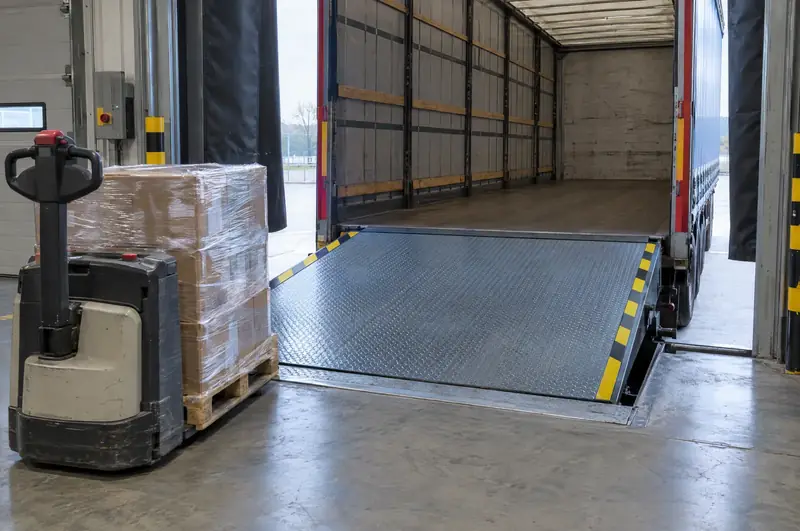
A swing-lip dock leveller is a hydraulic ramp set into a pit at the dock edge, with a hinged steel lip along its front. When a trailer is docked the platform rises, the lip swings out, and the platform lowers until the lip rests on the trailer bed, forming a bridge for forklifts and pallet trucks. The lip is typically about 400 to 500 mm long.
How much does a swing-lip dock leveller cost?
A swing-lip dock leveller typically costs £5,200 to £8,800 per leveller, excluding VAT, supply and fit, assuming it goes into an existing, sound pit. New pits, pit repairs, concrete and groundworks are priced separately after survey.
Within that range, the price is driven by:
- Platform length: longer platforms give a gentler gradient but cost more.
- Width and capacity: wider decks and higher load ratings use heavier steel and cylinders.
- Lip length: a longer lip reaches further onto the trailer bed.
- Insulation and sealing: insulated platforms and pit seals for chilled buildings.
- Controls and interlocks: links to the door, restraint or traffic lights.
- Removal and access: taking out the old unit, lifting equipment for delivery and out-of-hours work.
If the pit edge steel is damaged or the pit is out of square, we tell you at survey and price the repair as a separate item, so the leveller price stays clear. The written quote is then the fixed price for the work described.
Do dock levellers have to be inspected by law?
Yes, dock levellers are work equipment and must be kept in a safe condition and inspected where deterioration could lead to danger. The law and the regulator depend on where the site is.
- Great Britain: the Provision and Use of Work Equipment Regulations 1998 (PUWER), enforced by HSE.
- Northern Ireland: PUWER (Northern Ireland) 1999, enforced by HSENI.
- Inspection interval: engineering insurers commonly inspect dock levellers under PUWER at 12-month intervals.
- LOLER: most levellers are treated as work equipment under PUWER, but one designed or used to lift people may fall under LOLER, or LOLER (Northern Ireland) 1999, with 6-monthly thorough examination. It depends on the equipment and how it is used; your insurer or competent person will confirm.
- Standard: BS EN 1398:2009 sets the safety requirements for dock levellers. It is current and under review.
Our inspection guide explains what an examiner looks at.
How long should a dock leveller platform be?
A leveller platform should be long enough to keep the slope gentle across the full range of trailer heights you load, because the steepest gradient decides which handling equipment can use it safely. A longer platform spreads the same height difference over a greater distance.
- Know your trailer mix: with a dock typically around 1,200 mm high and trailer beds ranging from roughly 900 to 1,600 mm, the height difference can be considerable.
- Check your equipment: low-clearance electric pallet trucks cope with less gradient than a counterbalance forklift with good ground clearance.
- Common lengths: platforms are commonly made from around 2 to 3.5 m long, with longer units where trailers sit very low or very high.
- Width: a wider platform gives more room when pallets sit close to the trailer sides.
When replacing a unit, the pit size limits what can be fitted, so we measure the pit and record your trailer heights at survey before recommending a length.
Which types and options are available?
Standard swing-lip leveller
A hydraulic pit leveller with a hinged lip of about 400 to 500 mm, suited to general distribution with curtain-siders and box trailers.
Long-platform leveller
A longer platform that keeps gradients gentle where trailer heights vary widely or low-clearance electric pallet trucks are used across the bay.
Insulated leveller
An insulated platform with perimeter seals around the pit that reduces cold loss through the floor of the bay at chilled and frozen docks.
Interlocked controls
Control panels linked to the dock door, vehicle restraint or traffic lights so the leveller can only be operated when the dock is safe.
Typical specification
| Lip length | Typically about 400 to 500 mm |
|---|---|
| Platform length | Commonly about 2 to 3.5 m |
| Platform width | Typically about 2.0 to 2.2 m |
| Capacity | Typically rated around 60 kN, with heavier ratings available |
| Operation | Electro-hydraulic with push-button control |
| Safety features | Typically toe guards, velocity fuse, maintenance strut and emergency stop |
| Pit | Existing sound pit assumed; pit works priced separately |
| Standard | BS EN 1398:2009 dock levellers safety requirements |
Budget range for supply and fit. Your written quote after a free site survey is the fixed price. See all guide prices.
What happens when a swing-lip leveller is fitted into an existing pit?
Fitting a swing-lip leveller into an existing pit normally takes one to two working days per bay, with the bay closed throughout. The work runs in a set order:
- The old leveller is isolated, lifted out and removed from site.
- The pit is cleaned and measured, and the edge steel checked for damage.
- The new leveller is lowered in, set level, and welded or anchored to the pit steel.
- The hydraulic power pack and control panel are connected, and any interlocks wired.
- Toe guards, lip and bumpers are checked, then the leveller is run through its full range.
From your side we need the bay emptied and taken out of service, clear access for lifting equipment inside or outside the building, and a suitable power supply, which for most hydraulic levellers is three-phase. If the pit needs repairs, these are done first and can add time, which we confirm in the quote.
Which trailers and loads suit a swing-lip leveller?
A swing-lip leveller suits everyday loading of standard trailers, where pallets sit a little way back from the rear of the trailer and the lip has room to land on the bed. It is a common choice for general distribution.
- Good fit: curtain-siders and box trailers loaded by forklift or pallet truck, with the lip landing behind the first row of pallets.
- Less suited: trailers loaded right up to the rear doors, because the lip needs clear bed space to rest on.
- Tail-lift vehicles: a folded tail lift can stop the lip reaching the bed.
- End loading: loading the last row of pallets at the very rear is awkward with a fixed-length lip.
Where these situations are common, a telescopic-lip dock leveller places its lip exactly where it is needed. Many sites fit both types across their bays, matching each bay to the vehicles it receives.
What wears out on a swing-lip dock leveller?
The lip hinge, hydraulic hoses and seals are usually the first parts to wear on a swing-lip leveller, and planned servicing finds most of these problems before they stop a bay.
- Lip hinge: takes an impact every time the lip lands, and suffers badly if trailers reverse into a lip that has not been stored.
- Hydraulics: hoses, cylinder seals and power pack oil age and can leak.
- Velocity fuse: the safety valve that stops the platform dropping if a trailer pulls away must be tested.
- Toe guards and maintenance strut: must be intact and working. HSE guidance notes guards or skirting may be needed where something could be caught.
- Dock bumpers: worn bumpers let trailers strike the leveller and dock edge.
A leveller with a cracked lip hinge, a bent platform or repeated hydraulic leaks may be better replaced than repaired. Service and repair visits are chargeable and agreed before anyone attends.
When is this the right choice?
- The lip hinge is cracked or the lip no longer swings out fully.
- Hydraulic oil is leaking from hoses, cylinders or the power pack.
- The platform drifts down under load or rises unevenly on one side.
- Gradients are too steep for your electric pallet trucks at some trailer heights.
- Your insurer's inspection report lists defects that would be costly to put right.
How the job runs
- Free site survey
We measure the pit, check the edge steel and concrete, record dock height and trailer bed heights, and note the handling equipment and power supply at the bay.
- Written quote
A fixed written price for the leveller, removal of the old unit, installation and controls, with any pit repairs or groundworks listed separately.
- Installation
The old unit is removed, the new leveller set into the pit, fixed to the edge steel and connected to its power pack and controls, typically over one to two days.
- Testing and handover
The leveller is run through its full range, the lip, toe guards and emergency stop tested, and your dock team shown safe operation and storage.
Swing-lip dock levellers: questions
Can a new leveller fit our old pit?
Usually, yes. Levellers are made in standard sizes and many can be supplied to suit an existing pit, but the pit must be square, sound and deep enough. We measure the pit and check the edge steel at survey, and if adjustment or repair is needed we price it separately.
What capacity of leveller do we need?
The leveller needs to be rated for the heaviest combined load of forklift and goods that will cross it, allowing for the truck moving over it. General-purpose levellers are typically rated around 60 kN, with heavier ratings for heavy goods or large forklifts. We confirm the rating after looking at your equipment.
Can a swing-lip leveller be used as a ramp to the yard?
No, a leveller should only be used to bridge a docked trailer. The lip and toe guards are designed to work with a trailer bed in place, and the platform is not built as a ramp down to yard level. Where you need ground-level access, a separate door or a lift table is the safer answer.
How long does a replacement leveller take to arrive?
Lead times depend on size, specification and the manufacturer, and we confirm them in the written quote. The existing leveller can usually stay in use until the replacement is on site, so the bay is only closed for the installation itself.
Do levellers need a three-phase supply?
Most hydraulic dock levellers use a three-phase supply, although some smaller units run on single phase. When replacing like for like, the existing supply can often be reused if it is in good order. We check the supply at survey and include any electrical work in the quote.
What happens if a trailer pulls away with the lip on its bed?
The platform drops until its safety system stops it. Hydraulic levellers have a velocity fuse that arrests the fall, but the event can still damage the leveller and endanger anyone on it, which is why dock traffic lights, restraints and key control are used to prevent early drive-away.
Related equipment and services
Further reading
Swing-lip dock levellers by area
England
- Bedfordshire
- Berkshire
- Buckinghamshire
- Cambridgeshire
- Cheshire
- City and County of Bristol
- Cornwall
- County Durham
- Cumbria
- Derbyshire
- Devon
- Dorset
- East Riding of Yorkshire
- East Sussex
- Essex
- Gloucestershire
- Greater London
- Greater Manchester
- Hampshire
- Herefordshire
- Hertfordshire
- Isle of Wight
- Kent
- Lancashire
- Leicestershire
- Lincolnshire
- Merseyside
- Norfolk
- North Yorkshire
- Northamptonshire
- Northumberland
- Nottinghamshire
- Oxfordshire
- Rutland
- Shropshire
- Somerset
- South Yorkshire
- Staffordshire
- Suffolk
- Surrey
- Tyne and Wear
- Warwickshire
- West Midlands
- West Sussex
- West Yorkshire
- Wiltshire
- Worcestershire