
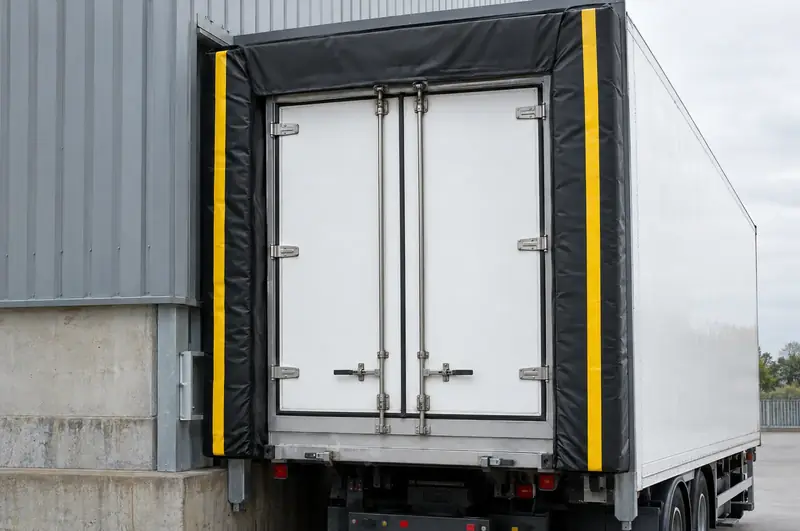
A dock seal is a set of fabric-covered foam pads fixed to the building around a loading bay door, usually a head pad and two side pads. When a trailer reverses in, its rear end presses into the foam, which compresses to close the gaps around the trailer body. Seals give a very tight fit but work best when the trailers using the bay are a consistent size.
How much do dock seals cost?
A set of dock seals typically costs £1,100 to £2,600 per set, excluding VAT, supply and fit. A set is normally a head pad and two side pads for one bay.
The price depends on:
- Pad size and depth: larger openings and deeper foam cost more.
- Head arrangement: a fixed head pad, or a curtain head for varied trailer heights.
- Cover fabric: heavier coated fabric and replaceable wear pleats last longer.
- Pad shape: tapered side pads that guide the trailer and intrude less into the opening.
- Mounting: fixing direct to masonry, to a steel frame, or to brackets that set the projection.
- Site work: removing old seals, adjusting bumpers and powered access equipment.
Where the foam is still sound, new covers can cost less than new pads, and we will say if that is an option. After a free site survey you receive a fixed written price for the work described.
What do workplace transport rules mean for a sealed dock?
A sealed dock still needs safeguards against a trailer leaving early, and the seal, bumpers and other dock equipment must be kept in safe working order. In Great Britain the regulator is HSE; in Northern Ireland it is HSENI.
- Drive-away: HSE workplace transport guidance (HSG136) and the HSE loading factsheet call for safeguards against drivers driving away too early, including traffic lights, vehicle or trailer restraints, or the person in charge keeping keys or paperwork until it is safe.
- Trailer creep: because the trailer is pressed into compressed foam, it can ease forward during forklift loading. Restraints and well-set bumpers help keep it in position.
- Equipment duties: a dock seal forms part of the loading bay's work equipment, so the general duty under PUWER 1998 in Great Britain, or PUWER (Northern Ireland) 1999, to keep equipment suitable and maintained applies.
Torn covers and crushed pads can hide damage to the fixings and wall behind, so seals belong in planned inspections of the dock.
When is a dock seal a better choice than a shelter?
A dock seal is a better choice than a shelter when the trailers using a bay are consistent in size, the dock height suits them, and the tightest practical seal matters. Mixed fleets are usually better served by a shelter.
- Consistent fleets: dedicated vehicles or regular hauliers using the same trailer type.
- Temperature control: chilled or heated buildings where gaps around the trailer are costly.
- Security and hygiene: fewer gaps for pests, dust and unauthorised access during loading.
- Budget: seals cost less than inflatable shelters for a close fit.
The trade-offs are that seals can leave gaps at trailer door hinges, side pads can intrude into the trailer opening if poorly sized, and the covers wear from rubbing. If your trailers vary, compare our retractable dock shelters before deciding, as they leave the full opening clear.
Which types and options are available?
Fixed head pad seal
A head pad and two side pads of set depth, the simplest and tightest arrangement where every trailer using the bay is the same height.
Seal with curtain head
Foam side pads combined with a flexible top curtain that adjusts to trailers of different heights, a halfway point between a seal and a shelter.
Tapered side pads
Side pads tapered in section so they guide the trailer in and intrude less into the trailer opening, which extends pad and cover life.
Replaceable wear pleats
Sacrificial fabric strips on the pad faces that take the rubbing from trailers and can be replaced without changing the whole cover.
Typical specification
| Components | Typically one head pad and two side pads per bay |
|---|---|
| Foam | Typically resilient foam in a coated fabric cover |
| Projection | Typically set relative to the bumpers for controlled compression |
| Head options | Fixed head pad or flexible curtain head |
| Power needed | Not required |
| Fixing | Wall brackets or steel frame, with a subframe on cladding |
| Typical use | Consistent fleets at chilled and heated buildings |
Budget range for supply and fit. Your written quote after a free site survey is the fixed price. See all guide prices.
How are dock seals fitted to a loading bay?
Dock seals are fixed to the outside wall around the dock door, normally on brackets or a frame that sets their projection, and a set usually takes a few hours to fit. No power supply is needed.
- The wall is checked for sound fixing points, with a frame or spreader plates added on cladding.
- The head pad and side pads are positioned to suit your trailer width and height.
- Projection is set relative to the bumpers, so trailers compress the foam by the right amount.
- Bumpers are checked and, if worn, replaced at the same time.
- A trailer is docked to confirm an even seal along the head and sides.
From you we need the bay taken out of use, a clear area in the yard for powered access equipment and, ideally, one of your usual trailers available at the end of the job so the fit can be checked under real conditions.
Why does the gap between the seal and the bumpers matter?
The distance between the face of the seal and the face of the bumpers decides how far the trailer compresses the foam, and getting it right is the difference between a good seal and pads that are crushed or leave gaps.
- Too little projection: the trailer meets the bumpers before it presses the foam enough, leaving gaps at the head and sides.
- Too much projection: the foam is over-compressed, which crushes the pads, strains the fixings and can push the trailer forward as the foam recovers.
- Worn bumpers: let trailers travel further than designed, over-compressing the seal every time.
Correct projection depends on the foam depth and your trailers, so we set it at installation and it should be checked at each service. Keeping dock bumpers in good condition protects both the seal and the leveller from repeated impact.
How can dock seal pads be made to last longer?
Dock seal pads last longer when trailers arrive straight and stop at the right point, because most wear comes from trailers rubbing against the covers or pressing too far into the foam. Covers usually wear first, and the foam inside can outlast them.
- Replaceable wear pleats: sacrificial strips on the pad faces take the abrasion and can be swapped cheaply.
- Wheel guides and dock lights: help drivers reverse squarely into the centre of the bay.
- Bumper maintenance: keeps compression within design limits.
- Tapered side pads: guide trailers in and reduce rubbing on the pad edges.
- Driver briefings: regular hauliers who know the bay damage it less.
When covers split, replacing them promptly stops rain soaking into the foam, which makes it heavy, slow to recover and prone to freezing in winter.
When is this the right choice?
- Daylight and draughts show around the sides of docked trailers.
- The same trailer type uses the bay almost every time.
- Foam pads are crushed, waterlogged or permanently flattened.
- Covers have split and the foam inside is exposed to rain.
- You run a chilled or heated building where every gap around the trailer matters.
How the job runs
- Free site survey
We measure the door and wall, record trailer widths and heights, check bumper condition and projection, and note how consistent the vehicles using the bay are.
- Written quote
A fixed written price stating pad sizes, head arrangement, cover fabric, mounting method and any bumper replacement, with removal of old seals included.
- Installation
Pads are fixed to the wall from the yard using powered access equipment and set to the right projection relative to the bumpers, usually within a few hours.
- Testing and handover
A trailer is docked to check the seal along the head and sides, and we explain how to spot cover wear and over-compression early.
Dock seals: questions
Can dock seals handle trailers of different heights?
Only within a limited range. A fixed head pad seals well on trailers of one height but leaves gaps over lower ones and can be crushed by taller ones. A seal with a flexible curtain head copes better with varied heights, and for very mixed fleets a shelter is usually the better option.
Can just the covers be replaced?
Yes, if the foam is still resilient and dry, new covers can often be fitted over the existing foam, which usually costs less than new pads. Waterlogged or permanently crushed foam should be replaced. Cover replacement is handled as a repair, with the visit price agreed beforehand.
Do dock seals block access to the trailer?
They can if they are poorly sized. Side pads that sit inside the line of the trailer body intrude into the opening and get in the way of pallets and forklifts. Correctly sized and tapered pads compress against the rear corners and leave the opening clear.
Do trailer doors need to be opened before docking against a seal?
Yes, the rear doors are opened and folded back before the trailer reverses onto a seal, so the pads press against the rear of the trailer rather than the doors. Gaps can remain at the door hinges, which is a known limitation of seals compared with shelters.
Are dock seals suitable for cold stores?
Yes, for cold stores with consistent trailers a dock seal gives a tight fit at a lower cost than an inflatable shelter. The pads must be kept in good condition, because water in the foam can freeze and stiffen it. Mixed fleets at cold stores are often better served by inflatable shelters.
How can I tell if seal projection is wrong?
Look at the pads with a trailer docked. Daylight around the head or sides suggests too little compression, while pads squashed flat or bulging around the trailer suggest too much. Worn bumpers are a common cause, and both can be checked at a planned service.
Related equipment and services
Further reading
Dock seals by area
England
- Bedfordshire
- Berkshire
- Buckinghamshire
- Cambridgeshire
- Cheshire
- City and County of Bristol
- Cornwall
- County Durham
- Cumbria
- Derbyshire
- Devon
- Dorset
- East Riding of Yorkshire
- East Sussex
- Essex
- Gloucestershire
- Greater London
- Greater Manchester
- Hampshire
- Herefordshire
- Hertfordshire
- Isle of Wight
- Kent
- Lancashire
- Leicestershire
- Lincolnshire
- Merseyside
- Norfolk
- North Yorkshire
- Northamptonshire
- Northumberland
- Nottinghamshire
- Oxfordshire
- Rutland
- Shropshire
- Somerset
- South Yorkshire
- Staffordshire
- Suffolk
- Surrey
- Tyne and Wear
- Warwickshire
- West Midlands
- West Sussex
- West Yorkshire
- Wiltshire
- Worcestershire