
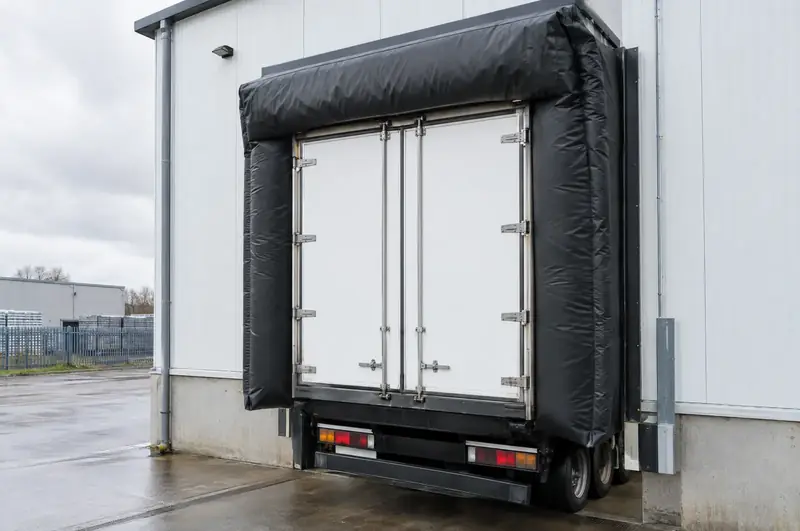
An inflatable dock shelter is a dock shelter with air-filled fabric cushions at the top and sides of the opening, kept deflated and close to the building until a trailer has reversed in. A fan then inflates the cushions so they press against the trailer roof and sides, giving a close seal that adapts to different trailer widths and heights, and deflates again before the trailer leaves.
How much does an inflatable dock shelter cost?
An inflatable dock shelter typically costs £6,800 to £12,800 per shelter, excluding VAT, supply and fit. It costs more than a curtain shelter or foam seal because of its cushions, fan and controls, and the closer seal it gives.
Costs are driven mainly by:
- Size: door width and height, and the range of trailers to be sealed.
- Cushion layout: a top cushion only, or top and side cushions.
- Fan and controls: standalone push-button control or full integration with the door, leveller and restraint.
- Frame and covers: the steel frame and any protective outer curtains.
- Cold store features: insulated frames or heating where ice is a concern.
- Site work: wall fixings, power supply, powered access equipment and removal of an old shelter or seal.
We fix the price in the written quote after a free site survey, which also confirms whether your trailer range suits an inflatable shelter.
What safety rules affect inflatable dock shelters?
An inflatable shelter is powered dock equipment, so it must be suitable, maintained and correctly marked, and it should be controlled so a trailer cannot pull away with the cushions inflated around it.
- Work equipment: PUWER 1998 in Great Britain and PUWER (Northern Ireland) 1999 require it to be maintained in a safe condition and inspected where deterioration could lead to danger.
- Marking: in Great Britain powered dock equipment may carry the UKCA or the CE mark. For Northern Ireland, the CE mark or CE with UKNI applies.
- Drive-away: HSE workplace transport guidance (HSG136), followed by HSENI in Northern Ireland, calls for safeguards against drivers driving away too early, such as traffic lights, vehicle or trailer restraints, or keeping keys until it is safe. Linking deflation to these controls protects both the cushions and the driver.
- Regulator: HSE in Great Britain and HSENI in Northern Ireland.
A vehicle restraint interlocked with the shelter and door is a common way to make the whole sequence dependable.
Inflatable shelter, curtain shelter or dock seal: which suits a cold chain dock?
For a cold chain dock that receives trailers of different sizes, an inflatable shelter usually gives the best balance of close sealing and flexibility. A dock seal can match it on a uniform fleet, while a curtain shelter is better suited to ambient bays.
- Inflatable shelter: cushions adapt to each trailer's width and height and seal close to the body, with the full opening left clear.
- Dock seal: a tight, lower-cost seal when every trailer is the same size, but it can leave gaps on other vehicles and the pads can intrude into the opening.
- Curtain shelter: flexible and robust, but leaves small gaps that matter more at chilled and frozen docks.
Inflatables also stand clear of the trailer until it has docked, avoiding the rubbing that wears foam pads and curtains. The trade-off is the fan and controls, which need power and servicing. For frozen docks we specify the shelter alongside cold store dock doors so the two work together.
Which types and options are available?
Top cushion only
A single inflatable cushion across the top of the opening, paired with fixed side pads or curtains, for docks where trailer heights vary more than widths.
Three-sided inflatable
Top and side cushions that inflate around the trailer for the closest seal, the usual choice for chilled and frozen docks with mixed trailers.
Interlocked controls
Controls linked to the door, leveller and restraint so the shelter inflates before the door opens and deflates only once it has closed.
Protective outer covers
Hard-wearing covers over the cushions that shield the fabric from weather, sunlight and trailer contact, extending cushion life on exposed docks.
Typical specification
| Cushions | Typically top and side cushions, or a top cushion only |
|---|---|
| Inflation | Electric fan, inflating once the trailer is docked and secured |
| Typical use | Chilled and frozen docks with mixed trailer sizes |
| Power supply | Typically a dedicated supply for the fan and controls |
| Controls | Push button, or interlocked with door, leveller and restraint |
| Retraction | Internal straps, weights or springs pull the cushions clear |
| Fabric | Typically coated industrial fabric with wear patches |
| Marking | UKCA or CE in Great Britain; CE or CE with UKNI in Northern Ireland |
Budget range for supply and fit. Your written quote after a free site survey is the fixed price. See all guide prices.
What is involved in installing an inflatable dock shelter?
Installing an inflatable shelter involves fixing a steel frame to the building around the dock door, mounting the cushions and fan, and wiring the controls, usually over one to two days per bay.
- The wall is checked and fixing points or a subframe prepared.
- The frame is fixed from powered access equipment in the yard.
- Top and side cushions are fitted, with protective covers where specified.
- The fan unit is mounted and the control panel wired, including interlocks to the door, leveller or restraint.
- Inflation, deflation and cushion retraction are tested with a trailer in the bay.
You will need to provide a clear yard area in front of the bay, take the bay out of use and arrange a power supply near the door, or ask us to include one. At cold stores we plan the work with the dock door kept closed, so the store stays at temperature while the shelter goes up outside.
How does an inflatable shelter work with the dock door and leveller?
An inflatable shelter is the first step in the dock sequence: it seals around the trailer before the door opens and only deflates once the door has closed. Getting that order right is what makes it effective.
- The trailer reverses onto the bumpers, guided by dock lights and wheel guides.
- The trailer is secured by restraint or key control, and the outside light shows red.
- The cushions inflate around the top and sides of the trailer.
- With the trailer sealed, the door opens and the leveller is deployed.
- After loading, the leveller is stored and the door closed.
- The cushions deflate and retract, and the light turns green.
Deflated cushions must sit clear of the door and leveller, and internal straps or weights pull them back so trailers do not catch them. Interlocks make each step depend on the last, so staff cannot open the door onto an unsealed trailer.
What maintenance does an inflatable dock shelter need?
An inflatable shelter needs regular checks on its fabric, fan and controls, because a puncture or a weak fan stops it sealing properly. Planned servicing catches most faults before they affect the cold chain.
- Cushion fabric: inspect for punctures, abrasion and failed seams, and patch or replace cushions as needed.
- Fan unit: check filters, motor and airflow so the cushions inflate fully and promptly.
- Retraction system: straps, weights or springs must pull the cushions back clear of the trailer.
- Controls and interlocks: confirm the sequence with the door, leveller and restraint still works.
- Frame and fixings: look for impact damage and corrosion.
Snow and ice on the top cushion can stop it retracting, so a check before winter is worthwhile. Service and repair visits are chargeable, and the price is agreed before anyone attends.
When is this the right choice?
- Chilled or frozen goods are exposed to warm air around the trailer during loading.
- Your cold store receives trailers of many different widths and heights.
- Foam seals are worn out from rubbing against trailers that do not fit them.
- Ice and condensation form around the dock door at refrigerated bays.
- You are upgrading a temperature-controlled dock and want the closest practical seal.
How the job runs
- Free site survey
We measure the door and wall, record the full range of trailers you receive, note store temperature, and check power and the existing door and leveller controls.
- Written quote
A fixed written price for the shelter, cushion layout, fan, controls, interlocks, fixings and power works, including removal of any old shelter or seal.
- Installation
The frame, cushions and fan are fitted from the yard, then controls and interlocks are wired to the door, leveller or restraint, usually over one to two days.
- Testing and handover
We test inflation, deflation and retraction with a trailer in the bay, check the interlock sequence and show your team how the controls work.
Inflatable dock shelters: questions
Do the cushions touch the trailer as it reverses in?
No, the cushions stay deflated and pulled back against the building while the trailer reverses in, so there is no rubbing as it docks. They inflate only once the trailer is in position and secured, which reduces wear on the fabric compared with foam seals and curtain shelters.
What happens to an inflatable shelter if the power fails?
If the power fails, the fan stops and the cushions gradually deflate, so the trailer can leave once loading has been brought to a safe end. At a cold store, the dock door should be closed by hand where possible to protect the store. We explain the power failure routine at handover.
Is an inflatable shelter worth it at an ambient dock?
An inflatable shelter works at any dock, but at ambient bays a curtain shelter or dock seal usually gives enough sealing for less cost. Inflatables make most sense where temperature, hygiene or energy use makes the closest practical seal worth paying for.
Can a punctured cushion be repaired?
Small punctures and tears can usually be patched, and a badly damaged cushion can be replaced on its own without changing the frame or fan. Repairs are carried out on a chargeable visit, with the price agreed before anyone attends.
Does an inflatable shelter work with containers and double-deck trailers?
Yes, provided the shelter is sized for the tallest and widest vehicles you receive. The cushions adapt to each vehicle's dimensions, which is a key reason inflatable shelters suit sites handling containers, standard trailers and double-deck units at the same bays.
Will we need to change the rest of the dock?
Usually not. Most inflatable shelters fit around an existing door opening, though the leveller, bumpers and door controls are reviewed so the cushions clear them and the interlocks work. Where the wall cannot carry the frame, a subframe is added. We confirm what is needed at survey.
Related equipment and services
Further reading
Inflatable dock shelters by area
England
- Bedfordshire
- Berkshire
- Buckinghamshire
- Cambridgeshire
- Cheshire
- City and County of Bristol
- Cornwall
- County Durham
- Cumbria
- Derbyshire
- Devon
- Dorset
- East Riding of Yorkshire
- East Sussex
- Essex
- Gloucestershire
- Greater London
- Greater Manchester
- Hampshire
- Herefordshire
- Hertfordshire
- Isle of Wight
- Kent
- Lancashire
- Leicestershire
- Lincolnshire
- Merseyside
- Norfolk
- North Yorkshire
- Northamptonshire
- Northumberland
- Nottinghamshire
- Oxfordshire
- Rutland
- Shropshire
- Somerset
- South Yorkshire
- Staffordshire
- Suffolk
- Surrey
- Tyne and Wear
- Warwickshire
- West Midlands
- West Sussex
- West Yorkshire
- Wiltshire
- Worcestershire