
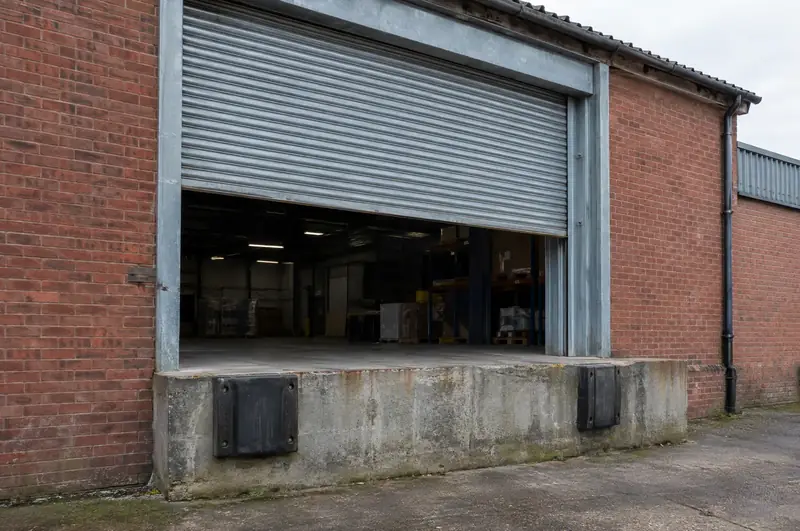
A roller shutter loading bay door is a door made from interlocking horizontal slats, called laths, that coil around a barrel in a box above the opening. Because it rolls up into a compact space, a shutter needs little headroom and no ceiling tracks, which suits older units, low-headroom openings and buildings with cranes, pipes or racking close above the door.
How much does a roller shutter loading bay door cost?
A roller shutter loading bay door typically costs £1,600 to £4,800 per door, excluding VAT, supply and fit. That usually makes it the most economical door for a dock opening, though the specification makes a big difference to where a door lands.
The price depends mainly on:
- Size: wider openings need a larger barrel, heavier laths and stronger brackets.
- Lath type: single-skin steel is the cheapest; foam-filled insulated laths and aluminium cost more.
- Operation: hand chain, or an electric motor with controls, safety edge and photocells.
- Wind resistance: end locks, deeper guides or heavier gauge laths for exposed openings.
- Finish: galvanised steel or a powder-coated colour, plus a hood box to protect the coil.
- Site work: stripping out an old shutter, repairing reveals, providing power and working out of hours.
The written quote that follows our free site survey fixes the price for the work described.
What safety and energy rules apply to roller shutters at a dock?
A dock roller shutter must be protected against falling, must not trap anyone if powered, and in a heated building may need insulated laths to meet energy rules.
- Falling back: the Workplace (Health, Safety and Welfare) Regulations 1992 in Great Britain, and the Northern Ireland regulations of 1993, require upward-opening doors to have a device that stops them falling back. On a shutter this is usually a safety brake or anti-fall device on the barrel.
- Trapping: powered shutters need suitable features to prevent trapping, typically a safety edge and photocells, and a way to open by hand, such as a chain override, where needed.
- Energy: in England, Approved Document L (2021) Volume 2 sets a limiting U-value of 1.3 W/m²K for vehicle access doors in new and replacement work. A single-skin steel shutter will not normally reach that figure. Wales, Scotland and Northern Ireland set their own rules, and we confirm the figure for your nation and project.
Our guide to energy rules for loading bay doors explains U-values in more detail.
Which lath should I choose: single skin, insulated or aluminium?
Choose single-skin steel for unheated buildings where cost and strength matter most, insulated laths where the building is heated, and aluminium where weight or corrosion is the main concern.
- Single-skin steel: strong and economical, ideal for unheated stores, trade counters and secure external openings, but it offers little insulation.
- Insulated steel laths: twin-skin laths filled with foam improve thermal performance and reduce noise. The coil is larger, so the box above the opening is bigger.
- Aluminium laths: lighter and corrosion resistant, useful in coastal or washdown environments, and easier on the motor at large openings.
- Perforated or punched laths: let light and air through while keeping the opening secure, better suited to internal cages than external docks.
Lath gauge and profile matter too. Heavier gauges resist forklift knocks and wind better, and we specify them for wide or exposed openings.
Which types and options are available?
Single-skin steel shutter
Galvanised or powder-coated steel laths giving a strong, economical door for unheated stores, builders merchants and openings where security matters more than insulation.
Insulated lath shutter
Foam-filled twin-skin laths that improve thermal performance and reduce noise, for heated goods-in areas where headroom rules out a sectional door.
Aluminium shutter
Lighter laths that resist corrosion, suited to coastal sites, washdown areas and large openings where a lighter curtain puts less strain on the motor.
Electric operation with safety devices
An external or tubular motor with push-button controls, safety edge, photocells and a hand-chain override for use during a power cut.
Wind-resistant build
End locks, deeper guides and heavier gauge laths for wide or exposed openings where gusts could pull the curtain out of its guides.
Typical specification
| Lath types | Single-skin steel, insulated twin-skin steel, aluminium or perforated |
|---|---|
| Typical dock opening | Commonly about 3.0 m wide by 3.0 to 3.5 m high |
| Headroom needed | Typically only the coil and box above the opening, far less than a sectional door |
| Operation | Hand chain, or external or tubular electric motor |
| Safety features | Typically safety brake or anti-fall device, plus safety edge and photocells on powered shutters |
| Wind resistance | End locks, deeper guides and heavier gauge laths where needed |
| Finish | Typically galvanised or powder-coated, with optional hood box |
| Standards | BS EN 13241 product standard; BS EN 12453 for powered shutters |
Budget range for supply and fit. Your written quote after a free site survey is the fixed price. See all guide prices.
How is a roller shutter fitted to an existing loading bay opening?
A roller shutter is fitted either behind the opening on the inside face or between the reveals, with guides fixed down each side and the barrel mounted on brackets above. Fitting usually takes a day or less per opening once the shutter is on site.
The work normally includes:
- Removing and disposing of the old door or shutter.
- Checking the lintel and reveals will take the fixings, and adding steel packers if not.
- Fixing the guides, brackets and barrel, then running the curtain onto the barrel.
- Fitting the motor, controls, safety edge and photocells on electric shutters.
- Setting limits, testing the safety brake and demonstrating the manual override.
You will need to clear the area inside the opening and take the bay out of use. An electric shutter also needs a suitable isolated power supply near the barrel, which we can include in the quote if one is not already there.
Can a roller shutter cope with high winds at an exposed dock?
Yes, if it is specified for the exposure. Wind pushes the curtain inwards or draws it outwards, and on a wide opening that load can pull laths out of their guides or bow the whole curtain.
For exposed docks we typically consider:
- End locks: clips on the ends of the laths that hold the curtain inside the guides under load.
- Deeper guides: give the end locks more to hold on to.
- Heavier gauge or profiled laths: stiffer across wide openings.
- Intermediate wind bars: horizontal reinforcement on very large shutters.
Openings that face open yards, sit at the end of a building or are funnelled between units tend to see the strongest gusts. We note orientation and surroundings at survey and choose a wind-resistant build where it is needed, rather than adding cost to every door on the site.
Is a roller shutter or a sectional door better for a loading bay?
A roller shutter is usually better where headroom is tight, budgets are limited or the building is unheated, while a sectional door is usually better for heated buildings and busy docks that open and close all day.
- Headroom: a shutter coils into a box above the opening; a sectional door needs track running back under the ceiling or up the wall.
- Insulation: insulated sectional panels generally outperform insulated laths.
- Speed: shutters are slower to open and close than most electric sectional doors.
- Security: a closed steel shutter is a robust barrier.
- Repairs: damaged laths can be replaced individually, just as a dented sectional panel can be swapped.
See sectional loading bay doors to compare the two. Where either would work, we can quote both so you can weigh price against performance.
When is this the right choice?
- Your building is unheated and you need a strong, economical door for the dock.
- There is too little headroom above the opening for sectional door tracks.
- Laths are bent or jumping out of the guides after wind or forklift damage.
- An old manual shutter is too heavy to open safely by hand chain several times a day.
- Cranes, pipework or racking sit close above the opening and block overhead tracks.
How the job runs
- Free site survey
We measure the opening and the space above it, check the lintel and reveals for fixings, note wind exposure and heating, and look at power for an electric shutter.
- Written quote
Your fixed written price sets out lath type, gauge, operation, wind features, safety devices, finish, removal of the old door and any making good.
- Installation
Guides, brackets and barrel are fixed, the curtain run on, and the motor and safety devices wired, usually with the bay out of use for a day or less.
- Testing and handover
Limits are set, the safety brake and safety edge tested, and your staff shown the controls and hand-chain override, with warranty paperwork handed over.
Roller shutter loading bay doors: questions
Are roller shutters noisy at a loading bay?
A roller shutter is generally noisier than a sectional door because the laths move against each other as they coil, though insulated laths and well-adjusted guides reduce this. Noise matters most where the dock is close to offices or neighbours. Keeping the barrel and guides clean and lubricated keeps running noise down.
Can an existing manual shutter be motorised?
Often yes. If the barrel, end plates and curtain are in good condition, an external or tubular motor can be added with controls and safety devices. Older or heavier shutters sometimes need a stronger barrel first, and a badly worn curtain is usually better replaced at the same time.
Can individual damaged laths be replaced?
Yes, damaged laths can usually be cut out and replaced without changing the whole curtain, provided matching laths are still available. If damage spreads across many laths or the guides are bent, a new curtain is often more economical. Lath repairs are carried out on a chargeable visit with the price agreed first.
Do roller shutters work on cold store docks?
Roller shutters are rarely used as the main door on a cold store dock, because even insulated laths do not hold temperature as well as a purpose-made cold store door. They can work as an outer security door in front of an insulated door, or at ambient bays on the same site.
What finish options are available?
Most dock shutters are supplied in galvanised steel or powder-coated in a standard colour, with other colours available at extra cost. A hood box over the coil protects it from dust and weather and gives a tidier finish inside. We confirm finish and colour in the written quote.
How long does a new roller shutter take to arrive?
Shutters are made to measure, so the lead time depends on size, lath type and finish, and we confirm it in the written quote. The existing door stays in use until the new shutter is ready, and installation is then booked for a time that suits your operation.
Related equipment and services
Further reading
Roller shutter loading bay doors by area
England
- Bedfordshire
- Berkshire
- Buckinghamshire
- Cambridgeshire
- Cheshire
- City and County of Bristol
- Cornwall
- County Durham
- Cumbria
- Derbyshire
- Devon
- Dorset
- East Riding of Yorkshire
- East Sussex
- Essex
- Gloucestershire
- Greater London
- Greater Manchester
- Hampshire
- Herefordshire
- Hertfordshire
- Isle of Wight
- Kent
- Lancashire
- Leicestershire
- Lincolnshire
- Merseyside
- Norfolk
- North Yorkshire
- Northamptonshire
- Northumberland
- Nottinghamshire
- Oxfordshire
- Rutland
- Shropshire
- Somerset
- South Yorkshire
- Staffordshire
- Suffolk
- Surrey
- Tyne and Wear
- Warwickshire
- West Midlands
- West Sussex
- West Yorkshire
- Wiltshire
- Worcestershire