
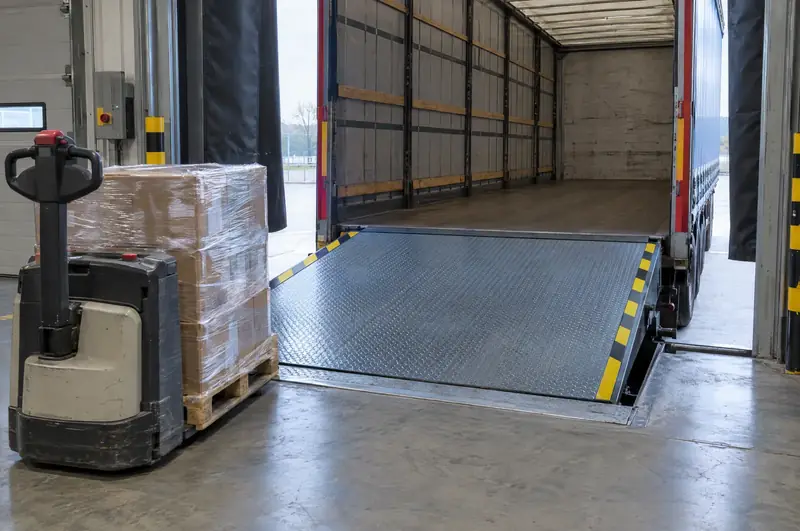
A swing-lip dock leveller is a hydraulic ramp set into a pit at the dock edge, with a hinged steel lip along its front. When a trailer is docked the platform rises, the lip swings out, and the platform lowers until the lip rests on the trailer bed, forming a bridge for forklifts and pallet trucks. The lip is typically about 400 to 500 mm long.
Where does this fit at a dock in Oxfordshire?
Ageing levellers in older docks around Oxfordshire can often be replaced like for like in the existing pit, avoiding new concrete work if the pit is sound. Chilled food distributors in Oxfordshire can specify insulated swing-lip levellers with pit seals to cut cold loss through the floor of the bay.
Distribution warehouses in Oxfordshire loading curtain-siders and box trailers every day are typical users of swing-lip levellers, which handle routine pallet loading well.
We keep the process simple for sites in Oxfordshire. A free survey tells us what the dock needs; a fixed written quote tells you what it will cost and what is included. We then organise the installation, with specialist engineers under our management and a programme agreed around your shifts. Night and weekend work is available by arrangement. Before we leave, the new equipment is tested, demonstrated and handed over with its documentation.
Do dock levellers have to be inspected by law?
Yes, dock levellers are work equipment and must be kept in a safe condition and inspected where deterioration could lead to danger. The law and the regulator depend on where the site is.
- Great Britain: the Provision and Use of Work Equipment Regulations 1998 (PUWER), enforced by HSE.
- Northern Ireland: PUWER (Northern Ireland) 1999, enforced by HSENI.
- Inspection interval: engineering insurers commonly inspect dock levellers under PUWER at 12-month intervals.
- LOLER: most levellers are treated as work equipment under PUWER, but one designed or used to lift people may fall under LOLER, or LOLER (Northern Ireland) 1999, with 6-monthly thorough examination. It depends on the equipment and how it is used; your insurer or competent person will confirm.
- Standard: BS EN 1398:2009 sets the safety requirements for dock levellers. It is current and under review.
Our inspection guide explains what an examiner looks at.
What happens when a swing-lip leveller is fitted into an existing pit?
Fitting a swing-lip leveller into an existing pit normally takes one to two working days per bay, with the bay closed throughout. The work runs in a set order:
- The old leveller is isolated, lifted out and removed from site.
- The pit is cleaned and measured, and the edge steel checked for damage.
- The new leveller is lowered in, set level, and welded or anchored to the pit steel.
- The hydraulic power pack and control panel are connected, and any interlocks wired.
- Toe guards, lip and bumpers are checked, then the leveller is run through its full range.
From your side we need the bay emptied and taken out of service, clear access for lifting equipment inside or outside the building, and a suitable power supply, which for most hydraulic levellers is three-phase. If the pit needs repairs, these are done first and can add time, which we confirm in the quote.
Towns we cover in Oxfordshire
Find your town in the list below for details of swing-lip dock levellers across Oxfordshire, or contact us if your location is not shown.
Budget range for supply and fit. The written quote after a free survey is the fixed price. All guide prices.
Which rules apply in England?
Powered doors and dock equipment installed in England may carry the UKCA or the CE mark, and doors are covered by the product standard BS EN 13241. We hand over the relevant documentation for each item fitted in Oxfordshire. Planning and Building Regulations questions are never assumed either way: we check what applies at survey, so you know before work is booked.
Questions
How do you price swing-lip dock levellers for a site in Oxfordshire?
Guide budgets for supply and fit are £5,200 to £8,800 per leveller, excluding VAT. The figure moves with size, insulation, the operator, electrics, access, any pit or groundworks and out-of-hours working. Where levellers are involved, the guide assumes an existing, sound pit. After the free survey you receive a fixed written quote, and that is the price for the agreed scope.
Do you remove and dispose of the old equipment?
Yes, where it is part of the scope. When we replace doors, levellers, shelters or seals at a site in Oxfordshire, removal and disposal of the old equipment can be included and is itemised in the quote, so it is clear what is covered. If anything should be kept, such as a frame or motor that is still serviceable, we agree that at survey.
What happens if a trailer pulls away with the lip on its bed?
The platform drops until its safety system stops it. Hydraulic levellers have a velocity fuse that arrests the fall, but the event can still damage the leveller and endanger anyone on it, which is why dock traffic lights, restraints and key control are used to prevent early drive-away.
What capacity of leveller do we need?
The leveller needs to be rated for the heaviest combined load of forklift and goods that will cross it, allowing for the truck moving over it. General-purpose levellers are typically rated around 60 kN, with heavier ratings for heavy goods or large forklifts. We confirm the rating after looking at your equipment.
Other services in Oxfordshire
Full guide to swing-lip dock levellers · All loading bay services in Oxfordshire