
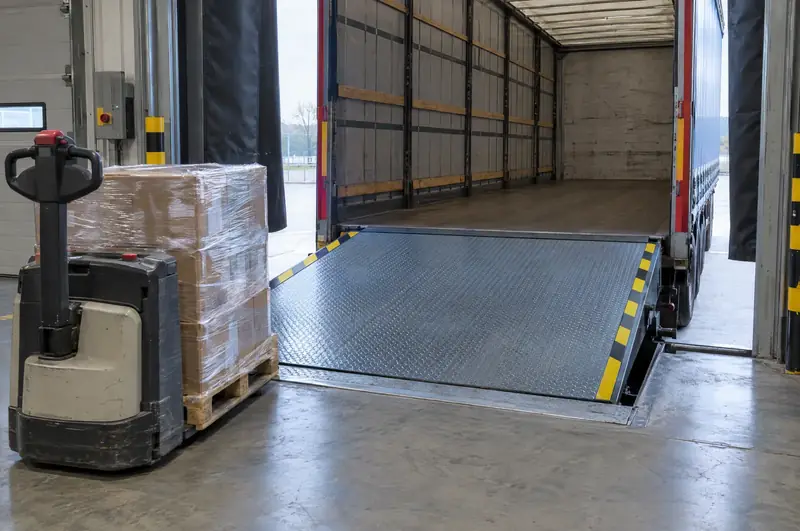
A swing-lip dock leveller is a hydraulic ramp set into a pit at the dock edge, with a hinged steel lip along its front. When a trailer is docked the platform rises, the lip swings out, and the platform lowers until the lip rests on the trailer bed, forming a bridge for forklifts and pallet trucks. The lip is typically about 400 to 500 mm long.
Is this right for your site in the West Midlands?
Every leveller recommendation we make for a dock in the West Midlands follows a measured survey of the pit, dock height and the trailers you actually receive. Should a recent insurance inspection at a site in the West Midlands have flagged leveller defects, a survey can show whether repair or replacement makes more sense.
Chilled food distributors in the West Midlands can specify insulated swing-lip levellers with pit seals to cut cold loss through the floor of the bay.
The survey is free, the quote is written and the price is fixed: that is how every installation in the West Midlands begins. We then manage the work from start to finish. Fitting is carried out by specialist installers under our management, phased so the operation keeps moving, and nights or weekends can be booked by arrangement. On the final day we test the equipment with you and hand over the operating and maintenance information.
What wears out on a swing-lip dock leveller?
The lip hinge, hydraulic hoses and seals are usually the first parts to wear on a swing-lip leveller, and planned servicing finds most of these problems before they stop a bay.
- Lip hinge: takes an impact every time the lip lands, and suffers badly if trailers reverse into a lip that has not been stored.
- Hydraulics: hoses, cylinder seals and power pack oil age and can leak.
- Velocity fuse: the safety valve that stops the platform dropping if a trailer pulls away must be tested.
- Toe guards and maintenance strut: must be intact and working. HSE guidance notes guards or skirting may be needed where something could be caught.
- Dock bumpers: worn bumpers let trailers strike the leveller and dock edge.
A leveller with a cracked lip hinge, a bent platform or repeated hydraulic leaks may be better replaced than repaired. Service and repair visits are chargeable and agreed before anyone attends.
Which trailers and loads suit a swing-lip leveller?
A swing-lip leveller suits everyday loading of standard trailers, where pallets sit a little way back from the rear of the trailer and the lip has room to land on the bed. It is a common choice for general distribution.
- Good fit: curtain-siders and box trailers loaded by forklift or pallet truck, with the lip landing behind the first row of pallets.
- Less suited: trailers loaded right up to the rear doors, because the lip needs clear bed space to rest on.
- Tail-lift vehicles: a folded tail lift can stop the lip reaching the bed.
- End loading: loading the last row of pallets at the very rear is awkward with a fixed-length lip.
Where these situations are common, a telescopic-lip dock leveller places its lip exactly where it is needed. Many sites fit both types across their bays, matching each bay to the vehicles it receives.
Towns we cover in the West Midlands
Choose a town below to see how we handle swing-lip dock levellers in that part of the West Midlands.
- Birmingham
- Coventry
- Wolverhampton
- Dudley
- Walsall
- Solihull
- Sutton Coldfield
- West Bromwich
- Halesowen
- Stourbridge
- Smethwick
- Willenhall
- Tipton
- Bloxwich
- Wednesfield
- Washwood Heath
- Aston
- Shirley
- Brierley Hill
- Aldridge
- Bartley Green
- Wednesbury
Budget range for supply and fit. The written quote after a free survey is the fixed price. All guide prices.
Which rules apply in England?
Powered doors and dock equipment installed in England may carry the UKCA or the CE mark, and doors are covered by the product standard BS EN 13241. We hand over the relevant documentation for each item fitted in the West Midlands. Planning and Building Regulations questions are never assumed either way: we check what applies at survey, so you know before work is booked.
Questions
Do you remove and dispose of the old equipment?
Yes, where it is part of the scope. When we replace doors, levellers, shelters or seals at a site in the West Midlands, removal and disposal of the old equipment can be included and is itemised in the quote, so it is clear what is covered. If anything should be kept, such as a frame or motor that is still serviceable, we agree that at survey.
How long does installation take at a site in the West Midlands?
It depends on the equipment, the number of bays, the condition of the dock and whether any building or electrical work is needed. We agree a programme with you after the survey, setting out which bays are out of use and when. Larger jobs are usually phased so that part of the dock stays open, and out-of-hours working can be arranged.
What capacity of leveller do we need?
The leveller needs to be rated for the heaviest combined load of forklift and goods that will cross it, allowing for the truck moving over it. General-purpose levellers are typically rated around 60 kN, with heavier ratings for heavy goods or large forklifts. We confirm the rating after looking at your equipment.
Can a new leveller fit our old pit?
Usually, yes. Levellers are made in standard sizes and many can be supplied to suit an existing pit, but the pit must be square, sound and deep enough. We measure the pit and check the edge steel at survey, and if adjustment or repair is needed we price it separately.
Other services in the West Midlands
Full guide to swing-lip dock levellers · All loading bay services in the West Midlands