
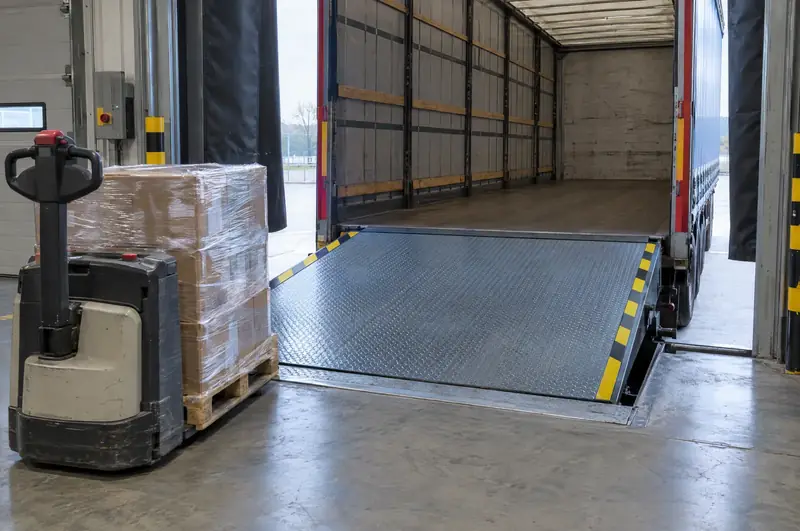
A swing-lip dock leveller is a hydraulic ramp set into a pit at the dock edge, with a hinged steel lip along its front. When a trailer is docked the platform rises, the lip swings out, and the platform lowers until the lip rests on the trailer bed, forming a bridge for forklifts and pallet trucks. The lip is typically about 400 to 500 mm long.
Where does this fit at a dock in Lincolnshire?
Distribution warehouses in Lincolnshire loading curtain-siders and box trailers every day are typical users of swing-lip levellers, which handle routine pallet loading well. Mixed bays at a site in Lincolnshire, where some trailers have tail lifts and others do not, may suit a combination of swing-lip and telescopic levellers.
Operators in Lincolnshire who have added electric pallet trucks to their fleet may find an existing leveller too short, making a longer platform worth considering.
How does an installation in Lincolnshire work? First, a free, no-obligation survey to measure up and understand the operation. Next, a fixed written quote. Then a programme agreed with you, so the work fits around deliveries, with out-of-hours slots if needed. The installation itself is carried out by specialist engineers who answer to us, and it finishes with testing, a walk-through for your staff and a handover pack.
Do dock levellers have to be inspected by law?
Yes, dock levellers are work equipment and must be kept in a safe condition and inspected where deterioration could lead to danger. The law and the regulator depend on where the site is.
- Great Britain: the Provision and Use of Work Equipment Regulations 1998 (PUWER), enforced by HSE.
- Northern Ireland: PUWER (Northern Ireland) 1999, enforced by HSENI.
- Inspection interval: engineering insurers commonly inspect dock levellers under PUWER at 12-month intervals.
- LOLER: most levellers are treated as work equipment under PUWER, but one designed or used to lift people may fall under LOLER, or LOLER (Northern Ireland) 1999, with 6-monthly thorough examination. It depends on the equipment and how it is used; your insurer or competent person will confirm.
- Standard: BS EN 1398:2009 sets the safety requirements for dock levellers. It is current and under review.
Our inspection guide explains what an examiner looks at.
How long should a dock leveller platform be?
A leveller platform should be long enough to keep the slope gentle across the full range of trailer heights you load, because the steepest gradient decides which handling equipment can use it safely. A longer platform spreads the same height difference over a greater distance.
- Know your trailer mix: with a dock typically around 1,200 mm high and trailer beds ranging from roughly 900 to 1,600 mm, the height difference can be considerable.
- Check your equipment: low-clearance electric pallet trucks cope with less gradient than a counterbalance forklift with good ground clearance.
- Common lengths: platforms are commonly made from around 2 to 3.5 m long, with longer units where trailers sit very low or very high.
- Width: a wider platform gives more room when pallets sit close to the trailer sides.
When replacing a unit, the pit size limits what can be fitted, so we measure the pit and record your trailer heights at survey before recommending a length.
Towns we cover in Lincolnshire
Find your town in the list below for details of swing-lip dock levellers across Lincolnshire, or contact us if your location is not shown.
- Lincoln
- Grimsby
- Scunthorpe
- Boston
- Grantham
- Cleethorpes
- Spalding
- Skegness
- Stamford
- Gainsborough
- Louth
- Sleaford
- Immingham
Budget range for supply and fit. The written quote after a free survey is the fixed price. All guide prices.
Regulations and approvals in England
Sites in Lincolnshire fall under the rules for England. Structural changes such as forming a new opening or a dock leveller pit may need Building Regulations approval, and external structures such as loading houses, canopies or new dock approaches can need planning permission from the local planning authority. We check what applies at survey and build any approvals into the plan.
Questions
What warranty comes with new loading bay equipment?
New equipment comes with the manufacturer's warranty, which varies by product. Our workmanship terms are set out in writing in the quote for your Lincolnshire site, so you can see what is covered before you commit. Check the warranty terms for any servicing conditions, and we can quote for planned maintenance once the installation is complete.
Is the site survey in Lincolnshire free?
Yes. For new installations, replacements, upgrades, conversions and complete bays, the site survey and written quote are free and come with no obligation. The survey lets us measure the openings, check the dock and structure, and understand how the bay is used, so the quote reflects your site. Repair and servicing visits are different: they are chargeable, with the price agreed before anyone attends.
Can a new leveller fit our old pit?
Usually, yes. Levellers are made in standard sizes and many can be supplied to suit an existing pit, but the pit must be square, sound and deep enough. We measure the pit and check the edge steel at survey, and if adjustment or repair is needed we price it separately.
What capacity of leveller do we need?
The leveller needs to be rated for the heaviest combined load of forklift and goods that will cross it, allowing for the truck moving over it. General-purpose levellers are typically rated around 60 kN, with heavier ratings for heavy goods or large forklifts. We confirm the rating after looking at your equipment.
Other services in Lincolnshire
Full guide to swing-lip dock levellers · All loading bay services in Lincolnshire