
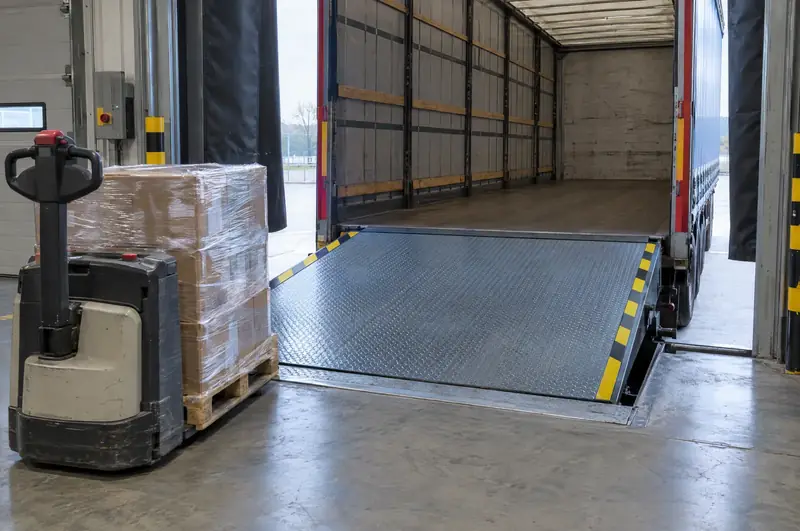
A swing-lip dock leveller is a hydraulic ramp set into a pit at the dock edge, with a hinged steel lip along its front. When a trailer is docked the platform rises, the lip swings out, and the platform lowers until the lip rests on the trailer bed, forming a bridge for forklifts and pallet trucks. The lip is typically about 400 to 500 mm long.
What matters for swing-lip dock levellers in the Highlands?
Ageing levellers in older docks around the Highlands can often be replaced like for like in the existing pit, avoiding new concrete work if the pit is sound. Every leveller recommendation we make for a dock in the Highlands follows a measured survey of the pit, dock height and the trailers you actually receive.
Mixed bays at a site in the Highlands, where some trailers have tail lifts and others do not, may suit a combination of swing-lip and telescopic levellers.
It starts with a free site survey in the Highlands, where we measure the openings, check the dock and talk through how the bay is used. You then receive a fixed written quote. Once you accept, we manage the job: specialist installation engineers carry out the work under our management, planned around your deliveries, and out-of-hours working can be arranged. At handover we test everything with you and leave the documentation.
What wears out on a swing-lip dock leveller?
The lip hinge, hydraulic hoses and seals are usually the first parts to wear on a swing-lip leveller, and planned servicing finds most of these problems before they stop a bay.
- Lip hinge: takes an impact every time the lip lands, and suffers badly if trailers reverse into a lip that has not been stored.
- Hydraulics: hoses, cylinder seals and power pack oil age and can leak.
- Velocity fuse: the safety valve that stops the platform dropping if a trailer pulls away must be tested.
- Toe guards and maintenance strut: must be intact and working. HSE guidance notes guards or skirting may be needed where something could be caught.
- Dock bumpers: worn bumpers let trailers strike the leveller and dock edge.
A leveller with a cracked lip hinge, a bent platform or repeated hydraulic leaks may be better replaced than repaired. Service and repair visits are chargeable and agreed before anyone attends.
What happens when a swing-lip leveller is fitted into an existing pit?
Fitting a swing-lip leveller into an existing pit normally takes one to two working days per bay, with the bay closed throughout. The work runs in a set order:
- The old leveller is isolated, lifted out and removed from site.
- The pit is cleaned and measured, and the edge steel checked for damage.
- The new leveller is lowered in, set level, and welded or anchored to the pit steel.
- The hydraulic power pack and control panel are connected, and any interlocks wired.
- Toe guards, lip and bumpers are checked, then the leveller is run through its full range.
From your side we need the bay emptied and taken out of service, clear access for lifting equipment inside or outside the building, and a suitable power supply, which for most hydraulic levellers is three-phase. If the pit needs repairs, these are done first and can add time, which we confirm in the quote.
Towns we cover in the Highlands
We take enquiries about swing-lip dock levellers from across the Highlands. These are the towns with their own pages:
Budget range for supply and fit. The written quote after a free survey is the fixed price. All guide prices.
Which rules apply in Scotland?
Doors and dock equipment installed in Scotland may carry the UKCA or the CE mark, and we pass on the documentation for everything fitted in the Highlands. Because building warrant and planning questions can affect the programme, we check what applies at survey and raise any approvals early rather than assuming none are needed.
Questions
Can you work alongside our main contractor on a new build in the Highlands?
Yes. For new warehouses and fit-outs, we can supply and install the dock package as part of a wider project, working to the main contractor's programme, site rules and permits. We will need drawings, dock levels and the programme, and we coordinate pit details, power supplies and door openings with the relevant trades before installation begins.
Will you deal with building control and planning for a project in the Highlands?
We check at survey whether the work is likely to need approval. Forming a new opening or dock pit may need Building Regulations approval, a building warrant or building control approval, depending on the nation, and external structures such as loading houses can need planning permission. Where approval is needed, we explain what is involved, work with your designer or agent, and build it into the programme.
Do levellers need a three-phase supply?
Most hydraulic dock levellers use a three-phase supply, although some smaller units run on single phase. When replacing like for like, the existing supply can often be reused if it is in good order. We check the supply at survey and include any electrical work in the quote.
What capacity of leveller do we need?
The leveller needs to be rated for the heaviest combined load of forklift and goods that will cross it, allowing for the truck moving over it. General-purpose levellers are typically rated around 60 kN, with heavier ratings for heavy goods or large forklifts. We confirm the rating after looking at your equipment.
Other services in the Highlands
Full guide to swing-lip dock levellers · All loading bay services in the Highlands