
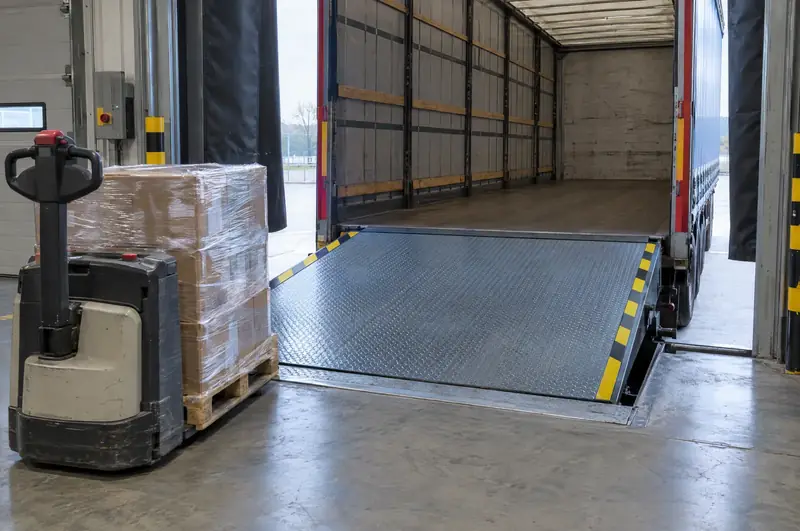
A swing-lip dock leveller is a hydraulic ramp set into a pit at the dock edge, with a hinged steel lip along its front. When a trailer is docked the platform rises, the lip swings out, and the platform lowers until the lip rests on the trailer bed, forming a bridge for forklifts and pallet trucks. The lip is typically about 400 to 500 mm long.
Why do sites in Greater London choose this?
Operators in Greater London who have added electric pallet trucks to their fleet may find an existing leveller too short, making a longer platform worth considering. Ageing levellers in older docks around Greater London can often be replaced like for like in the existing pit, avoiding new concrete work if the pit is sound.
Mixed bays at a site in Greater London, where some trailers have tail lifts and others do not, may suit a combination of swing-lip and telescopic levellers.
We keep the process simple for sites in Greater London. A free survey tells us what the dock needs; a fixed written quote tells you what it will cost and what is included. We then organise the installation, with specialist engineers under our management and a programme agreed around your shifts. Night and weekend work is available by arrangement. Before we leave, the new equipment is tested, demonstrated and handed over with its documentation.
Do dock levellers have to be inspected by law?
Yes, dock levellers are work equipment and must be kept in a safe condition and inspected where deterioration could lead to danger. The law and the regulator depend on where the site is.
- Great Britain: the Provision and Use of Work Equipment Regulations 1998 (PUWER), enforced by HSE.
- Northern Ireland: PUWER (Northern Ireland) 1999, enforced by HSENI.
- Inspection interval: engineering insurers commonly inspect dock levellers under PUWER at 12-month intervals.
- LOLER: most levellers are treated as work equipment under PUWER, but one designed or used to lift people may fall under LOLER, or LOLER (Northern Ireland) 1999, with 6-monthly thorough examination. It depends on the equipment and how it is used; your insurer or competent person will confirm.
- Standard: BS EN 1398:2009 sets the safety requirements for dock levellers. It is current and under review.
Our inspection guide explains what an examiner looks at.
Which trailers and loads suit a swing-lip leveller?
A swing-lip leveller suits everyday loading of standard trailers, where pallets sit a little way back from the rear of the trailer and the lip has room to land on the bed. It is a common choice for general distribution.
- Good fit: curtain-siders and box trailers loaded by forklift or pallet truck, with the lip landing behind the first row of pallets.
- Less suited: trailers loaded right up to the rear doors, because the lip needs clear bed space to rest on.
- Tail-lift vehicles: a folded tail lift can stop the lip reaching the bed.
- End loading: loading the last row of pallets at the very rear is awkward with a fixed-length lip.
Where these situations are common, a telescopic-lip dock leveller places its lip exactly where it is needed. Many sites fit both types across their bays, matching each bay to the vehicles it receives.
Towns we cover in Greater London
We cover swing-lip dock levellers throughout Greater London, and the towns below each have their own page. If yours is not listed, get in touch anyway.
- Barking
- Sutton
- Croydon
- Ilford
- Enfield
- Harrow
- Tottenham
- Walthamstow
- Dagenham
- Romford
- Hayes
- Wembley
- Edmonton
- Southall
- Uxbridge
- Hounslow
- Feltham
- Acton
- Greenford
- Thamesmead
- Barnet
- South Ruislip
- Harringay
- Enfield Lock
- Stepney
- Worcester Park
- Beckton
- Erith
- Park Royal
- Rainham
Budget range for supply and fit. The written quote after a free survey is the fixed price. All guide prices.
Regulations and approvals in England
Powered doors and dock equipment installed in England may carry the UKCA or the CE mark, and doors are covered by the product standard BS EN 13241. We hand over the relevant documentation for each item fitted in Greater London. Planning and Building Regulations questions are never assumed either way: we check what applies at survey, so you know before work is booked.
Questions
Which building and safety rules apply to a site in Greater London?
It depends on which UK nation the site is in. England and Wales use Building Regulations approval, Scotland uses building warrants and Northern Ireland uses building control approval from the council. Workplace safety is regulated by HSE in Great Britain and HSENI in Northern Ireland, and energy rules differ between nations. For your site in Greater London, we check what applies at survey and design to it.
How long does installation take at a site in Greater London?
It depends on the equipment, the number of bays, the condition of the dock and whether any building or electrical work is needed. We agree a programme with you after the survey, setting out which bays are out of use and when. Larger jobs are usually phased so that part of the dock stays open, and out-of-hours working can be arranged.
Do levellers need a three-phase supply?
Most hydraulic dock levellers use a three-phase supply, although some smaller units run on single phase. When replacing like for like, the existing supply can often be reused if it is in good order. We check the supply at survey and include any electrical work in the quote.
Can a swing-lip leveller be used as a ramp to the yard?
No, a leveller should only be used to bridge a docked trailer. The lip and toe guards are designed to work with a trailer bed in place, and the platform is not built as a ramp down to yard level. Where you need ground-level access, a separate door or a lift table is the safer answer.
Other services in Greater London
Full guide to swing-lip dock levellers · All loading bay services in Greater London