
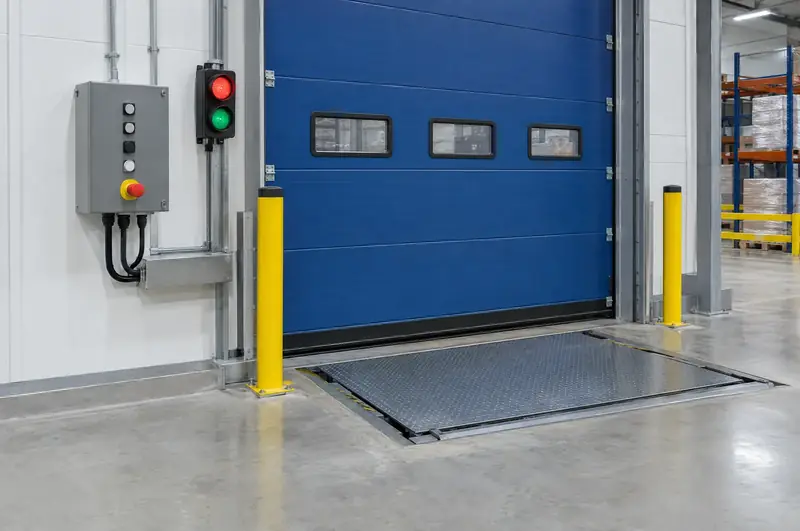
Dock traffic lights are red and green signals mounted outside and inside a loading bay to tell the driver and dock staff when it is safe to move or load. Interlocks are control links that stop equipment operating out of sequence, for example preventing the door opening until the trailer is restrained, or the leveller operating until the door is fully open.
What matters for dock traffic lights and interlocks in Cambridgeshire?
Food and chilled operations around Cambridgeshire with inflatable shelters often add interlocks so the shelter only inflates once a trailer is docked and restrained. New warehouses in Cambridgeshire can have lights and interlocks wired in during the electrical fit-out, avoiding retrofit cabling and keeping every bay on one control standard.
Whether your unit in Cambridgeshire has one dock or twenty, the survey looks at each bay's existing controls before we quote a fixed price in writing.
Keeping the dock running is usually the first concern, so we plan around it. After a free survey of your Cambridgeshire site and a written quote at a fixed price, we agree when each bay can be released and whether any work should happen out of hours. Specialist installation engineers working under our management then fit the equipment, and we test it and hand over the documentation before the bay goes back into use.
Which interlocks should a loading bay have?
The most useful loading bay interlocks stop the door opening until the trailer is in place or restrained, and stop the leveller operating until the door is fully open. Beyond that, the right set depends on the equipment fitted and your risk assessment.
- Door to restraint: the door cannot open until the restraint is engaged or a trailer is detected.
- Leveller to door: the leveller cannot be raised until the door is fully open, which prevents the lip hitting door panels.
- Door to leveller: the door cannot close until the leveller is back in its parked position.
- Restraint release: the restraint only releases once the door is closed and the leveller parked.
- Shelter to trailer: an inflatable shelter only inflates when a trailer is docked.
On a bay without a restraint, a trailer presence sensor can take its place in the door logic, although it confirms a trailer is there rather than holding it. Combining interlocks with vehicle restraints gives the strongest protection against drive-away.
What happens on site when traffic lights and interlocks are fitted?
Fitting lights and interlocks is mainly electrical work, and each bay is out of use while its controls are connected and tested. Working bay by bay keeps the rest of the dock running.
- Fix the signals: the outside light is mounted on brackets at a height drivers can see, and the inside light beside the door.
- Run the cables: wiring is run in conduit or trunking between lights, sensors and control panels.
- Isolate and connect: the door and leveller supplies are isolated and locked off while the interlock wiring is connected, or a new bay panel is fitted.
- Test every sequence: each interlock is tested, including what happens if a step is attempted out of order.
- Brief staff: dock staff are shown the new sequence, and signs are fitted for drivers.
It helps if you can provide any electrical drawings for the dock, access to the distribution board, a person who can authorise isolations and an agreed order for releasing bays.
Towns we cover in Cambridgeshire
Find your town in the list below for details of dock traffic lights and interlocks across Cambridgeshire, or contact us if your location is not shown.
Budget range for supply and fit. The written quote after a free survey is the fixed price. All guide prices.
Regulations and approvals in England
Sites in Cambridgeshire fall under the rules for England. Structural changes such as forming a new opening or a dock leveller pit may need Building Regulations approval, and external structures such as loading houses, canopies or new dock approaches can need planning permission from the local planning authority. We check what applies at survey and build any approvals into the plan.
Questions
What details do you need from us to quote for dock traffic lights and interlocks?
To get started, send the site address in Cambridgeshire, the number of bays or openings, approximate sizes, and photos of the dock from inside and outside. Tell us what vehicles you load, what goods you handle and any temperature requirements. Drawings help on new builds. We then arrange the free survey and confirm the details before the written quote is issued.
Which building and safety rules apply to a site in Cambridgeshire?
It depends on which UK nation the site is in. England and Wales use Building Regulations approval, Scotland uses building warrants and Northern Ireland uses building control approval from the council. Workplace safety is regulated by HSE in Great Britain and HSENI in Northern Ireland, and energy rules differ between nations. For your site in Cambridgeshire, we check what applies at survey and design to it.
Can interlocks be fitted to a manual loading bay door?
Yes. A door position switch fitted to a manual door can confirm when it is fully open or fully closed. That signal lets the traffic lights change automatically and stops the leveller being raised until the door is out of the way.
Can you add lights and interlocks across a whole dock in one project?
Yes. A whole-dock project is usually phased bay by bay so most doors stay in use, and every bay ends up on the same control standard. That consistency makes training easier for staff and drivers, and it simplifies servicing because every bay behaves in the same way.
Other services in Cambridgeshire
Full guide to dock traffic lights and interlocks · All loading bay services in Cambridgeshire