
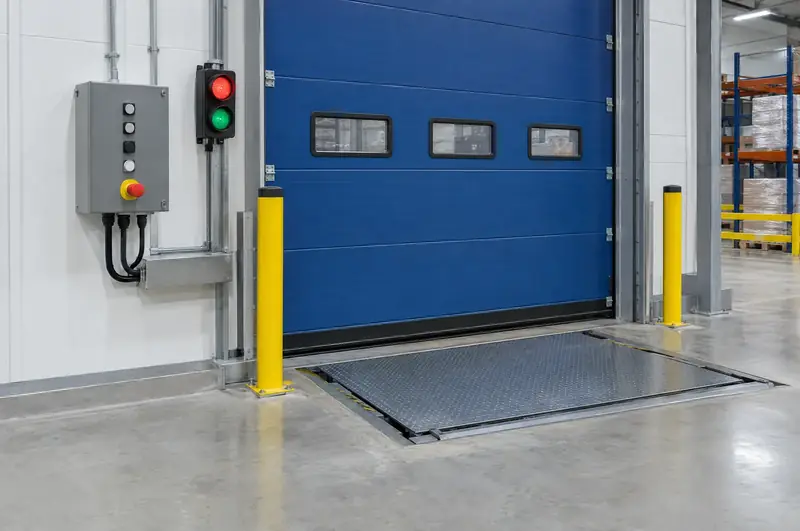
Dock traffic lights are red and green signals mounted outside and inside a loading bay to tell the driver and dock staff when it is safe to move or load. Interlocks are control links that stop equipment operating out of sequence, for example preventing the door opening until the trailer is restrained, or the leveller operating until the door is fully open.
What matters for dock traffic lights and interlocks in Lincolnshire?
If a site in Lincolnshire has had door panels damaged by levellers raised too early, a leveller-to-door interlock is a straightforward fix to consider. Food and chilled operations around Lincolnshire with inflatable shelters often add interlocks so the shelter only inflates once a trailer is docked and restrained.
Whether your unit in Lincolnshire has one dock or twenty, the survey looks at each bay's existing controls before we quote a fixed price in writing.
Before anything is ordered, we visit your site in Lincolnshire for a free survey and then send a written quote with a fixed price. From that point we manage the installation, coordinating delivery, access and any other trades. Fitting is done by specialist installation engineers engaged and managed by us, at times that suit your operation, including out of hours where agreed. You get a tested installation, a demonstration for your team and the manufacturer documentation.
Which interlocks should a loading bay have?
The most useful loading bay interlocks stop the door opening until the trailer is in place or restrained, and stop the leveller operating until the door is fully open. Beyond that, the right set depends on the equipment fitted and your risk assessment.
- Door to restraint: the door cannot open until the restraint is engaged or a trailer is detected.
- Leveller to door: the leveller cannot be raised until the door is fully open, which prevents the lip hitting door panels.
- Door to leveller: the door cannot close until the leveller is back in its parked position.
- Restraint release: the restraint only releases once the door is closed and the leveller parked.
- Shelter to trailer: an inflatable shelter only inflates when a trailer is docked.
On a bay without a restraint, a trailer presence sensor can take its place in the door logic, although it confirms a trailer is there rather than holding it. Combining interlocks with vehicle restraints gives the strongest protection against drive-away.
What does HSE guidance say about stopping drivers leaving too early?
HSE guidance (followed by HSENI in Northern Ireland) says there should be safeguards against drivers driving away from a loading bay too early, and it names traffic lights as one of the measures. Vehicle or trailer restraints, and the person in charge keeping keys or paperwork until it is safe, are the others listed in HSE's guide to workplace transport safety (HSG136) and its loading factsheet.
Traffic lights are a signal, not a physical barrier, so they work best as part of a clear procedure or alongside a restraint. Your risk assessment should decide the combination. In Northern Ireland the regulator is HSENI.
Interlocks also touch on door safety law. Under regulation 18 of the Workplace (Health, Safety and Welfare) Regulations 1992, or the Northern Ireland 1993 equivalent, powered doors need suitable and effective features to prevent them trapping anyone. Interlocks must never bypass those features, and door control work should respect BS EN 12453, the standard for safety in use of power-operated doors.
Read more in our guide to preventing drive-away and trailer creep.
Towns we cover in Lincolnshire
We cover dock traffic lights and interlocks throughout Lincolnshire, and the towns below each have their own page. If yours is not listed, get in touch anyway.
- Lincoln
- Grimsby
- Scunthorpe
- Boston
- Grantham
- Cleethorpes
- Spalding
- Skegness
- Stamford
- Gainsborough
- Louth
- Sleaford
- Immingham
Budget range for supply and fit. The written quote after a free survey is the fixed price. All guide prices.
What do the rules in England mean for the work?
Workplace safety in England is regulated by HSE. For a loading bay in Lincolnshire, that means doors meeting regulation 18 of the Workplace (Health, Safety and Welfare) Regulations 1992, equipment maintained under PUWER and suitable safeguards against vehicles driving away too early. We check what applies at survey and design the bay accordingly.
Questions
Can you work alongside our main contractor on a new build in Lincolnshire?
Yes. For new warehouses and fit-outs, we can supply and install the dock package as part of a wider project, working to the main contractor's programme, site rules and permits. We will need drawings, dock levels and the programme, and we coordinate pit details, power supplies and door openings with the relevant trades before installation begins.
Do you remove and dispose of the old equipment?
Yes, where it is part of the scope. When we replace doors, levellers, shelters or seals at a site in Lincolnshire, removal and disposal of the old equipment can be included and is itemised in the quote, so it is clear what is covered. If anything should be kept, such as a frame or motor that is still serviceable, we agree that at survey.
Can you add lights and interlocks across a whole dock in one project?
Yes. A whole-dock project is usually phased bay by bay so most doors stay in use, and every bay ends up on the same control standard. That consistency makes training easier for staff and drivers, and it simplifies servicing because every bay behaves in the same way.
Do traffic lights and interlocks need maintenance?
Yes. Lights, sensors and interlocks should be checked at each planned service visit, including testing the full sequence and confirming that steps attempted out of order are blocked. As part of the dock equipment they fall under PUWER, which requires work equipment to be maintained in a safe condition.
Other services in Lincolnshire
Full guide to dock traffic lights and interlocks · All loading bay services in Lincolnshire