
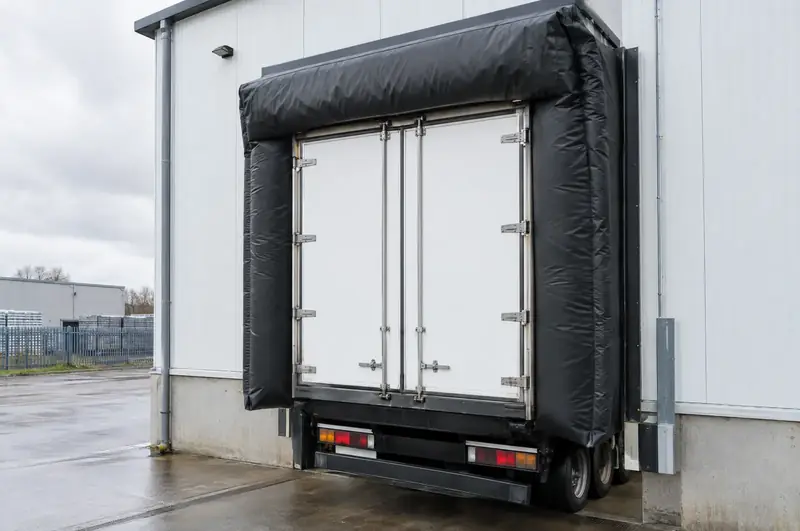
An inflatable dock shelter is a dock shelter with air-filled fabric cushions at the top and sides of the opening, kept deflated and close to the building until a trailer has reversed in. A fan then inflates the cushions so they press against the trailer roof and sides, giving a close seal that adapts to different trailer widths and heights, and deflates again before the trailer leaves.
Why do sites in Hampshire choose this?
Mixed fleets arriving at a cold store in Hampshire, from rigids to double-deck trailers, are exactly the situation inflatable cushions are designed for. Driving rain and wind at an open bay in Hampshire can wear cushion fabric, so a protective outer cover is worth considering on exposed docks.
Operators replacing foam seals in Hampshire that keep wearing out against ill-fitting trailers may find an inflatable shelter suffers far less rubbing.
We keep the process simple for sites in Hampshire. A free survey tells us what the dock needs; a fixed written quote tells you what it will cost and what is included. We then organise the installation, with specialist engineers under our management and a programme agreed around your shifts. Night and weekend work is available by arrangement. Before we leave, the new equipment is tested, demonstrated and handed over with its documentation.
How does an inflatable shelter work with the dock door and leveller?
An inflatable shelter is the first step in the dock sequence: it seals around the trailer before the door opens and only deflates once the door has closed. Getting that order right is what makes it effective.
- The trailer reverses onto the bumpers, guided by dock lights and wheel guides.
- The trailer is secured by restraint or key control, and the outside light shows red.
- The cushions inflate around the top and sides of the trailer.
- With the trailer sealed, the door opens and the leveller is deployed.
- After loading, the leveller is stored and the door closed.
- The cushions deflate and retract, and the light turns green.
Deflated cushions must sit clear of the door and leveller, and internal straps or weights pull them back so trailers do not catch them. Interlocks make each step depend on the last, so staff cannot open the door onto an unsealed trailer.
What maintenance does an inflatable dock shelter need?
An inflatable shelter needs regular checks on its fabric, fan and controls, because a puncture or a weak fan stops it sealing properly. Planned servicing catches most faults before they affect the cold chain.
- Cushion fabric: inspect for punctures, abrasion and failed seams, and patch or replace cushions as needed.
- Fan unit: check filters, motor and airflow so the cushions inflate fully and promptly.
- Retraction system: straps, weights or springs must pull the cushions back clear of the trailer.
- Controls and interlocks: confirm the sequence with the door, leveller and restraint still works.
- Frame and fixings: look for impact damage and corrosion.
Snow and ice on the top cushion can stop it retracting, so a check before winter is worthwhile. Service and repair visits are chargeable, and the price is agreed before anyone attends.
Towns we cover in Hampshire
Choose a town below to see how we handle inflatable dock shelters in that part of Hampshire.
- Southampton
- Portsmouth
- Basingstoke
- Gosport
- Waterlooville
- Farnborough
- Eastleigh
- Winchester
- Havant
- Andover
- Fareham
- Aldershot
- Fleet
- Totton
- New Milton
- Bordon
- Hythe
- Yateley
- Alton
- Emsworth
- Hedge End
- Bishopstoke
Budget range for supply and fit. The written quote after a free survey is the fixed price. All guide prices.
Which rules apply in England?
Sites in Hampshire fall under the rules for England. Structural changes such as forming a new opening or a dock leveller pit may need Building Regulations approval, and external structures such as loading houses, canopies or new dock approaches can need planning permission from the local planning authority. We check what applies at survey and build any approvals into the plan.
Questions
How long does installation take at a site in Hampshire?
It depends on the equipment, the number of bays, the condition of the dock and whether any building or electrical work is needed. We agree a programme with you after the survey, setting out which bays are out of use and when. Larger jobs are usually phased so that part of the dock stays open, and out-of-hours working can be arranged.
Will you deal with building control and planning for a project in Hampshire?
We check at survey whether the work is likely to need approval. Forming a new opening or dock pit may need Building Regulations approval, a building warrant or building control approval, depending on the nation, and external structures such as loading houses can need planning permission. Where approval is needed, we explain what is involved, work with your designer or agent, and build it into the programme.
Is an inflatable shelter worth it at an ambient dock?
An inflatable shelter works at any dock, but at ambient bays a curtain shelter or dock seal usually gives enough sealing for less cost. Inflatables make most sense where temperature, hygiene or energy use makes the closest practical seal worth paying for.
Can a punctured cushion be repaired?
Small punctures and tears can usually be patched, and a badly damaged cushion can be replaced on its own without changing the frame or fan. Repairs are carried out on a chargeable visit, with the price agreed before anyone attends.
Other services in Hampshire
Full guide to inflatable dock shelters · All loading bay services in Hampshire