
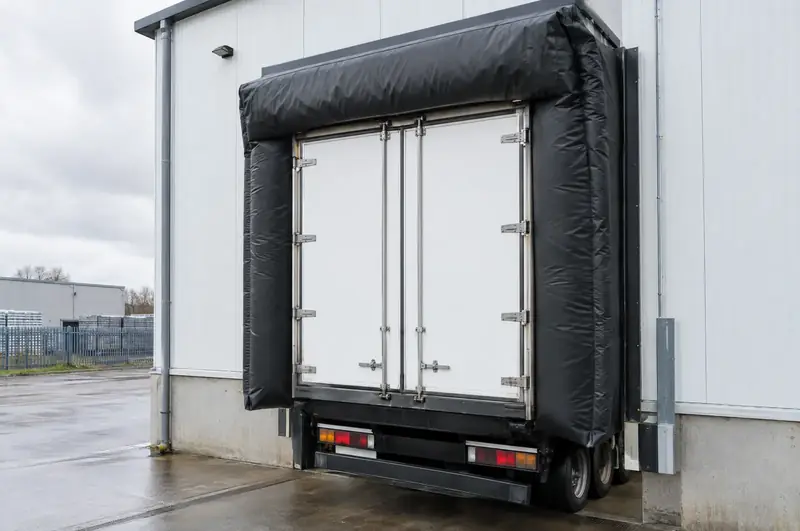
An inflatable dock shelter is a dock shelter with air-filled fabric cushions at the top and sides of the opening, kept deflated and close to the building until a trailer has reversed in. A fan then inflates the cushions so they press against the trailer roof and sides, giving a close seal that adapts to different trailer widths and heights, and deflates again before the trailer leaves.
Is this right for your site in Lancashire?
Specifying a new temperature-controlled warehouse in Lancashire is the ideal time to design inflatable shelters in with the doors and levellers, so controls are integrated from the start. Fresh produce cooled at a packhouse in Lancashire stays colder during loading when the gap around the trailer is sealed by inflated cushions.
Pharmaceutical distributors around Lancashire working to tight temperature limits may want the close seal an inflatable shelter gives during every load.
Keeping the dock running is usually the first concern, so we plan around it. After a free survey of your Lancashire site and a written quote at a fixed price, we agree when each bay can be released and whether any work should happen out of hours. Specialist installation engineers working under our management then fit the equipment, and we test it and hand over the documentation before the bay goes back into use.
Inflatable shelter, curtain shelter or dock seal: which suits a cold chain dock?
For a cold chain dock that receives trailers of different sizes, an inflatable shelter usually gives the best balance of close sealing and flexibility. A dock seal can match it on a uniform fleet, while a curtain shelter is better suited to ambient bays.
- Inflatable shelter: cushions adapt to each trailer's width and height and seal close to the body, with the full opening left clear.
- Dock seal: a tight, lower-cost seal when every trailer is the same size, but it can leave gaps on other vehicles and the pads can intrude into the opening.
- Curtain shelter: flexible and robust, but leaves small gaps that matter more at chilled and frozen docks.
Inflatables also stand clear of the trailer until it has docked, avoiding the rubbing that wears foam pads and curtains. The trade-off is the fan and controls, which need power and servicing. For frozen docks we specify the shelter alongside cold store dock doors so the two work together.
How does an inflatable shelter work with the dock door and leveller?
An inflatable shelter is the first step in the dock sequence: it seals around the trailer before the door opens and only deflates once the door has closed. Getting that order right is what makes it effective.
- The trailer reverses onto the bumpers, guided by dock lights and wheel guides.
- The trailer is secured by restraint or key control, and the outside light shows red.
- The cushions inflate around the top and sides of the trailer.
- With the trailer sealed, the door opens and the leveller is deployed.
- After loading, the leveller is stored and the door closed.
- The cushions deflate and retract, and the light turns green.
Deflated cushions must sit clear of the door and leveller, and internal straps or weights pull them back so trailers do not catch them. Interlocks make each step depend on the last, so staff cannot open the door onto an unsealed trailer.
Towns we cover in Lancashire
We take enquiries about inflatable dock shelters from across Lancashire. These are the towns with their own pages:
- Preston
- Burnley
- Blackburn
- Blackpool
- Morecambe
- Lancaster
- Lytham St Annes
- Skelmersdale
- Leyland
- Accrington
- Chorley
- Darwen
- Thornton-Cleveleys
- Nelson
- Fleetwood
- Ormskirk
- Rawtenstall
- Colne
- Poulton-le-Fylde
- Heysham
- Haslingden
Budget range for supply and fit. The written quote after a free survey is the fixed price. All guide prices.
Planning, building control and safety law in England
Powered doors and dock equipment installed in England may carry the UKCA or the CE mark, and doors are covered by the product standard BS EN 13241. We hand over the relevant documentation for each item fitted in Lancashire. Planning and Building Regulations questions are never assumed either way: we check what applies at survey, so you know before work is booked.
Questions
Do you cover Lancashire for inflatable dock shelters?
Yes. We take on inflatable dock shelters for businesses in Lancashire and across Lancashire. We survey the site, provide a fixed written quote and manage the installation, with specialist installation engineers working under our management. Visits are arranged in advance at a time that suits your operation, and the same single contact stays with the job through to handover.
Will you deal with building control and planning for a project in Lancashire?
We check at survey whether the work is likely to need approval. Forming a new opening or dock pit may need Building Regulations approval, a building warrant or building control approval, depending on the nation, and external structures such as loading houses can need planning permission. Where approval is needed, we explain what is involved, work with your designer or agent, and build it into the programme.
Do the cushions touch the trailer as it reverses in?
No, the cushions stay deflated and pulled back against the building while the trailer reverses in, so there is no rubbing as it docks. They inflate only once the trailer is in position and secured, which reduces wear on the fabric compared with foam seals and curtain shelters.
Does an inflatable shelter work with containers and double-deck trailers?
Yes, provided the shelter is sized for the tallest and widest vehicles you receive. The cushions adapt to each vehicle's dimensions, which is a key reason inflatable shelters suit sites handling containers, standard trailers and double-deck units at the same bays.
Other services in Lancashire
Full guide to inflatable dock shelters · All loading bay services in Lancashire