
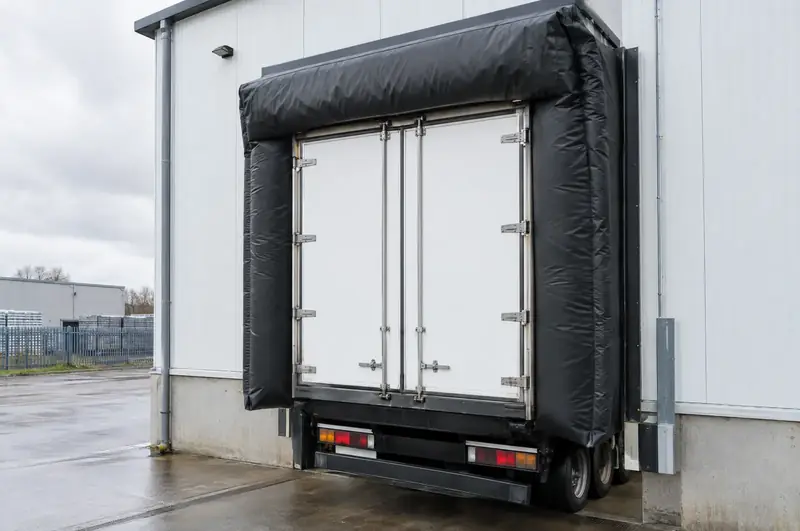
An inflatable dock shelter is a dock shelter with air-filled fabric cushions at the top and sides of the opening, kept deflated and close to the building until a trailer has reversed in. A fan then inflates the cushions so they press against the trailer roof and sides, giving a close seal that adapts to different trailer widths and heights, and deflates again before the trailer leaves.
How does this suit sites in Greater London?
Frozen food stores in Greater London loading trailers of varying sizes can use inflatable shelters to keep warm outside air away from the open door. Fresh produce cooled at a packhouse in Greater London stays colder during loading when the gap around the trailer is sealed by inflated cushions.
When a chilled dock in Greater London sees condensation and ice around the door, the seal at the trailer is often where improvement starts.
The survey is free, the quote is written and the price is fixed: that is how every installation in Greater London begins. We then manage the work from start to finish. Fitting is carried out by specialist installers under our management, phased so the operation keeps moving, and nights or weekends can be booked by arrangement. On the final day we test the equipment with you and hand over the operating and maintenance information.
Inflatable shelter, curtain shelter or dock seal: which suits a cold chain dock?
For a cold chain dock that receives trailers of different sizes, an inflatable shelter usually gives the best balance of close sealing and flexibility. A dock seal can match it on a uniform fleet, while a curtain shelter is better suited to ambient bays.
- Inflatable shelter: cushions adapt to each trailer's width and height and seal close to the body, with the full opening left clear.
- Dock seal: a tight, lower-cost seal when every trailer is the same size, but it can leave gaps on other vehicles and the pads can intrude into the opening.
- Curtain shelter: flexible and robust, but leaves small gaps that matter more at chilled and frozen docks.
Inflatables also stand clear of the trailer until it has docked, avoiding the rubbing that wears foam pads and curtains. The trade-off is the fan and controls, which need power and servicing. For frozen docks we specify the shelter alongside cold store dock doors so the two work together.
How does an inflatable shelter work with the dock door and leveller?
An inflatable shelter is the first step in the dock sequence: it seals around the trailer before the door opens and only deflates once the door has closed. Getting that order right is what makes it effective.
- The trailer reverses onto the bumpers, guided by dock lights and wheel guides.
- The trailer is secured by restraint or key control, and the outside light shows red.
- The cushions inflate around the top and sides of the trailer.
- With the trailer sealed, the door opens and the leveller is deployed.
- After loading, the leveller is stored and the door closed.
- The cushions deflate and retract, and the light turns green.
Deflated cushions must sit clear of the door and leveller, and internal straps or weights pull them back so trailers do not catch them. Interlocks make each step depend on the last, so staff cannot open the door onto an unsealed trailer.
Towns we cover in Greater London
Each of the following towns in Greater London has its own page on inflatable dock shelters, covering how we work and what to send us.
- Barking
- Sutton
- Croydon
- Ilford
- Enfield
- Harrow
- Tottenham
- Walthamstow
- Dagenham
- Romford
- Hayes
- Wembley
- Edmonton
- Southall
- Uxbridge
- Hounslow
- Feltham
- Acton
- Greenford
- Thamesmead
- Barnet
- South Ruislip
- Harringay
- Enfield Lock
- Stepney
- Worcester Park
- Beckton
- Erith
- Park Royal
- Rainham
Budget range for supply and fit. The written quote after a free survey is the fixed price. All guide prices.
What do the rules in England mean for the work?
Sites in Greater London fall under the rules for England. Structural changes such as forming a new opening or a dock leveller pit may need Building Regulations approval, and external structures such as loading houses, canopies or new dock approaches can need planning permission from the local planning authority. We check what applies at survey and build any approvals into the plan.
Questions
Can you work alongside our main contractor on a new build in Greater London?
Yes. For new warehouses and fit-outs, we can supply and install the dock package as part of a wider project, working to the main contractor's programme, site rules and permits. We will need drawings, dock levels and the programme, and we coordinate pit details, power supplies and door openings with the relevant trades before installation begins.
Which building and safety rules apply to a site in Greater London?
It depends on which UK nation the site is in. England and Wales use Building Regulations approval, Scotland uses building warrants and Northern Ireland uses building control approval from the council. Workplace safety is regulated by HSE in Great Britain and HSENI in Northern Ireland, and energy rules differ between nations. For your site in Greater London, we check what applies at survey and design to it.
What happens to an inflatable shelter if the power fails?
If the power fails, the fan stops and the cushions gradually deflate, so the trailer can leave once loading has been brought to a safe end. At a cold store, the dock door should be closed by hand where possible to protect the store. We explain the power failure routine at handover.
Does an inflatable shelter work with containers and double-deck trailers?
Yes, provided the shelter is sized for the tallest and widest vehicles you receive. The cushions adapt to each vehicle's dimensions, which is a key reason inflatable shelters suit sites handling containers, standard trailers and double-deck units at the same bays.
Other services in Greater London
Full guide to inflatable dock shelters · All loading bay services in Greater London