
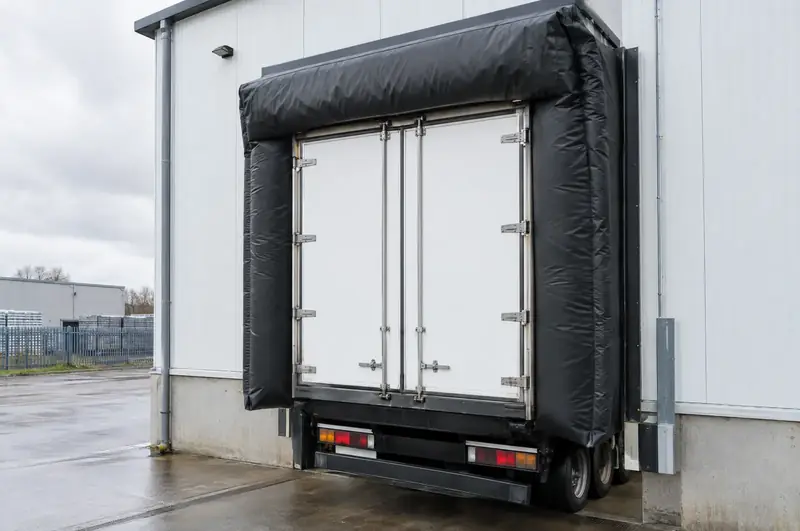
An inflatable dock shelter is a dock shelter with air-filled fabric cushions at the top and sides of the opening, kept deflated and close to the building until a trailer has reversed in. A fan then inflates the cushions so they press against the trailer roof and sides, giving a close seal that adapts to different trailer widths and heights, and deflates again before the trailer leaves.
Why do sites in the West Midlands choose this?
Operators replacing foam seals in the West Midlands that keep wearing out against ill-fitting trailers may find an inflatable shelter suffers far less rubbing. When a chilled dock in the West Midlands sees condensation and ice around the door, the seal at the trailer is often where improvement starts.
Pharmaceutical distributors around the West Midlands working to tight temperature limits may want the close seal an inflatable shelter gives during every load.
Your loading bay stays our responsibility from the survey to the handover. In the West Midlands, the survey and written quote are free, and the quoted price is fixed for the agreed scope. Installation is carried out by specialist engineers working under our management, at times planned with you to protect your loading schedule. Out-of-hours work is available by arrangement. We finish by testing the equipment and handing over its documentation.
What is involved in installing an inflatable dock shelter?
Installing an inflatable shelter involves fixing a steel frame to the building around the dock door, mounting the cushions and fan, and wiring the controls, usually over one to two days per bay.
- The wall is checked and fixing points or a subframe prepared.
- The frame is fixed from powered access equipment in the yard.
- Top and side cushions are fitted, with protective covers where specified.
- The fan unit is mounted and the control panel wired, including interlocks to the door, leveller or restraint.
- Inflation, deflation and cushion retraction are tested with a trailer in the bay.
You will need to provide a clear yard area in front of the bay, take the bay out of use and arrange a power supply near the door, or ask us to include one. At cold stores we plan the work with the dock door kept closed, so the store stays at temperature while the shelter goes up outside.
How does an inflatable shelter work with the dock door and leveller?
An inflatable shelter is the first step in the dock sequence: it seals around the trailer before the door opens and only deflates once the door has closed. Getting that order right is what makes it effective.
- The trailer reverses onto the bumpers, guided by dock lights and wheel guides.
- The trailer is secured by restraint or key control, and the outside light shows red.
- The cushions inflate around the top and sides of the trailer.
- With the trailer sealed, the door opens and the leveller is deployed.
- After loading, the leveller is stored and the door closed.
- The cushions deflate and retract, and the light turns green.
Deflated cushions must sit clear of the door and leveller, and internal straps or weights pull them back so trailers do not catch them. Interlocks make each step depend on the last, so staff cannot open the door onto an unsealed trailer.
Towns we cover in the West Midlands
We take enquiries about inflatable dock shelters from across the West Midlands. These are the towns with their own pages:
- Birmingham
- Coventry
- Wolverhampton
- Dudley
- Walsall
- Solihull
- Sutton Coldfield
- West Bromwich
- Halesowen
- Stourbridge
- Smethwick
- Willenhall
- Tipton
- Bloxwich
- Wednesfield
- Washwood Heath
- Aston
- Shirley
- Brierley Hill
- Aldridge
- Bartley Green
- Wednesbury
Budget range for supply and fit. The written quote after a free survey is the fixed price. All guide prices.
What do the rules in England mean for the work?
Powered doors and dock equipment installed in England may carry the UKCA or the CE mark, and doors are covered by the product standard BS EN 13241. We hand over the relevant documentation for each item fitted in the West Midlands. Planning and Building Regulations questions are never assumed either way: we check what applies at survey, so you know before work is booked.
Questions
Which building and safety rules apply to a site in the West Midlands?
It depends on which UK nation the site is in. England and Wales use Building Regulations approval, Scotland uses building warrants and Northern Ireland uses building control approval from the council. Workplace safety is regulated by HSE in Great Britain and HSENI in Northern Ireland, and energy rules differ between nations. For your site in the West Midlands, we check what applies at survey and design to it.
Will you deal with building control and planning for a project in the West Midlands?
We check at survey whether the work is likely to need approval. Forming a new opening or dock pit may need Building Regulations approval, a building warrant or building control approval, depending on the nation, and external structures such as loading houses can need planning permission. Where approval is needed, we explain what is involved, work with your designer or agent, and build it into the programme.
Will we need to change the rest of the dock?
Usually not. Most inflatable shelters fit around an existing door opening, though the leveller, bumpers and door controls are reviewed so the cushions clear them and the interlocks work. Where the wall cannot carry the frame, a subframe is added. We confirm what is needed at survey.
Does an inflatable shelter work with containers and double-deck trailers?
Yes, provided the shelter is sized for the tallest and widest vehicles you receive. The cushions adapt to each vehicle's dimensions, which is a key reason inflatable shelters suit sites handling containers, standard trailers and double-deck units at the same bays.
Other services in the West Midlands
Full guide to inflatable dock shelters · All loading bay services in the West Midlands