
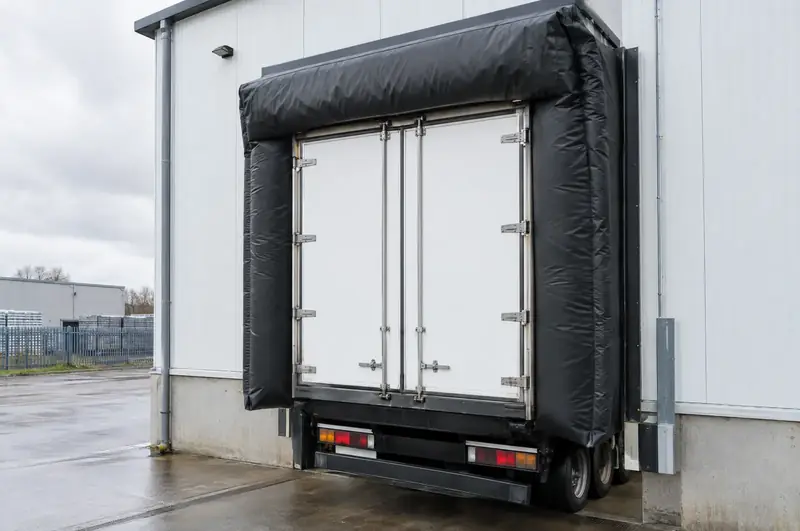
An inflatable dock shelter is a dock shelter with air-filled fabric cushions at the top and sides of the opening, kept deflated and close to the building until a trailer has reversed in. A fan then inflates the cushions so they press against the trailer roof and sides, giving a close seal that adapts to different trailer widths and heights, and deflates again before the trailer leaves.
What should sites in Gloucestershire consider?
Fresh produce cooled at a packhouse in Gloucestershire stays colder during loading when the gap around the trailer is sealed by inflated cushions. Pharmaceutical distributors around Gloucestershire working to tight temperature limits may want the close seal an inflatable shelter gives during every load.
When a chilled dock in Gloucestershire sees condensation and ice around the door, the seal at the trailer is often where improvement starts.
If you are planning inflatable dock shelters for a site in Gloucestershire, expect four stages. A free survey and fixed written quote come first. We then agree a programme with you, including any out-of-hours work. Specialist installation engineers carry out the installation under our management, with us as your single point of contact. Finally, the equipment is tested, your staff are shown how it works and everything is handed over with its documentation.
What safety rules affect inflatable dock shelters?
An inflatable shelter is powered dock equipment, so it must be suitable, maintained and correctly marked, and it should be controlled so a trailer cannot pull away with the cushions inflated around it.
- Work equipment: PUWER 1998 in Great Britain and PUWER (Northern Ireland) 1999 require it to be maintained in a safe condition and inspected where deterioration could lead to danger.
- Marking: in Great Britain powered dock equipment may carry the UKCA or the CE mark. For Northern Ireland, the CE mark or CE with UKNI applies.
- Drive-away: HSE workplace transport guidance (HSG136), followed by HSENI in Northern Ireland, calls for safeguards against drivers driving away too early, such as traffic lights, vehicle or trailer restraints, or keeping keys until it is safe. Linking deflation to these controls protects both the cushions and the driver.
- Regulator: HSE in Great Britain and HSENI in Northern Ireland.
A vehicle restraint interlocked with the shelter and door is a common way to make the whole sequence dependable.
How does an inflatable shelter work with the dock door and leveller?
An inflatable shelter is the first step in the dock sequence: it seals around the trailer before the door opens and only deflates once the door has closed. Getting that order right is what makes it effective.
- The trailer reverses onto the bumpers, guided by dock lights and wheel guides.
- The trailer is secured by restraint or key control, and the outside light shows red.
- The cushions inflate around the top and sides of the trailer.
- With the trailer sealed, the door opens and the leveller is deployed.
- After loading, the leveller is stored and the door closed.
- The cushions deflate and retract, and the light turns green.
Deflated cushions must sit clear of the door and leveller, and internal straps or weights pull them back so trailers do not catch them. Interlocks make each step depend on the last, so staff cannot open the door onto an unsealed trailer.
Towns we cover in Gloucestershire
We provide inflatable dock shelters right across Gloucestershire. Pick the town closest to your site from the list below.
Budget range for supply and fit. The written quote after a free survey is the fixed price. All guide prices.
Regulations and approvals in England
Sites in Gloucestershire fall under the rules for England. Structural changes such as forming a new opening or a dock leveller pit may need Building Regulations approval, and external structures such as loading houses, canopies or new dock approaches can need planning permission from the local planning authority. We check what applies at survey and build any approvals into the plan.
Questions
Can you work outside our normal operating hours in Gloucestershire?
Yes, by arrangement. Evening, night and weekend working can be planned so the installation causes as little disruption as possible to your loading schedule. Out-of-hours work can affect the price, so mention it at the survey and we will include it in the written quote. The agreed times are confirmed in the programme before the job starts.
Which building and safety rules apply to a site in Gloucestershire?
It depends on which UK nation the site is in. England and Wales use Building Regulations approval, Scotland uses building warrants and Northern Ireland uses building control approval from the council. Workplace safety is regulated by HSE in Great Britain and HSENI in Northern Ireland, and energy rules differ between nations. For your site in Gloucestershire, we check what applies at survey and design to it.
What happens to an inflatable shelter if the power fails?
If the power fails, the fan stops and the cushions gradually deflate, so the trailer can leave once loading has been brought to a safe end. At a cold store, the dock door should be closed by hand where possible to protect the store. We explain the power failure routine at handover.
Can a punctured cushion be repaired?
Small punctures and tears can usually be patched, and a badly damaged cushion can be replaced on its own without changing the frame or fan. Repairs are carried out on a chargeable visit, with the price agreed before anyone attends.
Other services in Gloucestershire
Full guide to inflatable dock shelters · All loading bay services in Gloucestershire