
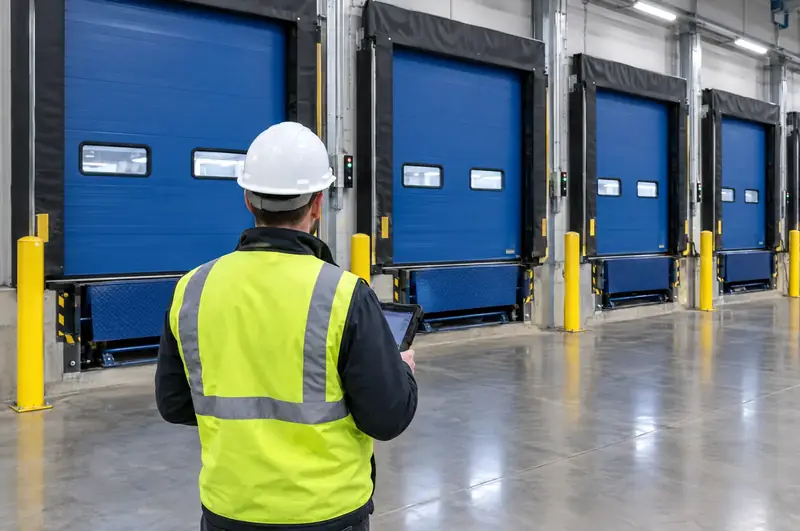
Loading bay servicing covers planned preventive maintenance of dock equipment at agreed intervals. An engineer checks, adjusts and lubricates doors, levellers, shelters, seals, restraints, traffic lights and lift tables, tests safety devices and records defects in a written report. Servicing supports, but is separate from, insurer inspections and the LOLER thorough examinations that some equipment needs.
Why do sites in Merseyside choose this?
When you take on a unit in Merseyside with no maintenance history, a baseline service report gives you a clear starting point for future planning. Distribution centres in Merseyside running high trailer volumes commonly need twice-yearly servicing to keep springs, hydraulics and seals ahead of wear.
Lift tables at warehouses in Merseyside need a LOLER thorough examination regime alongside servicing, and the two can be scheduled to suit the operation.
For loading bay servicing in Merseyside, the visit is chargeable and priced up front. You will know the cost in writing before an engineer is booked. Photos of the problem, the make and model if known, and a description of what happens when the equipment is operated all help us prepare. If further work is needed, we quote it separately before doing it, and a written report closes every visit.
What happens on site during a service visit?
During a service visit the engineer works through the dock bay by bay, taking each item out of use only while it is being checked. Most of the dock keeps working throughout.
- Agree the order: the engineer meets the dock manager and agrees which bays are released when.
- Isolate: each item is isolated and locked off, and levellers are propped before anyone works underneath.
- Service and test: checks, adjustments and safety device tests are carried out.
- Hand back: each bay is returned to use once tested, with any unsafe item left out of use and reported straight away.
It helps if you can provide an equipment list with asset numbers, previous service and insurer reports, a contact on the day, and bays released as agreed. Out-of-hours visits can be arranged where daytime access is difficult, at a price agreed beforehand.
How often should a loading bay be serviced?
Busy loading docks are commonly serviced twice a year, while lightly used bays may only need one visit a year. The right frequency depends on how hard the equipment works and what your risk assessment, the manufacturer's instructions and your insurer expect.
- Twice a year: common for distribution and logistics docks handling trailers through the day.
- Once a year: may suit occasional-use bays, such as a single goods-in door at a manufacturing site.
- More often: worth considering for docks running several shifts, very high door cycle counts, or harsh conditions such as frozen stores.
Insurer inspections and LOLER thorough examinations run on their own schedules. Many sites time a service shortly before each inspection so routine defects are dealt with first.
Our guide to loading bay maintenance sets out what a service covers and how to plan the frequency.
Towns we cover in Merseyside
We take enquiries about loading bay servicing from across Merseyside. These are the towns with their own pages:
- Liverpool
- Birkenhead
- St Helens
- Southport
- Wallasey
- Bootle
- Bebington
- Huyton
- Kirkby
- Prescot
- Heswall
- Maghull
- Newton-le-Willows
- Formby
- Litherland
- Garston
- Speke
- Halewood
- Moreton
- Haydock
- Fazakerley
- Hunts Cross
The visit price is agreed before anyone attends. All guide prices.
Which rules apply in England?
Workplace safety in England is regulated by HSE. For a loading bay in Merseyside, that means doors meeting regulation 18 of the Workplace (Health, Safety and Welfare) Regulations 1992, equipment maintained under PUWER and suitable safeguards against vehicles driving away too early. We check what applies before any work starts and design the bay accordingly.
Questions
Do you provide a written report after each visit?
Yes. After every repair or service visit to a site in Merseyside, you receive a written report setting out what was checked, what was found, what work was carried out and anything that still needs attention, with a quote for further work where needed. The report is useful for your maintenance records and for discussions with your insurer or inspector.
What is the difference between servicing and a statutory inspection?
Servicing keeps equipment working: cleaning, adjusting, lubricating and replacing worn parts. A statutory inspection or thorough examination is a separate check by a competent person, often arranged through your engineering insurer. Dock levellers are commonly inspected under PUWER at 12-month intervals, and lift tables may need LOLER thorough examination, depending on the equipment and how it is used. Your insurer or competent person will confirm what applies.
Is loading bay servicing the same as an insurer inspection?
No. Servicing is planned maintenance that keeps equipment working and safe, while an insurer inspection is an independent check, commonly every 12 months for levellers under PUWER. Many sites schedule a service shortly before each inspection, so routine defects are dealt with before the inspector attends.
What is included in the service price?
The service price covers checking, adjusting and lubricating each item, testing its safety devices and a written report. Parts and repair work are not included; they are quoted separately so you can decide what to approve. Minor adjustments made during the visit are part of the service.
Other services in Merseyside
Full guide to loading bay servicing · All loading bay services in Merseyside