
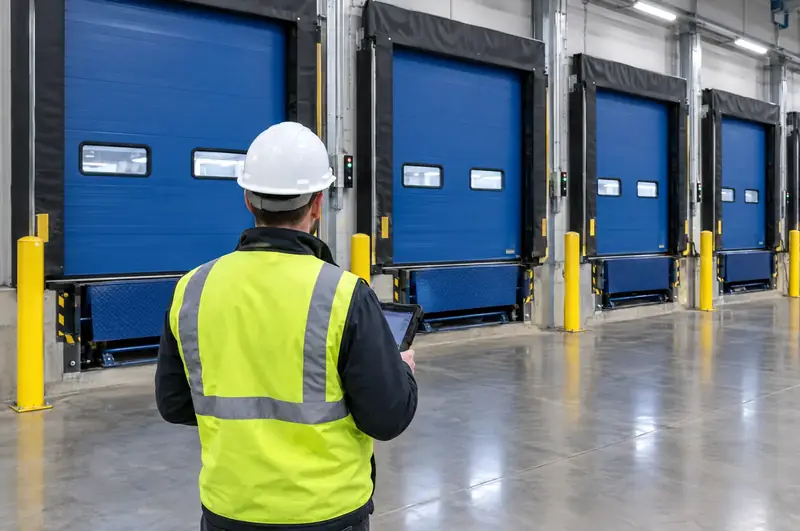
Loading bay servicing covers planned preventive maintenance of dock equipment at agreed intervals. An engineer checks, adjusts and lubricates doors, levellers, shelters, seals, restraints, traffic lights and lift tables, tests safety devices and records defects in a written report. Servicing supports, but is separate from, insurer inspections and the LOLER thorough examinations that some equipment needs.
What matters for loading bay servicing in Worcestershire?
When you take on a unit in Worcestershire with no maintenance history, a baseline service report gives you a clear starting point for future planning. Distribution centres in Worcestershire running high trailer volumes commonly need twice-yearly servicing to keep springs, hydraulics and seals ahead of wear.
Lift tables at warehouses in Worcestershire need a LOLER thorough examination regime alongside servicing, and the two can be scheduled to suit the operation.
When something stops working at a loading bay in Worcestershire, contact us with a description and, ideally, photos. We will confirm the cost of the visit in writing before booking anyone. If the engineer finds the problem goes further than expected, you receive a quote for the additional work and decide whether to proceed. Every visit is followed by a written report you can keep with your maintenance records.
How often should a loading bay be serviced?
Busy loading docks are commonly serviced twice a year, while lightly used bays may only need one visit a year. The right frequency depends on how hard the equipment works and what your risk assessment, the manufacturer's instructions and your insurer expect.
- Twice a year: common for distribution and logistics docks handling trailers through the day.
- Once a year: may suit occasional-use bays, such as a single goods-in door at a manufacturing site.
- More often: worth considering for docks running several shifts, very high door cycle counts, or harsh conditions such as frozen stores.
Insurer inspections and LOLER thorough examinations run on their own schedules. Many sites time a service shortly before each inspection so routine defects are dealt with first.
Our guide to loading bay maintenance sets out what a service covers and how to plan the frequency.
What inspections does the law require for loading bay equipment?
Loading bay equipment is work equipment under the Provision and Use of Work Equipment Regulations 1998 (PUWER), so it must be maintained in a safe condition and inspected where deterioration could lead to danger. In Northern Ireland the equivalent is PUWER (Northern Ireland) 1999.
- Insurer inspections: engineering insurers commonly inspect dock levellers under PUWER at 12-month intervals. This is separate from servicing.
- Lift tables: scissor lift tables fall under LOLER 1998, or LOLER (Northern Ireland) 1999, with thorough examination at least every 12 months, every 6 months if they lift people, or to a written examination scheme.
- Levellers and LOLER: most levellers are treated under PUWER, but one designed or used to lift people may fall under LOLER. This depends on the equipment and how it is used; your insurer or competent person will confirm.
- Doors: regulation 18 of the Workplace (Health, Safety and Welfare) Regulations 1992, and the Northern Ireland 1993 equivalent, require fall-back and anti-trap protection, so these devices are tested at every service.
Our guide to dock leveller inspections under PUWER and LOLER explains what applies.
Towns we cover in Worcestershire
We take enquiries about loading bay servicing from across Worcestershire. These are the towns with their own pages:
The visit price is agreed before anyone attends. All guide prices.
Which rules apply in England?
Powered doors and dock equipment installed in England may carry the UKCA or the CE mark, and doors are covered by the product standard BS EN 13241. We hand over the relevant documentation for each item fitted in Worcestershire. Planning and Building Regulations questions are never assumed either way: we check what applies before any work starts, so you know before work is booked.
Questions
What is the difference between servicing and a statutory inspection?
Servicing keeps equipment working: cleaning, adjusting, lubricating and replacing worn parts. A statutory inspection or thorough examination is a separate check by a competent person, often arranged through your engineering insurer. Dock levellers are commonly inspected under PUWER at 12-month intervals, and lift tables may need LOLER thorough examination, depending on the equipment and how it is used. Your insurer or competent person will confirm what applies.
Can you take over our existing loading bay maintenance arrangement?
Yes. Send us a list of the equipment at your Worcestershire site, with makes, models and approximate ages if known, plus recent service or inspection reports. We will propose a planned maintenance schedule and price it per item per visit. The first visit records the condition of everything, so you have a clear starting point for future servicing.
How often should dock levellers be serviced?
Dock levellers on busy docks are commonly serviced twice a year, while lightly used levellers may only need an annual service. The right interval depends on usage, the manufacturer's instructions and your risk assessment. Insurer inspections and any LOLER examinations run on their own schedules.
Can servicing be carried out outside operating hours?
Yes, servicing can be arranged for evenings or weekends where daytime access is difficult. Out-of-hours visits cost more, and that price is agreed in writing before the visit. Many sites prefer quieter periods so bays can be released without affecting trailer arrivals.
Other services in Worcestershire
Full guide to loading bay servicing · All loading bay services in Worcestershire