
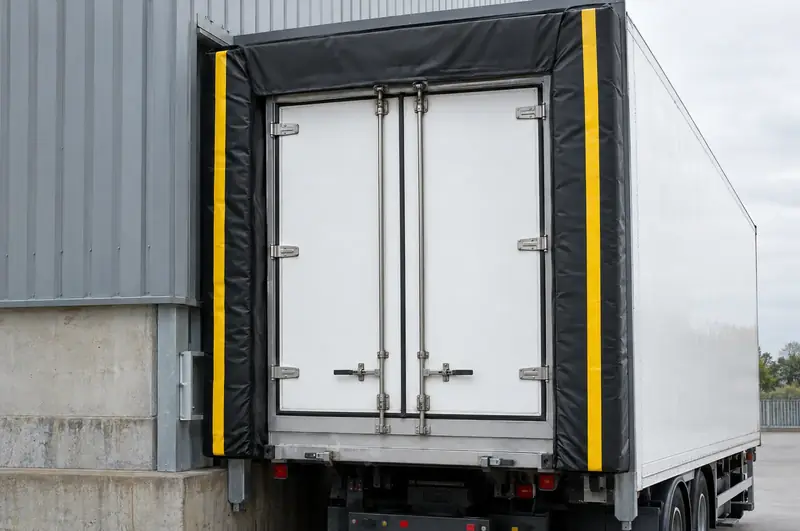
A dock seal is a set of fabric-covered foam pads fixed to the building around a loading bay door, usually a head pad and two side pads. When a trailer reverses in, its rear end presses into the foam, which compresses to close the gaps around the trailer body. Seals give a very tight fit but work best when the trailers using the bay are a consistent size.
Why do sites in Glasgow and Dunbartonshire choose this?
Heated packing halls next to a dock in Glasgow and Dunbartonshire lose less warmth during loading when the gap around each trailer is closed by compressed foam. Own-fleet distribution sites in Glasgow and Dunbartonshire, where the same trailers arrive day after day, are well suited to foam dock seals and the tight fit they give.
Where trailers reverse onto a bay in Glasgow and Dunbartonshire slightly off-centre, tapered side pads and wheel guides help protect the seal from rubbing.
Here is what happens after you contact us about a site in Glasgow and Dunbartonshire. We arrange a free survey, measure up and send a fixed written quote. If you go ahead, we manage the whole job, including ordering, delivery and coordination with your site team. Specialist installation engineers working under our management do the fitting, at times built around your loading schedule, with out-of-hours work by arrangement. Testing and handover documents close the job.
What do workplace transport rules mean for a sealed dock?
A sealed dock still needs safeguards against a trailer leaving early, and the seal, bumpers and other dock equipment must be kept in safe working order. In Great Britain the regulator is HSE; in Northern Ireland it is HSENI.
- Drive-away: HSE workplace transport guidance (HSG136) and the HSE loading factsheet call for safeguards against drivers driving away too early, including traffic lights, vehicle or trailer restraints, or the person in charge keeping keys or paperwork until it is safe.
- Trailer creep: because the trailer is pressed into compressed foam, it can ease forward during forklift loading. Restraints and well-set bumpers help keep it in position.
- Equipment duties: a dock seal forms part of the loading bay's work equipment, so the general duty under PUWER 1998 in Great Britain, or PUWER (Northern Ireland) 1999, to keep equipment suitable and maintained applies.
Torn covers and crushed pads can hide damage to the fixings and wall behind, so seals belong in planned inspections of the dock.
When is a dock seal a better choice than a shelter?
A dock seal is a better choice than a shelter when the trailers using a bay are consistent in size, the dock height suits them, and the tightest practical seal matters. Mixed fleets are usually better served by a shelter.
- Consistent fleets: dedicated vehicles or regular hauliers using the same trailer type.
- Temperature control: chilled or heated buildings where gaps around the trailer are costly.
- Security and hygiene: fewer gaps for pests, dust and unauthorised access during loading.
- Budget: seals cost less than inflatable shelters for a close fit.
The trade-offs are that seals can leave gaps at trailer door hinges, side pads can intrude into the trailer opening if poorly sized, and the covers wear from rubbing. If your trailers vary, compare our retractable dock shelters before deciding, as they leave the full opening clear.
Towns we cover in Glasgow and Dunbartonshire
Choose a town below to see how we handle dock seals in that part of Glasgow and Dunbartonshire.
Budget range for supply and fit. The written quote after a free survey is the fixed price. All guide prices.
Which rules apply in Scotland?
Doors and dock equipment installed in Scotland may carry the UKCA or the CE mark, and we pass on the documentation for everything fitted in Glasgow and Dunbartonshire. Because building warrant and planning questions can affect the programme, we check what applies at survey and raise any approvals early rather than assuming none are needed.
Questions
Do you remove and dispose of the old equipment?
Yes, where it is part of the scope. When we replace doors, levellers, shelters or seals at a site in Glasgow and Dunbartonshire, removal and disposal of the old equipment can be included and is itemised in the quote, so it is clear what is covered. If anything should be kept, such as a frame or motor that is still serviceable, we agree that at survey.
Do you cover Glasgow and Dunbartonshire for dock seals?
Yes. We take on dock seals for businesses in Glasgow and Dunbartonshire and across Glasgow and Dunbartonshire. We survey the site, provide a fixed written quote and manage the installation, with specialist installation engineers working under our management. Visits are arranged in advance at a time that suits your operation, and the same single contact stays with the job through to handover.
Can just the covers be replaced?
Yes, if the foam is still resilient and dry, new covers can often be fitted over the existing foam, which usually costs less than new pads. Waterlogged or permanently crushed foam should be replaced. Cover replacement is handled as a repair, with the visit price agreed beforehand.
Do dock seals block access to the trailer?
They can if they are poorly sized. Side pads that sit inside the line of the trailer body intrude into the opening and get in the way of pallets and forklifts. Correctly sized and tapered pads compress against the rear corners and leave the opening clear.
Other services in Glasgow and Dunbartonshire
Full guide to dock seals · All loading bay services in Glasgow and Dunbartonshire