
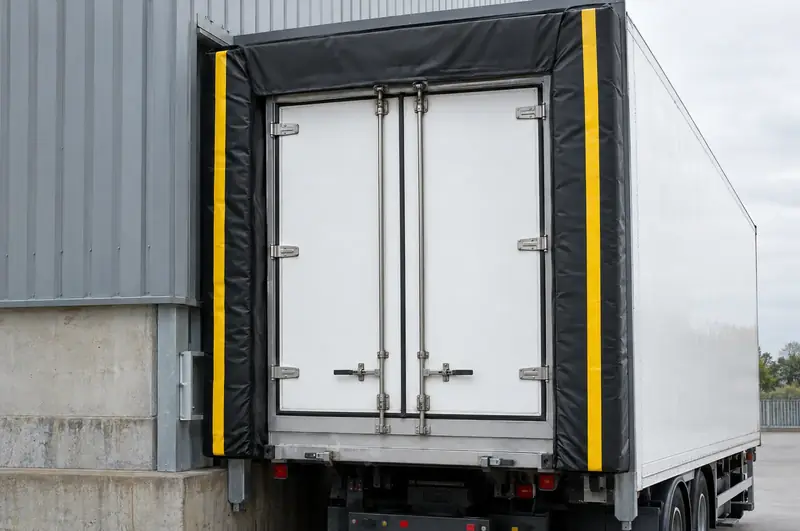
A dock seal is a set of fabric-covered foam pads fixed to the building around a loading bay door, usually a head pad and two side pads. When a trailer reverses in, its rear end presses into the foam, which compresses to close the gaps around the trailer body. Seals give a very tight fit but work best when the trailers using the bay are a consistent size.
Where does this fit at a dock in Hampshire?
Weather-exposed bays in Hampshire gain the most from a well-fitted seal, since wind and rain otherwise find every gap around the trailer. Where trailers reverse onto a bay in Hampshire slightly off-centre, tapered side pads and wheel guides help protect the seal from rubbing.
Older seals at docks in Hampshire that have been left with split covers can soak up rain, becoming heavy and losing their shape over winter.
Our part of the job in Hampshire is to survey, quote and manage; the fitting itself is done by specialist installation engineers working under our management. The survey and the written quote are free. Once the fixed price is accepted, we agree dates that work around your deliveries and shifts, including out-of-hours working where needed. Every installation is tested before handover, and you receive the documentation for each item fitted.
How are dock seals fitted to a loading bay?
Dock seals are fixed to the outside wall around the dock door, normally on brackets or a frame that sets their projection, and a set usually takes a few hours to fit. No power supply is needed.
- The wall is checked for sound fixing points, with a frame or spreader plates added on cladding.
- The head pad and side pads are positioned to suit your trailer width and height.
- Projection is set relative to the bumpers, so trailers compress the foam by the right amount.
- Bumpers are checked and, if worn, replaced at the same time.
- A trailer is docked to confirm an even seal along the head and sides.
From you we need the bay taken out of use, a clear area in the yard for powered access equipment and, ideally, one of your usual trailers available at the end of the job so the fit can be checked under real conditions.
How much do dock seals cost?
A set of dock seals typically costs £1,100 to £2,600 per set, excluding VAT, supply and fit. A set is normally a head pad and two side pads for one bay.
The price depends on:
- Pad size and depth: larger openings and deeper foam cost more.
- Head arrangement: a fixed head pad, or a curtain head for varied trailer heights.
- Cover fabric: heavier coated fabric and replaceable wear pleats last longer.
- Pad shape: tapered side pads that guide the trailer and intrude less into the opening.
- Mounting: fixing direct to masonry, to a steel frame, or to brackets that set the projection.
- Site work: removing old seals, adjusting bumpers and powered access equipment.
Where the foam is still sound, new covers can cost less than new pads, and we will say if that is an option. After a free site survey you receive a fixed written price for the work described.
Towns we cover in Hampshire
We cover dock seals throughout Hampshire, and the towns below each have their own page. If yours is not listed, get in touch anyway.
- Southampton
- Portsmouth
- Basingstoke
- Gosport
- Waterlooville
- Farnborough
- Eastleigh
- Winchester
- Havant
- Andover
- Fareham
- Aldershot
- Fleet
- Totton
- New Milton
- Bordon
- Hythe
- Yateley
- Alton
- Emsworth
- Hedge End
- Bishopstoke
Budget range for supply and fit. The written quote after a free survey is the fixed price. All guide prices.
Which rules apply in England?
Workplace safety in England is regulated by HSE. For a loading bay in Hampshire, that means doors meeting regulation 18 of the Workplace (Health, Safety and Welfare) Regulations 1992, equipment maintained under PUWER and suitable safeguards against vehicles driving away too early. We check what applies at survey and design the bay accordingly.
Questions
Will you deal with building control and planning for a project in Hampshire?
We check at survey whether the work is likely to need approval. Forming a new opening or dock pit may need Building Regulations approval, a building warrant or building control approval, depending on the nation, and external structures such as loading houses can need planning permission. Where approval is needed, we explain what is involved, work with your designer or agent, and build it into the programme.
Can you work alongside our main contractor on a new build in Hampshire?
Yes. For new warehouses and fit-outs, we can supply and install the dock package as part of a wider project, working to the main contractor's programme, site rules and permits. We will need drawings, dock levels and the programme, and we coordinate pit details, power supplies and door openings with the relevant trades before installation begins.
Do trailer doors need to be opened before docking against a seal?
Yes, the rear doors are opened and folded back before the trailer reverses onto a seal, so the pads press against the rear of the trailer rather than the doors. Gaps can remain at the door hinges, which is a known limitation of seals compared with shelters.
Can dock seals handle trailers of different heights?
Only within a limited range. A fixed head pad seals well on trailers of one height but leaves gaps over lower ones and can be crushed by taller ones. A seal with a flexible curtain head copes better with varied heights, and for very mixed fleets a shelter is usually the better option.
Other services in Hampshire
Full guide to dock seals · All loading bay services in Hampshire