
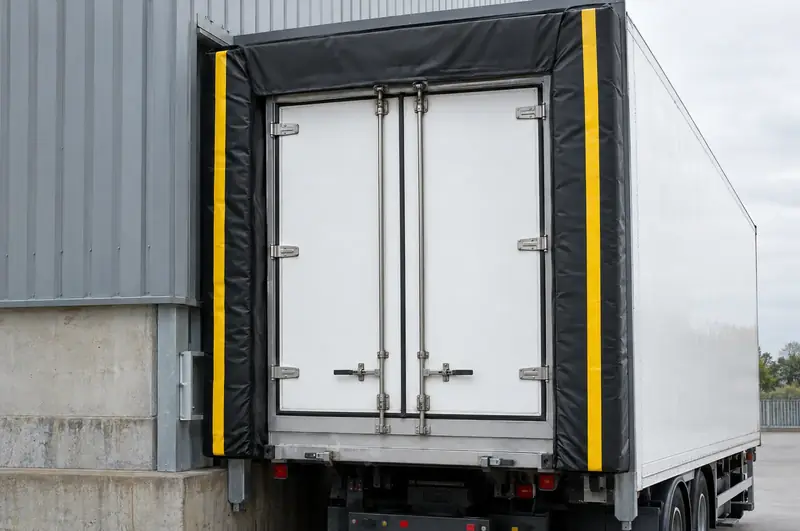
A dock seal is a set of fabric-covered foam pads fixed to the building around a loading bay door, usually a head pad and two side pads. When a trailer reverses in, its rear end presses into the foam, which compresses to close the gaps around the trailer body. Seals give a very tight fit but work best when the trailers using the bay are a consistent size.
Why do sites in Fife choose this?
Older seals at docks in Fife that have been left with split covers can soak up rain, becoming heavy and losing their shape over winter. Before recommending seals for a bay in Fife, we check how consistent your trailers are, because mixed fleets are usually better served by a shelter.
A dedicated chilled fleet serving a site in Fife can be sealed closely with foam pads, at lower cost than fitting an inflatable shelter.
For dock seals in Fife, we begin with a free site survey and a fixed written quote, so you know the scope and cost before committing. We take responsibility for managing the job, and specialist installation engineers carry it out under our supervision. Bays are taken out of use in a planned sequence so the rest of the dock keeps working, and evening or weekend work can be arranged. Each item is tested at handover and the documentation is left with you.
How can dock seal pads be made to last longer?
Dock seal pads last longer when trailers arrive straight and stop at the right point, because most wear comes from trailers rubbing against the covers or pressing too far into the foam. Covers usually wear first, and the foam inside can outlast them.
- Replaceable wear pleats: sacrificial strips on the pad faces take the abrasion and can be swapped cheaply.
- Wheel guides and dock lights: help drivers reverse squarely into the centre of the bay.
- Bumper maintenance: keeps compression within design limits.
- Tapered side pads: guide trailers in and reduce rubbing on the pad edges.
- Driver briefings: regular hauliers who know the bay damage it less.
When covers split, replacing them promptly stops rain soaking into the foam, which makes it heavy, slow to recover and prone to freezing in winter.
How are dock seals fitted to a loading bay?
Dock seals are fixed to the outside wall around the dock door, normally on brackets or a frame that sets their projection, and a set usually takes a few hours to fit. No power supply is needed.
- The wall is checked for sound fixing points, with a frame or spreader plates added on cladding.
- The head pad and side pads are positioned to suit your trailer width and height.
- Projection is set relative to the bumpers, so trailers compress the foam by the right amount.
- Bumpers are checked and, if worn, replaced at the same time.
- A trailer is docked to confirm an even seal along the head and sides.
From you we need the bay taken out of use, a clear area in the yard for powered access equipment and, ideally, one of your usual trailers available at the end of the job so the fit can be checked under real conditions.
Towns we cover in Fife
We take enquiries about dock seals from across Fife. These are the towns with their own pages:
Budget range for supply and fit. The written quote after a free survey is the fixed price. All guide prices.
Regulations and approvals in Scotland
Doors and dock equipment installed in Scotland may carry the UKCA or the CE mark, and we pass on the documentation for everything fitted in Fife. Because building warrant and planning questions can affect the programme, we check what applies at survey and raise any approvals early rather than assuming none are needed.
Questions
Is the site survey in Fife free?
Yes. For new installations, replacements, upgrades, conversions and complete bays, the site survey and written quote are free and come with no obligation. The survey lets us measure the openings, check the dock and structure, and understand how the bay is used, so the quote reflects your site. Repair and servicing visits are different: they are chargeable, with the price agreed before anyone attends.
How long does installation take at a site in Fife?
It depends on the equipment, the number of bays, the condition of the dock and whether any building or electrical work is needed. We agree a programme with you after the survey, setting out which bays are out of use and when. Larger jobs are usually phased so that part of the dock stays open, and out-of-hours working can be arranged.
How can I tell if seal projection is wrong?
Look at the pads with a trailer docked. Daylight around the head or sides suggests too little compression, while pads squashed flat or bulging around the trailer suggest too much. Worn bumpers are a common cause, and both can be checked at a planned service.
Can just the covers be replaced?
Yes, if the foam is still resilient and dry, new covers can often be fitted over the existing foam, which usually costs less than new pads. Waterlogged or permanently crushed foam should be replaced. Cover replacement is handled as a repair, with the visit price agreed beforehand.