
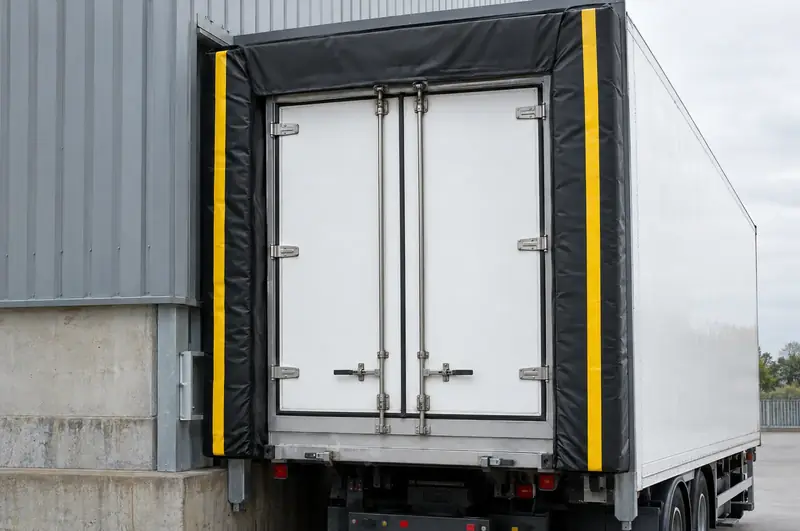
A dock seal is a set of fabric-covered foam pads fixed to the building around a loading bay door, usually a head pad and two side pads. When a trailer reverses in, its rear end presses into the foam, which compresses to close the gaps around the trailer body. Seals give a very tight fit but work best when the trailers using the bay are a consistent size.
What should sites in Warwickshire consider?
Older seals at docks in Warwickshire that have been left with split covers can soak up rain, becoming heavy and losing their shape over winter. Heated packing halls next to a dock in Warwickshire lose less warmth during loading when the gap around each trailer is closed by compressed foam.
Hygiene-sensitive sites in Warwickshire, such as food processors, can use dock seals to reduce the gaps through which dust and pests might enter during loading.
Step one is a survey at your site in Warwickshire, which costs nothing and carries no obligation. Step two is a written quote with a fixed price and a clear scope. Step three is installation, scheduled around your operation and carried out by specialist installation engineers working under our management, including evenings or weekends if agreed. Step four is handover, when the equipment is tested in front of you and the paperwork is passed over.
What do workplace transport rules mean for a sealed dock?
A sealed dock still needs safeguards against a trailer leaving early, and the seal, bumpers and other dock equipment must be kept in safe working order. In Great Britain the regulator is HSE; in Northern Ireland it is HSENI.
- Drive-away: HSE workplace transport guidance (HSG136) and the HSE loading factsheet call for safeguards against drivers driving away too early, including traffic lights, vehicle or trailer restraints, or the person in charge keeping keys or paperwork until it is safe.
- Trailer creep: because the trailer is pressed into compressed foam, it can ease forward during forklift loading. Restraints and well-set bumpers help keep it in position.
- Equipment duties: a dock seal forms part of the loading bay's work equipment, so the general duty under PUWER 1998 in Great Britain, or PUWER (Northern Ireland) 1999, to keep equipment suitable and maintained applies.
Torn covers and crushed pads can hide damage to the fixings and wall behind, so seals belong in planned inspections of the dock.
How much do dock seals cost?
A set of dock seals typically costs £1,100 to £2,600 per set, excluding VAT, supply and fit. A set is normally a head pad and two side pads for one bay.
The price depends on:
- Pad size and depth: larger openings and deeper foam cost more.
- Head arrangement: a fixed head pad, or a curtain head for varied trailer heights.
- Cover fabric: heavier coated fabric and replaceable wear pleats last longer.
- Pad shape: tapered side pads that guide the trailer and intrude less into the opening.
- Mounting: fixing direct to masonry, to a steel frame, or to brackets that set the projection.
- Site work: removing old seals, adjusting bumpers and powered access equipment.
Where the foam is still sound, new covers can cost less than new pads, and we will say if that is an option. After a free site survey you receive a fixed written price for the work described.
Towns we cover in Warwickshire
We provide dock seals right across Warwickshire. Pick the town closest to your site from the list below.
Budget range for supply and fit. The written quote after a free survey is the fixed price. All guide prices.
Which rules apply in England?
Powered doors and dock equipment installed in England may carry the UKCA or the CE mark, and doors are covered by the product standard BS EN 13241. We hand over the relevant documentation for each item fitted in Warwickshire. Planning and Building Regulations questions are never assumed either way: we check what applies at survey, so you know before work is booked.
Questions
Will you deal with building control and planning for a project in Warwickshire?
We check at survey whether the work is likely to need approval. Forming a new opening or dock pit may need Building Regulations approval, a building warrant or building control approval, depending on the nation, and external structures such as loading houses can need planning permission. Where approval is needed, we explain what is involved, work with your designer or agent, and build it into the programme.
Which building and safety rules apply to a site in Warwickshire?
It depends on which UK nation the site is in. England and Wales use Building Regulations approval, Scotland uses building warrants and Northern Ireland uses building control approval from the council. Workplace safety is regulated by HSE in Great Britain and HSENI in Northern Ireland, and energy rules differ between nations. For your site in Warwickshire, we check what applies at survey and design to it.
Are dock seals suitable for cold stores?
Yes, for cold stores with consistent trailers a dock seal gives a tight fit at a lower cost than an inflatable shelter. The pads must be kept in good condition, because water in the foam can freeze and stiffen it. Mixed fleets at cold stores are often better served by inflatable shelters.
Do dock seals block access to the trailer?
They can if they are poorly sized. Side pads that sit inside the line of the trailer body intrude into the opening and get in the way of pallets and forklifts. Correctly sized and tapered pads compress against the rear corners and leave the opening clear.
Other services in Warwickshire
Full guide to dock seals · All loading bay services in Warwickshire