
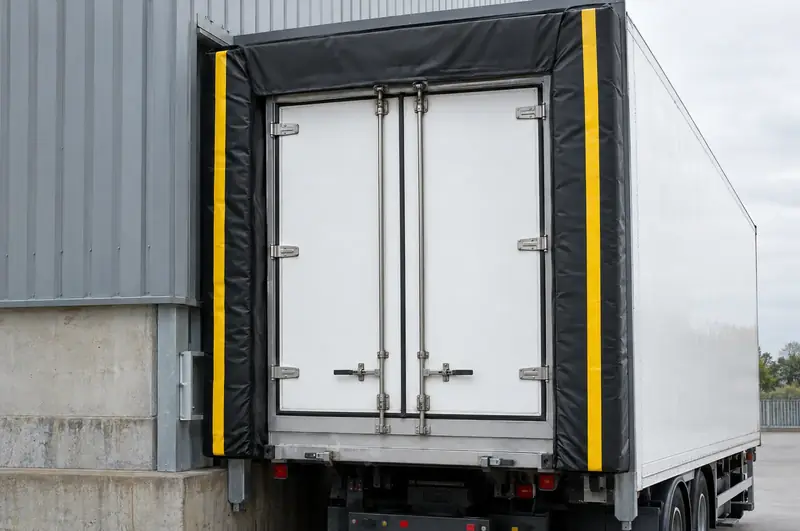
A dock seal is a set of fabric-covered foam pads fixed to the building around a loading bay door, usually a head pad and two side pads. When a trailer reverses in, its rear end presses into the foam, which compresses to close the gaps around the trailer body. Seals give a very tight fit but work best when the trailers using the bay are a consistent size.
What matters for dock seals in Orkney, Shetland and the Western Isles?
A dedicated chilled fleet serving a site in Orkney, Shetland and the Western Isles can be sealed closely with foam pads, at lower cost than fitting an inflatable shelter. Weather-exposed bays in Orkney, Shetland and the Western Isles gain the most from a well-fitted seal, since wind and rain otherwise find every gap around the trailer.
Before recommending seals for a bay in Orkney, Shetland and the Western Isles, we check how consistent your trailers are, because mixed fleets are usually better served by a shelter.
It starts with a free site survey in Orkney, Shetland and the Western Isles, where we measure the openings, check the dock and talk through how the bay is used. You then receive a fixed written quote. Once you accept, we manage the job: specialist installation engineers carry out the work under our management, planned around your deliveries, and out-of-hours working can be arranged. At handover we test everything with you and leave the documentation.
Why does the gap between the seal and the bumpers matter?
The distance between the face of the seal and the face of the bumpers decides how far the trailer compresses the foam, and getting it right is the difference between a good seal and pads that are crushed or leave gaps.
- Too little projection: the trailer meets the bumpers before it presses the foam enough, leaving gaps at the head and sides.
- Too much projection: the foam is over-compressed, which crushes the pads, strains the fixings and can push the trailer forward as the foam recovers.
- Worn bumpers: let trailers travel further than designed, over-compressing the seal every time.
Correct projection depends on the foam depth and your trailers, so we set it at installation and it should be checked at each service. Keeping dock bumpers in good condition protects both the seal and the leveller from repeated impact.
When is a dock seal a better choice than a shelter?
A dock seal is a better choice than a shelter when the trailers using a bay are consistent in size, the dock height suits them, and the tightest practical seal matters. Mixed fleets are usually better served by a shelter.
- Consistent fleets: dedicated vehicles or regular hauliers using the same trailer type.
- Temperature control: chilled or heated buildings where gaps around the trailer are costly.
- Security and hygiene: fewer gaps for pests, dust and unauthorised access during loading.
- Budget: seals cost less than inflatable shelters for a close fit.
The trade-offs are that seals can leave gaps at trailer door hinges, side pads can intrude into the trailer opening if poorly sized, and the covers wear from rubbing. If your trailers vary, compare our retractable dock shelters before deciding, as they leave the full opening clear.
Towns we cover in Orkney, Shetland and the Western Isles
Below is a list of towns in Orkney, Shetland and the Western Isles for dock seals. Each page explains our approach for sites in that town.
Budget range for supply and fit. The written quote after a free survey is the fixed price. All guide prices.
Which rules apply in Scotland?
In Scotland, building work such as forming a new opening or a dock leveller pit may need a building warrant from the local authority before it starts. For sites in Orkney, Shetland and the Western Isles, external structures such as loading houses or canopies may also need planning permission from the council. We check what applies at survey and factor any approvals into the programme.
For Orkney, Shetland and the Western Isles, installation work is planned in advance rather than on a routine round. The survey and quote are free; where we can, we group installation visits with other work nearby, and any travel and accommodation costs for fitting are set out clearly in the quote.
Questions
Is the site survey in Orkney, Shetland and the Western Isles free?
Yes. For new installations, replacements, upgrades, conversions and complete bays, the site survey and written quote are free and come with no obligation. The survey lets us measure the openings, check the dock and structure, and understand how the bay is used, so the quote reflects your site. Repair and servicing visits are different: they are chargeable, with the price agreed before anyone attends.
What warranty comes with new loading bay equipment?
New equipment comes with the manufacturer's warranty, which varies by product. Our workmanship terms are set out in writing in the quote for your Orkney, Shetland and the Western Isles site, so you can see what is covered before you commit. Check the warranty terms for any servicing conditions, and we can quote for planned maintenance once the installation is complete.
Can dock seals handle trailers of different heights?
Only within a limited range. A fixed head pad seals well on trailers of one height but leaves gaps over lower ones and can be crushed by taller ones. A seal with a flexible curtain head copes better with varied heights, and for very mixed fleets a shelter is usually the better option.
Do trailer doors need to be opened before docking against a seal?
Yes, the rear doors are opened and folded back before the trailer reverses onto a seal, so the pads press against the rear of the trailer rather than the doors. Gaps can remain at the door hinges, which is a known limitation of seals compared with shelters.
Other services in Orkney, Shetland and the Western Isles
Full guide to dock seals · All loading bay services in Orkney, Shetland and the Western Isles